Services
StrategyPlans, positioning, leadership›GrowthAds, search, email, social›Creative and webBrand, websites, content, video›OperationsHubSpot and revenue operations›Property marketingRendering to signed lease›Creative and web
All services →Strategy, creative and execution, all in house.
See pricing →Every channel, one team, weekly results.
See pricing →Work that ships weekly and looks like you.
See pricing →Every channel, one team, weekly results.
See pricing →Different buildings. Same obsession with leases.
See pricing →Industries
Real EstateIndustrial, commercial, residential›SaaS and technologyHR tech, EdTech, FinTech, PropTech›Home servicesHVAC, roofing, plumbing, electrical›Professional servicesLaw, accounting, advisors, recruiting›VC and private equityPortfolio and fund marketing›Real estate marketing
Overview →Services for every building
SaaS and technology marketing
Overview →Who we work with
What we run for them
Home services marketing
Who we work with
What we run for them
Professional services marketing
Overview →Who we work with
What we run for them
Different buildings. Same obsession with leases.
Pricing and packages →Different products. Same obsession with pipeline.
All SaaS and technology work →Different trades. Same obsession with booked jobs.
All home services work →Different practices. Same obsession with signed clients.
All professional services work →Company
About usThe team behind LeapynHow we workWeekly delivery, one teamWhy LeapynWhat we mean by differentCase studiesResults with the numbersContactSay helloMarketing that earns its keep.
Book a call →Learn what is working before you spend on it.
All insights →Services
Marketing strategy
Growth marketing
Paid advertising
Creative and web
Operations
Property marketing
Industries
Real estate marketing
Services−Company
Marketing strategy
A plain map of HR software along the employee lifecycle, with the budget owner and the veto holder for every stage.
In this post
The product marketer at an onboarding software startup is halfway through her cousin's wedding dinner when an uncle leans over and asks what she does. She says HR tech. He asks what is HR tech, then, and she starts drawing the employee lifecycle on a cocktail napkin until the band mercifully starts the next song.
The uncle forgets the napkin by dessert. She doesn't, because the same question follows her to work, where the person asking is a CFO on a demo call and no band is coming to the rescue.
Most explainers answer it with a pile of acronyms. This one maps the software to the people who own each budget, because that's the version anyone selling HR software has to know by heart.

HR tech is the software a company uses to hire, pay, manage, develop and keep its people, from the offer letter to the exit interview. It covers core HR records, payroll, benefits, time tracking, recruiting, onboarding, performance, learning and people analytics, sold as one suite or as separate tools that share employee data.
The long name is human resources technology. People who ask what is HR technology usually want to know which of those tools they need, while people who sell it need to know who pays for each one, so the rest of this page answers both.
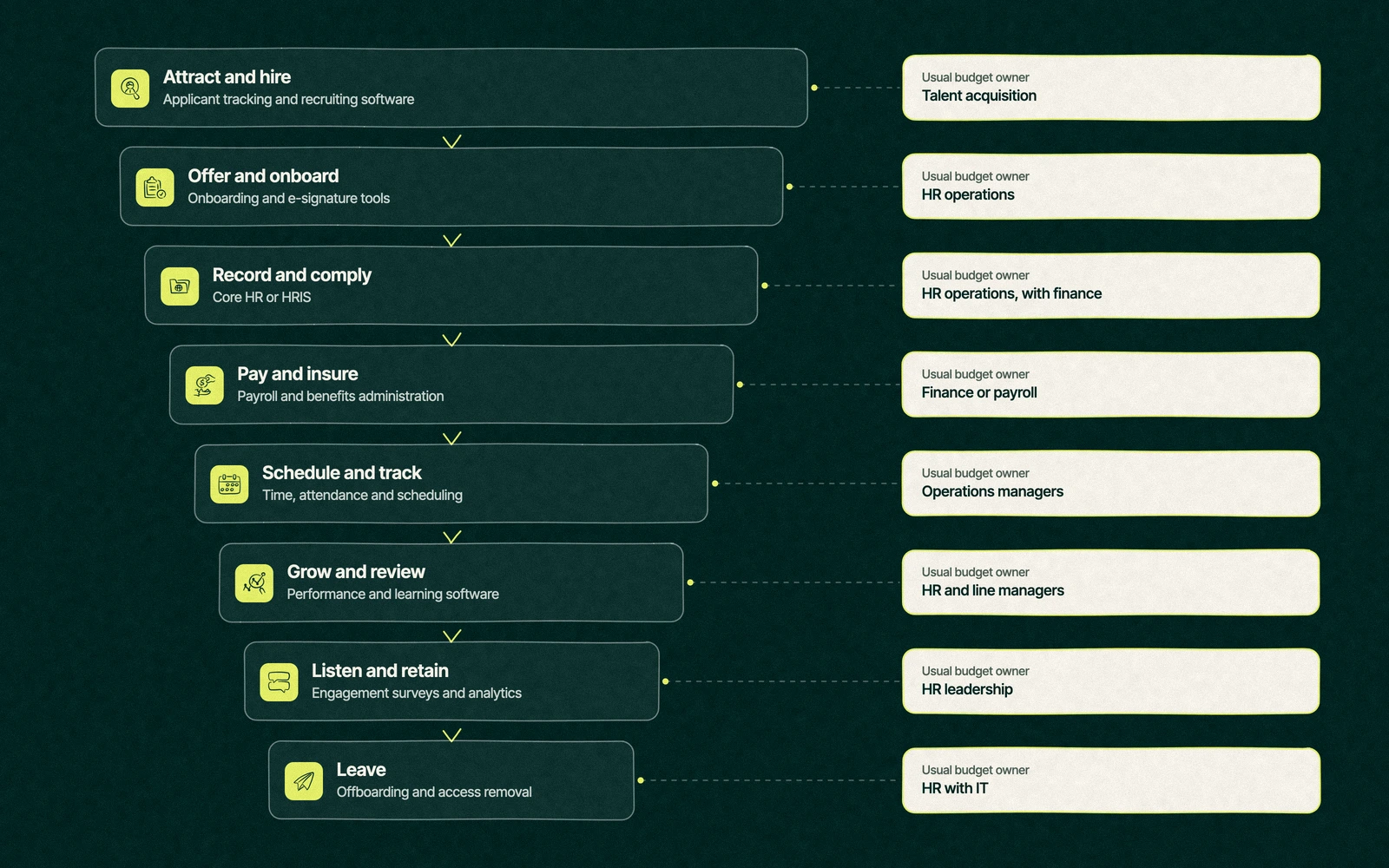
Technology in HR now reaches every stage of employment, from the job ad to the final paycheck. The clearest way to see the category is to follow one employee through a company, because each stage has its own type of software and often its own budget.

| Stage | HR tech category | What it replaced | Usual budget owner |
|---|---|---|---|
| Attract and hire | Applicant tracking and recruiting software | A resume folder in someone's inbox and a shared interview calendar | Talent acquisition |
| Offer and onboard | Onboarding and e-signature tools | Printed packets and a new hire chasing forms on day one | HR operations |
| Record and comply | Core HR or HRIS | The personnel filing cabinet | HR operations, with finance |
| Pay and insure | Payroll and benefits administration | The payroll bureau and the paper enrollment form | Finance or payroll |
| Schedule and track | Time, attendance and scheduling software | Punch cards and the rota on the break room whiteboard | Operations managers |
| Grow and review | Performance and learning software | The annual review form filed and forgotten | HR and line managers |
| Listen and retain | Engagement surveys and people analytics | Exit interviews and gut feel | HR leadership |
| Leave | Offboarding and access removal | An IT ticket someone remembers to file | HR with IT |
Those rows are the HR technology examples most buyers meet first, and the full market is wider. The Sapient Insights Group 2026-2027 HR Systems Survey, now in its 29th year, tracks 23 HR technology categories.
Most companies own a handful of those categories and run the rest on email and goodwill.
HR tech has more owners than almost any other software category, because employee data touches money, law and security at the same time. A single purchase can need sign-off from four departments that rarely share a meeting.
IT rarely says yes to anything first, but it can say no to everything. A vendor who leaves the security reviewer for last usually meets them in the final week of the deal.
Our guide to selling HR software goes deeper on how each of these readers decides.
Your email for great content delivered to your inbox. Regularly. Unless we forget. Or get busy. But we'll try.
Read the homepages and the category looks finished. HiBob calls itself all-in-one HR software for people, payroll and finance, and BambooHR calls itself the complete HR software for people, payroll and benefits.
Both claims are fair for the buyers each company targets. Inside a customer, though, the suite still sits next to a recruiting tool, a learning platform, a benefits broker's portal and a spreadsheet holding whatever didn't fit.
A guide to HR systems from Rippling, updated in August 2026, says 82% of HR teams use four or more different tools each month. When a company selling consolidation publishes that figure, the patchwork is the market.
It isn't a happy patchwork either. In SHRM's 2025 State of the Workplace research, only 43% of HR professionals and executives rated their organization's HR technology as effective, which is why the quilt keeps getting new squares.
Say a regional home care agency buys a modern HR suite in the spring. The demo went well, the implementation team was patient and the go-live email had a celebratory GIF.
By summer the caregivers' certification dates still live in a spreadsheet, because the suite tracks licenses for nurses and nothing for home health aides. The scheduling coordinator keeps the spreadsheet open beside the new system and updates both every morning.
The vendor's renewal deck calls this a successful implementation. The coordinator calls it two jobs.
A sharp competitor would spot that spreadsheet on the first discovery call and sell a certification tracker that plugs into the suite the agency already paid for. That company never has to win the HRIS deal, because it only has to fit the gap.
The spreadsheet has survived more HR system migrations than most HR directors, and it remains the most underrated competitor in the category.
An HRIS is one product inside HR tech, the system of record for employee data. HR tech is the whole category, including every tool that sits around that record.
| Term | What it means | What it usually includes |
|---|---|---|
| HR tech | Every kind of software used to manage people | All eight stages in the lifecycle table above |
| HRIS | The system of record | Employee profiles, job and pay data, documents, often payroll and benefits |
| HRMS | An HRIS plus everyday HR processes | Time, absence, onboarding and employee self-service |
| HCM | The broadest suite label | HRMS features plus talent, performance, learning and workforce planning |
Vendors use these labels loosely, and buyers tend to repeat whichever one their last employer used. We untangle them in HRIS vs HCM vs HRMS.
For an HR software company, the map above doubles as a sales plan. Few buyers will rip out their core system to buy yours, so the winning pitch fits into what they already run.
The vendors who get this right show up in buyer research long before a demo. Our list of HR tech companies shows how the sellers group themselves, the guide to the HR tech stack covers how the pieces connect on the buyer's side and our HR technology trends post covers what HR plans to fund next.
Leapyn is a B2B marketing agency, and HR software is one of the markets we work in every week. Placing a product inside the HR patchwork is usually where our marketing strategy work begins.
Our senior marketers do the mapping of budget owners and veto holders themselves, then build the plan around them. A first project carries a fixed fee that we put in writing before anything starts, and our pricing page shows how the project, monthly and retainer options compare.
You can see how we approach this market on our page for the marketing agency for HR tech companies, and our HR tech marketing guide covers the full program.
Send us the sentence your reps use to describe the product. We'll show you which budget it lands in and who can veto it. Book a free strategy session and you'll get a rough map of your buyer's org to keep.
“
The first call felt like talking to someone who already understood our business. We didn’t have to explain the basics. They showed up with questions that mattered.


James L.
Director of Growth, HR tech
Client
FAQ
The main types follow the employee lifecycle. Recruiting and applicant tracking bring people in, onboarding and core HR records set them up, payroll, benefits and time tracking pay them, and performance, learning and engagement tools develop and keep them. Many companies buy a suite for the core and add separate tools for recruiting, learning or scheduling where the suite falls short.
An HRIS is one product inside the HR tech category. It holds the employee record, such as names, job titles, pay rates and documents, and often runs payroll and benefits too. HR tech is the wider term for every tool that manages people, so it also covers recruiting, learning, scheduling and analytics software that may never touch the HRIS directly.
Small businesses mostly use HR software to pay people correctly and stay compliant. Payroll with tax filing comes first, then a simple employee record, time tracking and benefits enrollment. Recruiting and performance tools usually wait until the company hires often enough that email and spreadsheets start losing candidates, signed documents or review dates, which tends to happen sooner than owners expect.
Three groups judge every deal. HR wants something its team will use, finance wants a clear cost per employee and fewer payroll errors, and IT wants proof that salaries and medical data are safe. Leapyn plans HR tech campaigns so each of those readers gets their own proof, because a pitch written only for HR tends to stall in finance or security review.
Budget ownership depends on the tool. HR operations usually buys core HR and onboarding, finance or payroll signs for payroll and benefits, talent teams buy recruiting software and operations managers often buy scheduling. Executives get involved when a purchase replaces a core system, and IT reviews anything holding sensitive employee data before the contract is signed.
Stay updated
Keep reading