Lead generation for HR tech companies that sales won't send back
How HR software companies bring in leads sales wants to call, from the definition of a qualified lead to the triggers, offers, channels and handoff rules behind it.
Lead generation
Tech and SaaS
The Leapyn team
November 7, 2026
11 min read
In this post
toc
On Friday afternoon a sales rep at an HR software company posts in the team Slack. Half of this week's new leads are students and recruiters, she writes, and she has the call notes to prove it.
Nobody replies for an hour. Then the CEO adds a single eyes emoji underneath, which at a startup counts as a performance review.
Marketing had a good week by its own numbers, with form fills up and cost per lead down. The gap between that dashboard and the sales floor is where most lead generation for HR tech companies goes wrong.
This guide is for the founder or marketing lead who has to close that gap. It covers who counts as a lead, the moments that put an account in market, and the offers, channels and handoff rules that bring sales people it wants to call.
What does lead generation for HR tech companies need to produce?
It should produce conversations with people who can buy, at companies inside your size band, who have a reason to change systems before next year's budget closes. That means HR directors and above, plus the finance and IT reviewers around them, arriving with enough context that sales can book a demo on the first call.
Volume is the easy part. Any HR offer with a download button will fill a CRM, because HR is a big profession full of curious, helpful people who like a good template.
What counts as a qualified HR tech lead?
Start with the arithmetic of the profession. The Bureau of Labor Statistics lists 939,700 HR specialist jobs for 2025, against 224,900 HR manager jobs, so a campaign aimed at everyone in HR reaches about four practitioners for every person who runs a department.
Practitioners matter later, because they become your champions and your power users. They rarely sign, and the person who does sign is getting more senior each year. In the 2026 to 2027 HR Systems Survey from Sapient Insights Group, 31% of HR system selections were led by executives, compared with 25% in 2024.
Good HR software lead generation starts with a written definition. A qualified lead has most of these five signals, and sales should agree to them before you spend another dollar.
Company size in your band. The headcount where your pricing and implementation make sense, checked against enrichment data rather than whatever the form says.
A role with a budget. HR director, VP of people, CHRO, CFO, or the founder at a smaller company. Coordinators and generalists go to nurture.
A system old enough to resent. Spreadsheets held together by one patient person, a legacy on-premise HRIS or a contract coming up for renewal.
A trigger. Something that makes this year different from last year, covered in the next section.
Behavior that signals intent. A pricing page visit, a demo request, a comparison page read twice or a reply from a work email.
Score the first four from data you already hold and the fifth from what the lead does. A lead with all five is a sales conversation, and a lead with one is a newsletter subscriber, which is fine as long as nobody calls it pipeline.
Moments that make an HR leader take the call
HR teams don't replace a payroll system or an HRIS because an ad was clever. They switch when something breaks, grows or changes hands, and most of those moments are visible from the outside if someone is looking.
Trigger
Where you see it
What to send
A new CHRO or VP of people
LinkedIn job changes and press releases
A short note on what new HR leaders fix first, with no demo ask
A merger or acquisition
Business news and company announcements
A guide to combining two payroll and benefits setups
Expansion into new states or countries
Job posts in new locations
Compliance content on multi-state payroll or hiring abroad
A hiring spike
A jump in open roles on the careers page
Onboarding and applicant tracking content matched to their pace
Renewal season
Comparison page visits and review site activity
An honest side-by-side and a migration plan
A compliance scare
Regulation changes and industry news
A plain checklist for that specific rule
Intent data tools catch some of these. A researcher with a list of target accounts and an hour each morning catches most of the rest.
The download that took a year to become a deal
Imagine an HR director at a regional manufacturer who downloads an onboarding checklist in the spring. She fits the size band, she has the title and her company runs payroll on a system older than some of its forklifts.
Sales calls twice. She politely says the timing is wrong, and the record gets marked unqualified and closed.
In the fall her company buys a competitor in the next state. Overnight she has two payroll providers, two benefits renewals and a CFO asking why the combined headcount report takes a week to build.
Nobody at the HR software company notices, because closed records don't get emails. Her shortlist comes from a peer in an HR community and a review site comparison, and the vendor that once had her work email isn't on it.
The fix costs almost nothing. Fit without a trigger goes to nurture instead of the bin, someone watches those accounts for the moments in the table above, and a trigger sends the record back to sales with a note on what changed.
The lead was always good. It was early, and early leads are the cheapest pipeline you'll ever own as long as you keep them.
Trade You.
Your email for great content delivered to your inbox. Regularly. Unless we forget. Or get busy. But we'll try.
Thank you! Your submission has been received!
Oops! Something went wrong while submitting the form.
Which channels bring in the best HR software leads?
Rank channels by the share of leads sales accepts, never by volume. Lead generation for HR software sold to mid-market companies tends to sort like this, though the order shifts with your price point and how well known you already are.
Lead source
Typical quality
Cost
When to use
Demo and pricing page requests
Highest, because the buyer asked
Whatever it costs to get the right people to the page
Always, and fix these pages before anything else
Paid search on buying terms
High on bottom-funnel terms, poor on broad HR terms
Expensive. US data we pulled on November 6, 2026 puts a click on "hr software demo" at $189.01 and "hris comparison" at $153.29
When a click turns into a demo at a cost sales accepts
The offer decides who fills in the form. An HR coordinator who downloads an interview scorecard template wants an interview scorecard template, and no nurture sequence will turn her into a VP with a budget.
The standard B2B lead generation HR vendors borrow from horizontal SaaS says to gate the content and hide the price, and it gets the order backwards. Buyers respond to the things they need to make a case inside their own company.
A pricing page with published ranges, or at least the factors that set the price.
A cost calculator that compares their current setup with yours in numbers a CFO recognizes.
Honest comparison pages against the systems they already run.
A migration plan that shows how long the switch takes and who does the work.
A security and data handling page written for the IT reviewer.
A short recorded demo for the buyer who isn't ready to talk to anyone yet.
Keep the templates, since they build an audience of practitioners who will one day be promoted. Count them as audience growth, and judge the buyer offers on demos.
Handoff rules sales will sign
Most lead quality fights are handoff fights. Marketing passes a lead, sales calls it once, nobody records why it died, and both teams leave the Monday meeting sure the other one is the problem.
Put the rules on one page and ask the head of sales to sign it. These are the ones we would start with.
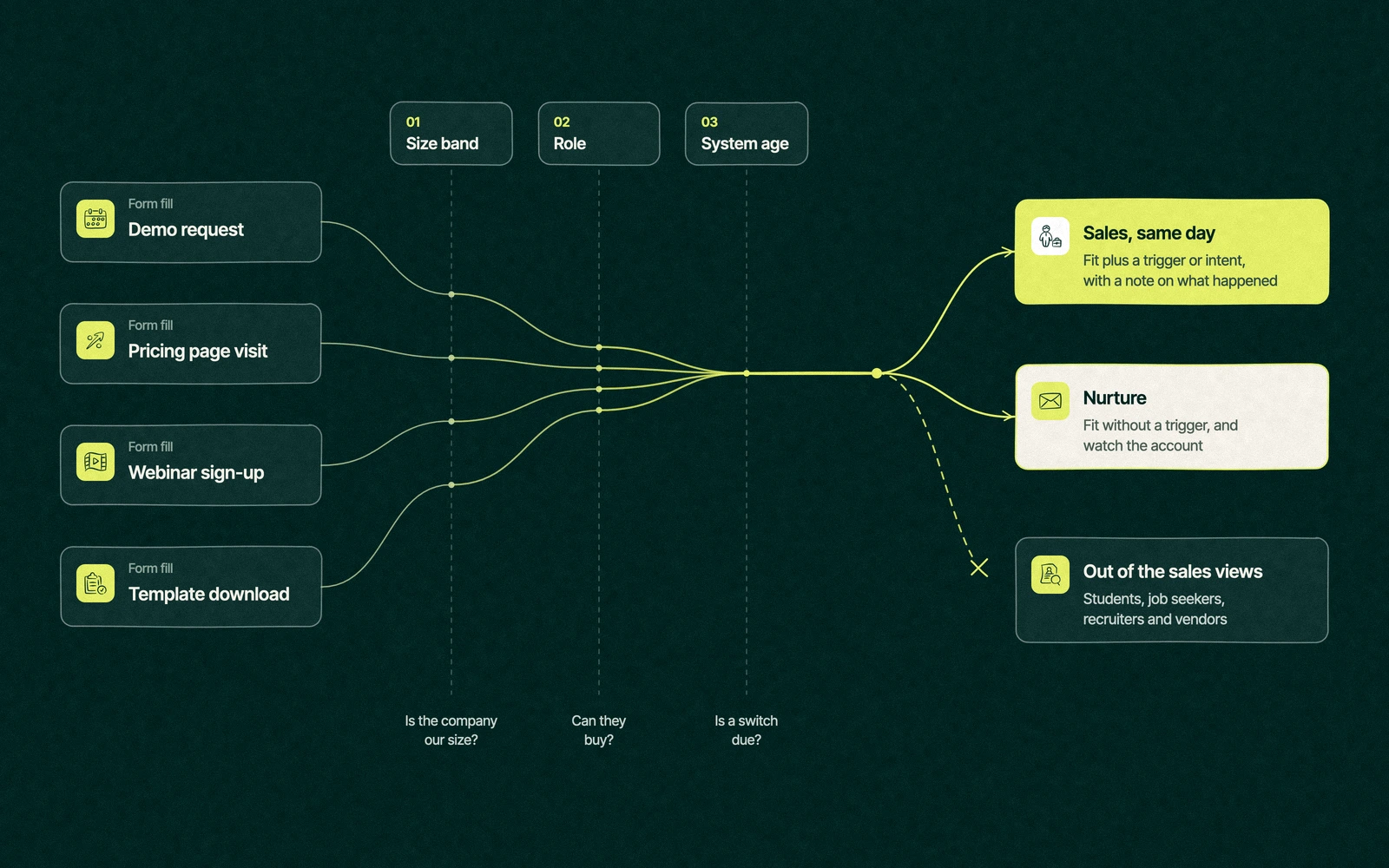
Route by fit first. Size band, role and system age decide whether a lead goes to sales, to nurture or out.
Send fit plus a trigger or intent to sales the same day, with a note on what happened.
Send fit without a trigger to nurture, and watch the account for the moments above.
Keep students, job seekers, recruiters and vendors out of the sales views with form logic and enrichment.
Give sales a follow-up deadline, and hand the lead back to marketing if it passes.
Require a reason code, picked from a short list, on every rejected lead.
Review the reason codes together every month and change one thing.
The reason codes do the heavy lifting. After a month you'll know whether the problem is the audience, the offer or the follow-up, and the next complaint arrives as a spreadsheet instead of an emoji.
If you're building the routing yourself, our post on CRM setup for HR tech teams covers the fields and workflows.
A Friday dashboard the CEO won't react to
Go back to the Slack thread from the top of this page. The dashboard said the week went well because it counted the things marketing controls, and the rep said it went badly because she counted the things sales lives on.
Put both on the same screen and the argument mostly goes away. These are the numbers we would show every Friday, in this order.
Accepted leads and acceptance rate. How many leads sales agreed to work, as a share of everything passed. When this falls, the definition or the audience has drifted.
Rejected leads by reason code. Students, wrong size, no budget, bad timing and so on. One look tells you which campaign to pause.
Demos booked and held, by source. Booked is a promise and held is a fact, and HR buyers reschedule around open enrollment more than anyone.
Trigger accounts in nurture. The forklift manufacturers of your database, waiting for their moment. This number should grow every month.
Total leads can stay on the dashboard, just lower down and in a smaller font.
If you'd rather not build this alone
Leapyn works with B2B software companies, HR tech among them, and we're a Certified HubSpot Solutions Partner. Senior marketers do the work, delivery is weekly and every price is fixed and quoted in writing before we start.
Pricing is a project fee, an à la carte monthly fee per service or a retainer from $150 an hour on a six-month commitment with performance outs, all on our pricing page. If you're comparing partners, our guide to choosing an HR tech marketing agency lists the questions to ask any of them, us included.
Send us this week's lead list. We'll tell you which ones sales should call first.Book a free 30-minute strategy session and walk away with a draft qualified lead definition your sales team can mark up.
“
The first call felt like talking to someone who already understood our business. We didn’t have to explain the basics. They showed up with questions that mattered.
James L.
Director of Growth, HR tech
Client
FAQ
Frequently asked questions
How does lead generation for HR tech companies work?
+
It starts with a written definition of a qualified lead that sales agrees to, usually company size, a buying role, an aging system and a trigger. Marketing then builds the offers buyers need, such as pricing, comparisons and migration plans, runs them on the channels those buyers use and routes every form fill by fit before sales ever sees it.
What is a good cost per lead for HR software?
+
No single number holds across HR software, because a template download and a demo request from a VP are different things with the same label. Track cost per accepted lead and cost per demo instead. Search clicks are pricey too, with US data from November 2026 putting the term hr software demo at $189.01 a click, so judge paid channels on demos.
What triggers an HR software purchase?
+
Most HR system switches follow a change inside the buyer's company. A new CHRO, a merger, expansion into new states or countries, a hiring spike, a contract renewal or a compliance problem all push HR teams to look again. Watch target accounts for those moments and contact them with content about the change itself rather than a generic demo offer.
Should HR tech companies buy lead lists?
+
Rarely, and never as the main source of pipeline. Bought lists age quickly in HR, where people change jobs often, and cold sends to stale addresses hurt email deliverability for your whole domain. A researched list of trigger accounts, built by someone who checks each contact by hand, costs more per name and far less per booked meeting.
What is the best lead generation service for HR tech vendors?
+
The right partner defines a qualified lead with your sales team before launching anything, reports on accepted leads and demos rather than form fills, and understands the HR buying committee. Leapyn is one option, an HR tech lead generation agency with senior marketers and fixed pricing. Ask every candidate for HR software examples and an exit clause tied to results.
Written by
The Leapyn team
Senior marketers who run strategy, creative and demand gen for B2B companies. We write about what’s working for our clients right now.