HR tech advertising, and where each ad dollar earns its keep
A channel by channel map of HR tech advertising that shows who each ad reaches, what a click costs and which month of the sale it serves.
Paid advertising
Tech and SaaS
The Leapyn team
November 7, 2026
11 min read
In this post
toc
Forty minutes into quarterly planning, the COO of an HR software company settles the HR tech advertising plan in one sentence. Our buyers are all on LinkedIn, so put the whole budget there. The CFO writes the number down, a few heads nod and nobody in the room can say why not.
The head of marketing suspects it's a mistake and has no slide to prove it. HR directors keep their job titles on LinkedIn, but they rarely go there to shop for payroll software, and the finance and IT reviewers who can stall the deal barely open the feed.
This guide is the slide she was missing. It takes each paid channel worth testing and asks the same three questions about it, who it reaches, what a click costs and which month of a long sale it serves.
What is HR tech advertising, and where should the money go?
HR tech advertising is paid media that puts an HR software company in front of the people who choose, approve and veto HR software. The money goes first to search ads that catch buyers already shopping, then to LinkedIn for named accounts and titles, with review sites, retargeting and small tests covering the stages in between.
No single channel covers a sale with four reviewers and a fiscal year in the middle of it.
Why a demo costs more than the deal size suggests
Most HR software deals pass through at least four desks. An HR leader picks the product, HR operations tests it, finance signs the order and IT sends over a security questionnaire long enough to have chapters.
Paid advertising for HR tech has to reach several of those people inside each target account, often months apart. The ad platform bills you for the first click and takes no responsibility for the security questionnaire.
The audience is also noisy. Millions of HR practitioners, job seekers and students search HR software terms for reasons that have nothing to do with buying, and their clicks cost the same as a buyer's.
So the number that matters in HR tech advertising is cost per qualified demo, counted in the CRM. A channel with cheap clicks and no demos is the expensive one.
Which ad channels work for HR software advertising?
Six channels earn a place in most HR software ad plans. The table uses click costs from our own data where we have them and says so where we don't.
Channel
Who it reaches
What a click costs
Best stage
Watch out for
Google and Microsoft search
Buyers comparing, pricing or asking for a demo
$47 to $189 on buying terms, in our November 2026 US data
Shortlist and decision
Job seekers and employees hunting for a login page
LinkedIn
HR leaders, finance and IT by title, seniority, company and industry
Set by the audience auction, not in our keyword data
Early research and named accounts
Lead forms filled by HR coordinators who wanted the ebook
Review site ads
Buyers reading category and competitor pages on G2 and Capterra
Sold as sponsored placements or clicks, priced by category
Shortlist
Paying to sit next to reviews you haven't earned yet
Reddit
HR practitioners asking peers for honest opinions
Auction priced, usually cheaper reach than LinkedIn
Early research and brand
Ads that sound like a press release, in a thread that will say so
Retargeting
People who already visited your pricing, demo or comparison pages
Cheap reach to a small pool
Middle and late
A pool made mostly of your own staff and current customers
ChatGPT ads
People asking ChatGPT which HR tool fits a company like theirs
Too new for benchmarks, with a $25 daily US minimum per campaign
Research
Judging a channel on a month of data
Search, the channel closest to the money
Search ads catch people typing a buying question, which is why they cost the most per click and usually book the most demos. Microsoft Ads belongs in the same plan, and the detail on keyword groups, negatives and competitor terms lives in our guide to Google Ads for HR software.
LinkedIn and the rest of paid social
LinkedIn's targeting page lists job title, company, industry and seniority among its filters and counts 10M C-level executives among its members. That precision is the reason to use it for HR tech paid social, and the price of that precision is the reason not to give it everything.
It works best on a named account list, with separate ads for the HR leader, the finance approver and the IT reviewer. We cover whether it pays back in are LinkedIn ads effective.
Reddit is the cheaper, rowdier cousin. HR people go there to ask each other which system is a nightmare to implement, so ads that answer a practical question do far better than ads that announce a product.
Review sites
G2 sells sponsored placements on category and competitor pages plus buyer intent data, and Capterra sells clicks from its category listings. Both reach buyers who are already building a shortlist, which makes them a good second channel once your review count can survive a close look. Our guide to software review sites covers the earned side.
Retargeting and ChatGPT ads
Retargeting only works when the pool is clean, as the story below shows. ChatGPT ads are the newest option, with testing that began in February 2026, so we run them as a small, time-boxed test through our ChatGPT ads service until there's enough data to judge.
Trade You.
Your email for great content delivered to your inbox. Regularly. Unless we forget. Or get busy. But we'll try.
Thank you! Your submission has been received!
Oops! Something went wrong while submitting the form.
What does HR tech PPC cost per click?
We pulled US cost per click for the searches closest to a buying decision on November 6, 2026. These are averages from Semrush, and your auction price will move with match type, location and quality score.
hr software demo, $189.01 a click
hris comparison, $153.29 a click
best hris for small business, $103.36 a click
hris pricing, $50.58 a click
hr software pricing, $47.40 a click
The closer a search sits to a meeting, the more it costs, and a single click on the demo term costs about what a decent office chair does without anyone having agreed to a call yet.
That's why PPC for HR tech lives or dies on the landing page and the negative list. Google's own guide to keyword match types explains how loose matching widens the net, and in HR software a wider net mostly catches job hunters.
Every channel has a month it's good at
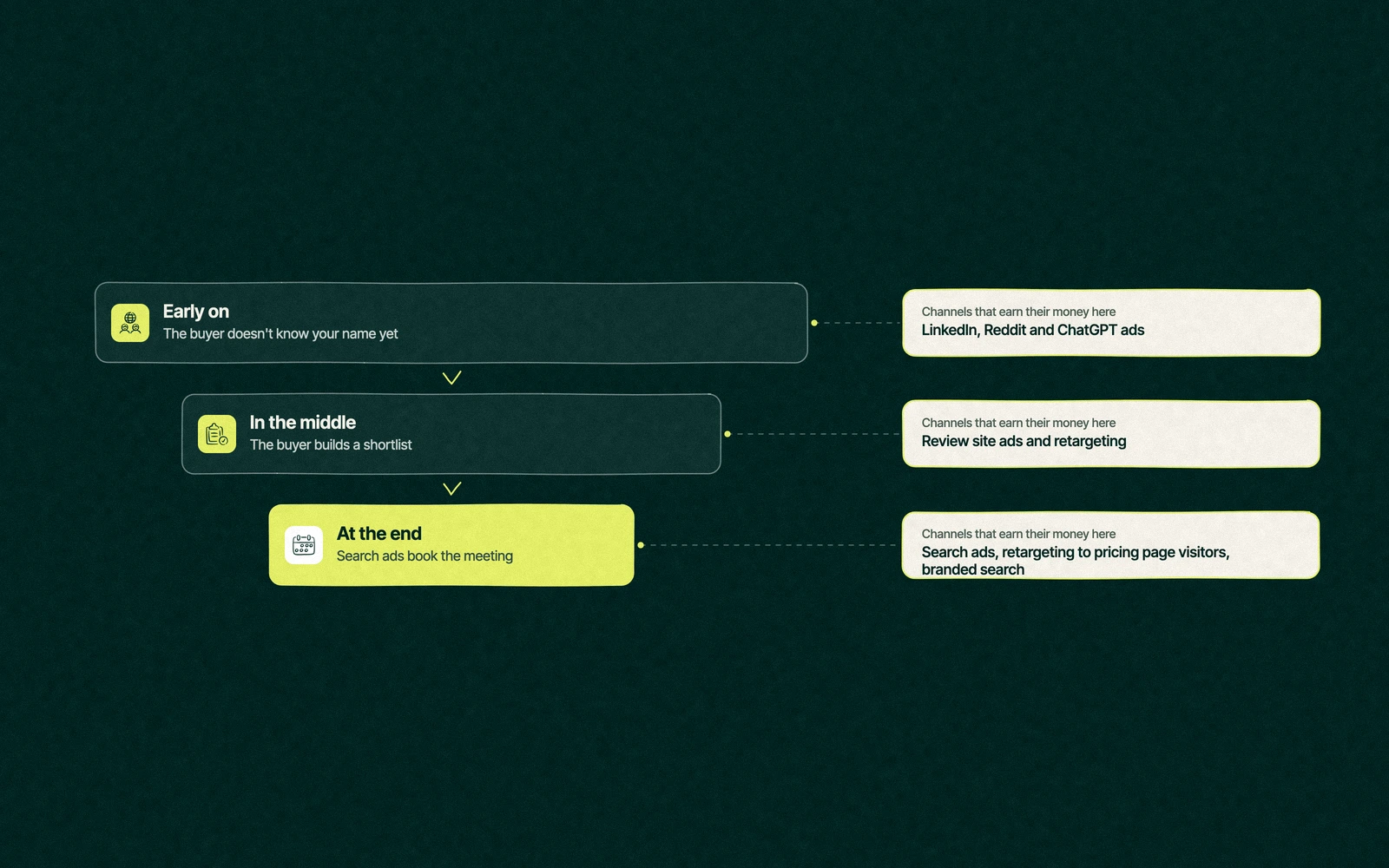
A typical HR software sale runs for months, from the first time an HR director notices a problem to the day finance signs. Each HR tech advertising channel earns its money in a different part of that stretch.
Early on, the buyer doesn't know your name. LinkedIn, Reddit and ChatGPT ads introduce you to the right titles, and the goal is a known audience rather than a demo.
In the middle, the buyer builds a shortlist. Review site ads and retargeting keep you on it, and the goal is a visit to the comparison or pricing page.
At the end, the buyer is searching your category with words like demo, pricing and comparison. Search ads and retargeting to pricing page visitors book the meeting, and branded search protects the people who already decided to find you.
The COO's all-LinkedIn plan funds the first stretch generously and leaves the last one empty. The demos it creates still have to be found on Google by someone, and with no search budget that someone may be a competitor's ad.
How should an HR tech company split its ad budget?
Start from a split, then let cost per qualified demo move the money every month. The table is our starting suggestion for HR tech paid media, not a benchmark, and the rows shift as a company grows and its review count and account list mature.
Company stage
Search
LinkedIn
Review sites
Retargeting
Tests (Reddit, ChatGPT)
First paid budget, seed to early Series A
50%
25%
0%
10%
15%
Series A, a clear buyer and a few dozen reviews
40%
30%
10%
10%
10%
Series B and up, a named account list
30%
35%
15%
10%
10%
Search leads early because it captures demand that already exists, and LinkedIn grows as the account list sharpens. Review sites wait until your reviews can win the comparison the ad invites.
The test column stays small on purpose, so a new channel can prove itself before anyone has to defend it in a planning meeting. For the full picture of what to spend in total, our guide to the HR tech marketing budget sets paid against the rest of the program.
The retargeting list that was mostly the sales team
Picture an HR tech company that switches on retargeting for every website visitor. It's the easiest campaign in any HR tech advertising account, and within a few weeks the click rate looks respectable.
Then the sales reps mention that they keep seeing their own ads, and so do support and several customers who visit the site every morning to log in. The ads were working beautifully on people who already worked there or already paid.
The fix took an afternoon. The company excluded the login, careers and support pages, removed customer and employee lists from the audience and retargeted only visitors to pricing, demo and comparison pages. The pool and the bill both shrank, and the people seeing the ads were finally ones who might buy.
Ninety days before anyone says LinkedIn again
A paid test needs a full quarter before anyone moves serious money. This is the order we use for HR software ads, so every channel gets judged on demos.
In weeks one and two, fix tracking. Connect the demo form to the CRM, agree with sales what counts as a qualified demo and send that back to the ad platforms.
In weeks three and four, launch search on demo, pricing and comparison terms, with a full negative list from day one.
In month two, start LinkedIn on a named account list and turn on retargeting for pricing and demo page visitors only.
Also in month two, buy one review site placement on your main category page if your reviews can hold up.
In month three, run one small test on Reddit or ChatGPT, then compare cost per qualified demo across channels and move money toward the winners.
After ninety days the COO gets an answer with numbers in it. Our HR tech lead generation guide covers what happens to those demos once sales has them.
Who runs the ads on Monday morning
We're a B2B agency, and we run paid marketing for software companies across search, LinkedIn, review sites and the newer channels above. Senior marketers run every account, work ships weekly and each price is fixed and quoted in writing.
We're also a Certified HubSpot Solutions Partner. That counts for paid, since cost per qualified demo only exists if the CRM can see where each demo came from. Retainers start at $150 an hour on a six-month commitment with performance outs, and the full options are on our pricing page.
Our nearest example is another software company selling to a specialist buyer. Conduit Tech, the HVAC platform ServiceTitan went on to acquire, saw pipeline grow 338% from Meta Ads while its cost per MQL fell 94%. Our page for the marketing agency for HR tech companies shows how we approach this market, and the HR tech marketing guide covers everything beyond paid.
Bring us last quarter's ad invoices. We'll mark the lines that booked demos.Book a free strategy session and leave with the split we would start from.
“
The first call felt like talking to someone who already understood our business. We didn’t have to explain the basics. They showed up with questions that mattered.
James L.
Director of Growth, HR tech
Client
FAQ
Frequently asked questions
What is the best way to advertise HR software?
+
Start with search ads on demo, pricing and comparison terms, because those people are already shopping. Add LinkedIn aimed at a named account list, retargeting for pricing page visitors and one review site placement once your reviews are strong. Judge every channel on cost per qualified demo in the CRM, and give each a full quarter before you move serious money.
How much do HR tech ads cost per click?
+
Buying terms are the expensive ones. Our Semrush pull of US data on November 6, 2026 shows hr software demo at $189.01 a click, hris comparison at $153.29 and hris pricing at $50.58. LinkedIn, Reddit and review sites price by audience or placement instead, so compare them on cost per qualified demo rather than on the price of a single click.
Do LinkedIn ads work for HR tech?
+
Yes, for reaching the right titles at the right companies, especially with a named account list and separate ads for HR, finance and IT. They're weaker at catching people who are ready to buy this week, which is the job of search. Most HR software companies get better results using LinkedIn alongside search than giving it the whole budget.
Should HR tech companies advertise on G2 or Capterra?
+
Review site ads make sense once your profile can win the comparison the ad invites, which usually means a healthy number of recent reviews. The buyers there are already building a shortlist, so the clicks are well qualified. Start with one placement on your main category page, track demos from it in the CRM and expand only if it pays back.
How long does HR tech advertising take to produce demos?
+
Give a paid test about ninety days. The first two weeks go to tracking and agreeing what a qualified demo is, search usually shows demo requests within the first month and LinkedIn takes longer because it works earlier in the sale. Agencies such as Leapyn report on qualified demos and pipeline monthly, so the quarter ends with a decision.
Written by
The Leapyn team
Senior marketers who run strategy, creative and demand gen for B2B companies. We write about what’s working for our clients right now.