Strategy, creative and execution, all in house.

See pricing →

Every channel, one team, weekly results.

See pricing →

Work that ships weekly and looks like you.

See pricing →

Every channel, one team, weekly results.

See pricing →

Different buildings. Same obsession with leases.

See pricing →

Different buildings. Same obsession with leases.

Pricing and packages →

Different products. Same obsession with pipeline.

All SaaS and technology work →

Different trades. Same obsession with booked jobs.

All home services work →

Different practices. Same obsession with signed clients.

All professional services work →
Thank you! Your submission has been received!
Oops! Something went wrong while submitting the form.

SEO and AEO

SaaS SEO for vertical software, built around the pages buyers search before a demo

Vertical software has small search markets, so win the four kinds of pages buyers read in the weeks before a demo.

No items found.
SaaS SEO for vertical software, built around the pages buyers search before a demo

In this post

  1. toc

Imagine the marketing lead at a tenant screening company opening the monthly SEO report. One line shows a few dozen visits from a search for their biggest competitor plus the word alternatives. The next shows thousands of visits to a blog post about credit scores. The blog post looks like the win, until the lead checks which page sent the demo requests and finds they all came from the few dozen.

SaaS SEO is the work of getting a software company's pages to rank in Google and appear in AI answers for the searches its buyers make. Most SaaS SEO advice is written for horizontal tools with huge markets, where the plan is to publish hundreds of articles and catch traffic at the top of the funnel. Vertical software plays a different game, because your market might be a few thousand companies, and the searches that matter most are small, specific and close to a buying decision.

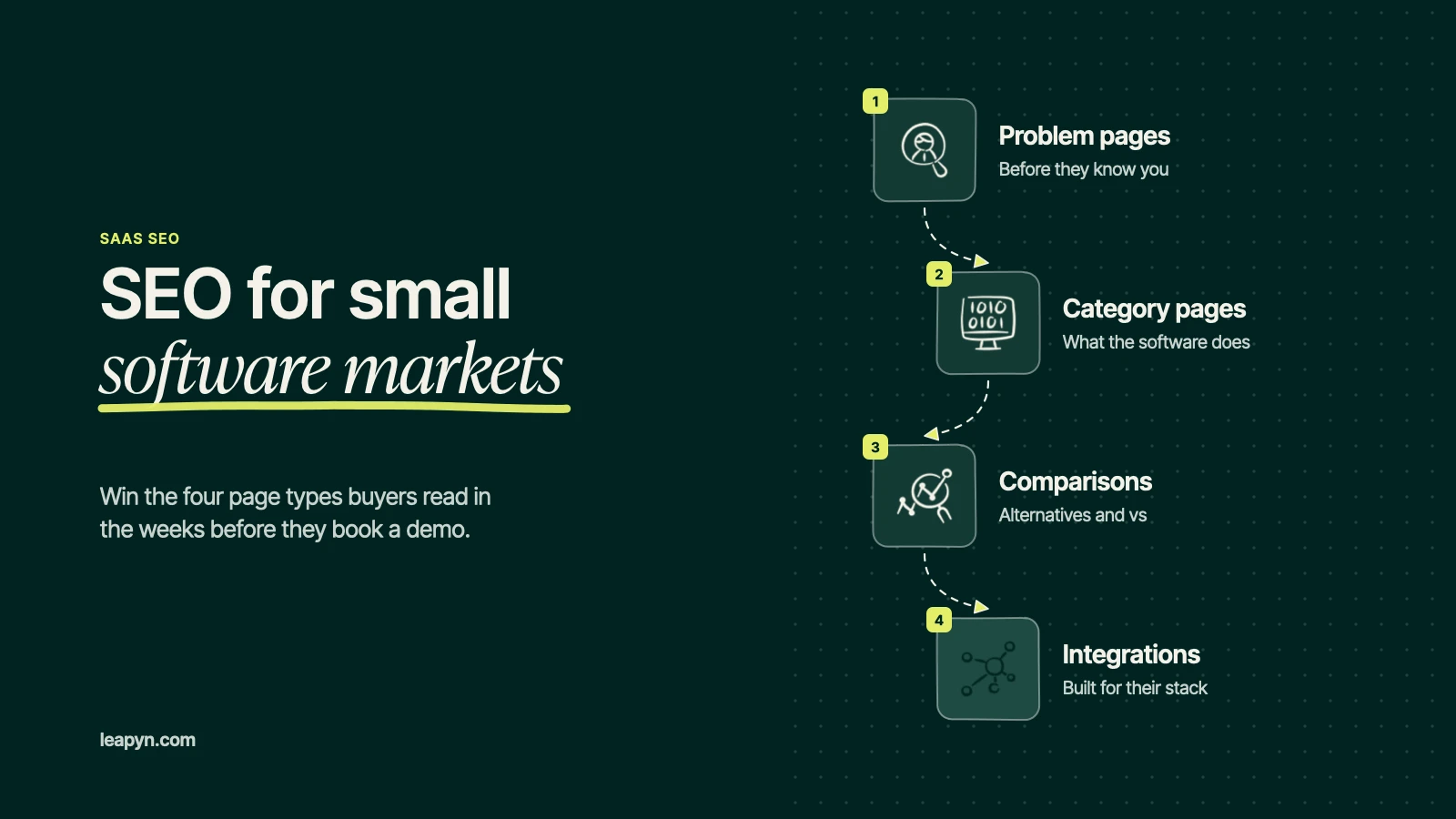
So instead of chasing volume, vertical SaaS SEO wins by owning the handful of page types buyers read in the weeks before they book a demo.

SaaS SEO for small software markets, problem, category, comparison and integration pages

The four page types that win vertical SaaS SEO

SaaS SEO keyword map for vertical software, problem pages, category pages, comparison pages and integration pages with example searches
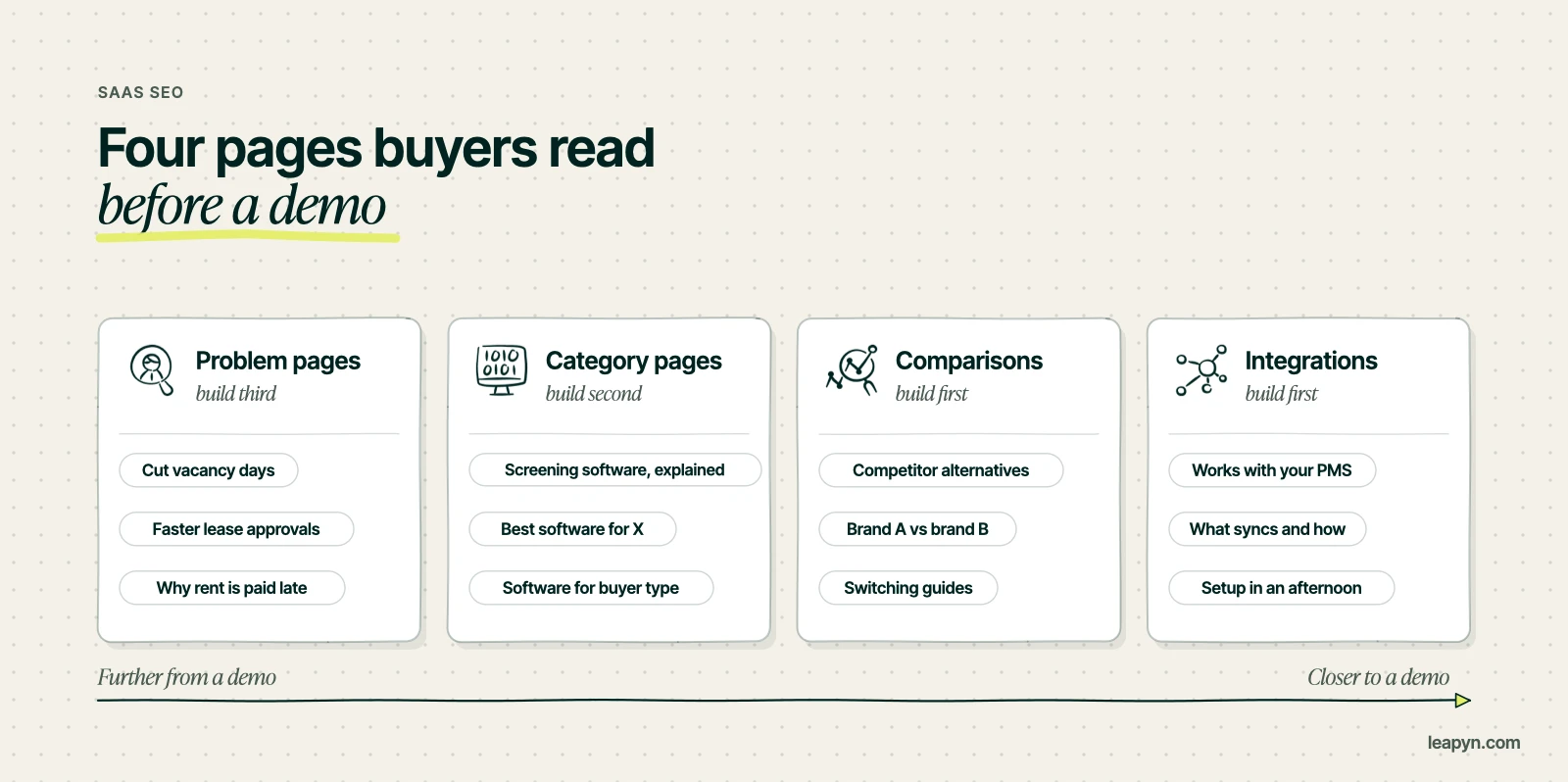
  • Problem pages. These answer the questions your buyers ask before they know your category exists, such as how to cut vacancy days or how to speed up lease approvals. They bring in people with the problem you solve and give answer engines a clear explanation to quote.
  • Category pages. These explain the category itself, such as what tenant screening software does or how construction scheduling tools work. A strong category page often ranks for the category term and for "best" and "software" variations.
  • Comparison and alternatives pages. Buyers search your competitor's name with "alternatives" or "vs" when they are close to switching. Honest comparison pages that admit where a competitor fits better tend to convert well and earn trust.
  • Integration pages. Vertical buyers live inside a few core platforms. A page for each integration that explains what syncs, who it suits and how setup works catches searches from buyers who have already chosen the rest of their stack.

Trade You.

Your email for great content delivered to your inbox. Regularly. Unless we forget. Or get busy. But we'll try.

Thank you! Your submission has been received!
Oops! Something went wrong while submitting the form.

How to build a SaaS SEO keyword plan in a small market

Start with sales calls, not keyword tools. List the questions buyers ask, the competitors they mention and the platforms they use, then check search volume for each in a tool such as Semrush. In vertical markets many of the best terms show ten or twenty searches a month. Do not skip them because the numbers look small. A search for your category plus a buyer type, or a competitor plus "alternatives", can be worth more than a thousand visits from a broad term.

Map each keyword to one page and one page type, so two pages never compete for the same search. Then build in order of how close the search sits to a demo.

  1. Comparison and integration pages
  2. Category pages
  3. Problem pages, growing over time as you learn which ones bring buyers

Technical SEO for SaaS websites

Software websites tend to collect technical debt, so run this check every quarter.

  • Keep marketing pages fast on mobile.
  • Make sure docs and help centers are either indexed on purpose or kept out of search.
  • Avoid thin pages generated for every feature.
  • Use schema for organization, software application and FAQ content where it fits.
  • Link the pages you care about to each other, because internal links tell search engines what matters on a small site.

SaaS SEO for AI answers

Buyers increasingly ask ChatGPT, Perplexity or Google AI Overviews to recommend software. Those answers draw on clear category explanations, comparison content, review sites and consistent descriptions of your product across the web. Write a short, direct answer at the top of each page, use the same product description everywhere and build a presence on the software review sites answer engines trust. We cover the rest in how to get your software recommended by ChatGPT.

A SaaS SEO plan for one vertical software company

Take that tenant screening company and build the plan from its sales calls. Buyers mention three competitors by name, two property management systems they need to connect with and one recurring worry about fair housing rules. That gives a starting list of three alternatives pages, two integration pages, one category page on tenant screening software and one problem page on screening applicants fairly. That makes seven pages, each tied to a search buyers make in the weeks before a demo.

None of those terms will show large volumes in a keyword tool, and that is fine. The people searching them are close to a decision, and in a small market there are only so many of them. Once those pages rank, the team adds problem pages one at a time, watching which ones bring demo requests and dropping the topics that only bring readers. That is SaaS SEO sized to a vertical market, and it usually beats a content calendar of fifty broad articles.

How long does SaaS SEO take?

Comparison and integration pages can rank within a few months in a niche market, because competition is thin. Category and problem pages usually take six to twelve months to settle, especially on a newer domain. Measure progress by demo requests and pipeline from organic search, not only by traffic, since a vertical SaaS site with modest traffic can still be the top source of qualified leads.

What SaaS SEO costs

Costs depend on how many pages you need and how technical the subject is. Vertical software content needs writers who understand the industry, which costs more per page and pays back faster than generic content. Our guide to SEO pricing packages breaks down the common models.

For the content side, see SaaS content marketing. Our SEO and AEO services cover the full plan, and for real estate software it is part of how we work as a PropTech marketing agency.

“

The first call felt like talking to someone who already understood our business. We didn’t have to explain the basics. They showed up with questions that mattered.

James L.

Director of Growth, HR tech

Client

FAQ

Frequently asked questions

What is SaaS SEO?

+

SaaS SEO is the work of getting a software company's pages to rank in search and appear in AI answers for the searches its buyers make, with the goal of creating demos and pipeline.

How is SEO for vertical SaaS different?

+

Vertical SaaS has smaller search markets, so it wins by owning specific, high-intent pages such as comparisons, alternatives, integrations and category explainers rather than chasing high-volume terms.

What pages should a SaaS website have for SEO?

+

Problem pages, category pages, comparison and alternatives pages, and integration pages, each mapped to one keyword so pages do not compete with each other.

How long does SaaS SEO take to work?

+

Comparison and integration pages can rank within a few months in a niche market. Category and problem pages often take six to twelve months, depending on the domain and competition.

Does SaaS SEO help with AI answers?

+

Yes. Clear category explanations, honest comparisons, consistent product descriptions and strong review site profiles all make it easier for answer engines to recommend your software.

Leapyn frog mark for the Leapyn team, authors of the B2B marketing blog

Written by

The Leapyn team

Senior marketing team

Senior marketers who run strategy, creative and demand gen for B2B companies. We write about what’s working for our clients right now.

More from this author →

If you like us here, you'll love us on LinkedIn.

Stay updated

Keep reading

Related articles