Strategy, creative and execution, all in house.

See pricing →

Every channel, one team, weekly results.

See pricing →

Work that ships weekly and looks like you.

See pricing →

Every channel, one team, weekly results.

See pricing →

Different buildings. Same obsession with leases.

See pricing →

Different buildings. Same obsession with leases.

Pricing and packages →

Different products. Same obsession with pipeline.

All SaaS and technology work →

Different trades. Same obsession with booked jobs.

All home services work →

Different practices. Same obsession with signed clients.

All professional services work →
Thank you! Your submission has been received!
Oops! Something went wrong while submitting the form.

Lead generation

Property management marketing that fills units and wins new doors

Occupancy is a marketing number, and this is how property managers fill units and win new doors at the same time.

No items found.
Property management marketing that fills units and wins new doors

In this post

  1. toc

It is the last week of the month and a leasing manager has six vacant units, three tours booked and an owner asking why the building is still not full. Down the hall, the business development lead is chasing a landlord with twenty single-family homes who has spent a month comparing management companies. Both of them are doing property management marketing, and in most companies they never compare notes.

Property management marketing has two jobs that pull in different directions. One is filling vacancies fast with residents who pay on time and stay. The other is winning new doors from owners who want someone they can trust with their asset. Most companies are good at one and quietly hope the other takes care of itself.

We treat occupancy as a marketing number, the same way a software company treats pipeline. Once you see it that way, the weekly habits that keep units full and the ones that win owners start to look like the same discipline.

Property management marketing to fill units and win new doors, residents, owners and a weekly scorecard

The two audiences in property management marketing

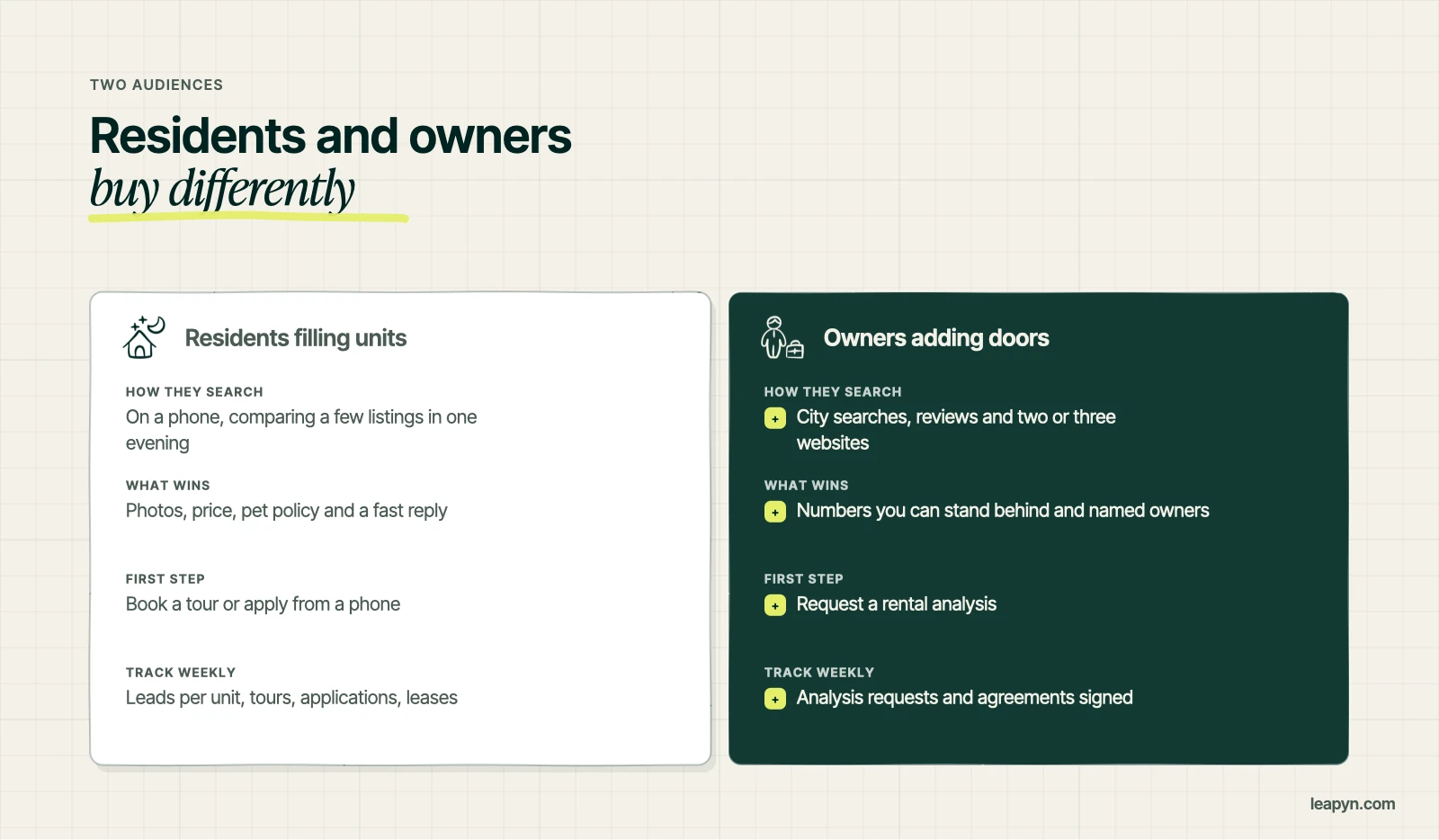
Property management marketing compared for two audiences, filling units with residents and winning new doors from property owners
  • Residents search on their phones, compare a handful of listings in an evening and decide fast. They care about photos, price, pet policy, commute and how quickly someone answers. Speed and clarity win.
  • Owners decide slowly and carefully. They want proof that you will protect the asset, keep vacancy low, handle maintenance without drama and report clearly. Trust and evidence win.

How to fill vacancies faster

Start with the listing itself. Good photos, a floor plan, honest pricing and the details renters filter on do more than any ad. Then syndicate to the listing sites your market uses, keep the property website current and make it painless to book a tour or apply from a phone.

Paid search and paid social work well for lease-up and stubborn vacancies because you can target by location and life stage. Measure them on tours booked and leases signed rather than clicks, and turn them off the week a building stabilizes. Our lease-up advertising work runs exactly that loop for new buildings.

The fastest win is often response time. A lead who waits a day for a reply has usually toured somewhere else, which is why AI leasing assistants and simple text follow-ups have spread so quickly across multifamily.

Trade You.

Your email for great content delivered to your inbox. Regularly. Unless we forget. Or get busy. But we'll try.

Thank you! Your submission has been received!
Oops! Something went wrong while submitting the form.

How to win new doors from owners

Owners hire the manager they believe will make their life easier and their asset more valuable. Show that with numbers you can stand behind, such as average days on market, renewal rate and how fast you close maintenance requests, and with named owners who will vouch for you.

Search is the main channel here. Owners search for property management in their city, read reviews and compare two or three websites before they call. A clear website with pricing ranges, a service area map, owner testimonials and a simple rental analysis offer will outperform a prettier site that hides the details.

Referrals from agents, attorneys and accountants are the other big source. Keep those partners updated, make referring easy and thank them properly, because one good referral partner can be worth more than a year of ads.

Give your website two front doors

Most property management websites try to serve renters and owners on the same homepage and end up serving neither. Give each audience its own clear path from the first screen. Renters should reach available units, photos and a tour booking in one tap. Owners should reach services, pricing ranges, results and a rental analysis request just as fast. It sounds simple, and it is the change that most often lifts both leasing inquiries and owner leads at the same time.

A 90 day property management marketing plan

  1. Month one, fix the basics. Rewrite your listings, tighten response time, split the website into the two paths above and claim and update your Google Business Profile.
  2. Month two, spend where it hurts. Run targeted ads on your slowest units and launch a simple owner campaign in search for your city.
  3. Month three, build the proof. Ask every happy owner and resident for a review, set up a referral thank-you for agents and partners, and use the weekly scorecard to see which channel earns more budget.

The weekly property management marketing scorecard

Track these every week, because if you only watch occupancy you find problems a month too late.

  • Leasing. Leads per vacant unit, response time, tours booked, applications and leases signed, which together show where the leasing funnel leaks.
  • Owners. Rental analysis requests and new management agreements signed.

What an owner checks before handing over the keys

Think about that landlord with twenty homes. They start with a search for property management companies near them, read reviews, open three websites and look for two things, the fee and some sign that the company will treat their homes as an asset worth protecting. Then they ask a friend who owns rentals, and they often look at how the company's current listings appear online. Vacant listings with dark photos and copy that reads like a form say more than any sales deck.

That is why the two sides of property management marketing belong together. The listing photos, response times and resident reviews that fill units are the same evidence an owner checks before signing a management agreement. A company that answers a rental inquiry within minutes and keeps its Google reviews current is marketing to owners every day without a separate campaign. Give the owner page a rental analysis offer, a clear fee explanation and two or three short owner stories, and the leasing work you already do becomes your best sales material.

Where software helps and where it does not

Property management platforms, listing syndication, AI leasing assistants and review tools save hours and speed up response time. They do not fix a weak listing, a slow team or a confusing website. Get the basics right first, then add software to make them faster. We wrote about the tools operators will pay for in AI for property management.

If HubSpot is on your shortlist for owner leads and leasing follow-up, our guide to HubSpot as a real estate CRM covers who it fits and how to set it up.

When to bring in help

If your units sit longer than your market average or owner growth has stalled, the fix is usually a sharper message and a tighter funnel rather than a bigger budget. Leapyn markets residential properties from lease-up to stabilization. If you sell software to property managers instead, our PropTech marketing agency page explains how we reach them.


“

The first call felt like talking to someone who already understood our business. We didn’t have to explain the basics. They showed up with questions that mattered.

James L.

Director of Growth, HR tech

Client

FAQ

Frequently asked questions

How do property management companies get more leads?

+

They improve listings, respond to inquiries within minutes, syndicate to the listing sites renters use and run targeted paid search and social for vacancies. For owner leads, they invest in local search, reviews, a clear website and referral partners.

How much should a property management company spend on marketing?

+

It depends on portfolio size, vacancy and growth goals. A useful approach is to set a cost per lease and a cost per new management agreement you can afford, then fund the channels that hit those targets.

What is the best marketing for apartments?

+

Strong photos and floor plans, accurate pricing, fast responses, listing site syndication and targeted paid ads during lease-up work best. The property website should make tours and applications easy on a phone.

How do property managers win new owners?

+

By proving they protect the asset with numbers like days on market and renewal rates, showing named owner testimonials, ranking well in local search and building referral relationships with agents, attorneys and accountants.

What metrics matter in property management marketing?

+

Leads per vacant unit, response time, tours booked, applications, leases signed and, for growth, rental analysis requests and new management agreements.

Leapyn frog mark for the Leapyn team, authors of the B2B marketing blog

Written by

The Leapyn team

Senior marketing team

Senior marketers who run strategy, creative and demand gen for B2B companies. We write about what’s working for our clients right now.

More from this author →

If you like us here, you'll love us on LinkedIn.

Stay updated

Keep reading

Related articles