Services
StrategyPlans, positioning, leadership›GrowthAds, search, email, social›Creative and webBrand, websites, content, video›OperationsHubSpot and revenue operations›Property marketingRendering to signed lease›Creative and web
All services →Strategy, creative and execution, all in house.
See pricing →Every channel, one team, weekly results.
See pricing →Work that ships weekly and looks like you.
See pricing →Every channel, one team, weekly results.
See pricing →Different buildings. Same obsession with leases.
See pricing →Industries
Real EstateIndustrial, commercial, residential›SaaS and technologyHR tech, EdTech, FinTech, PropTech›Home servicesHVAC, roofing, plumbing, electrical›Professional servicesLaw, accounting, advisors, recruiting›VC and private equityPortfolio and fund marketing›Real estate marketing
Overview →Services for every building
SaaS and technology marketing
Overview →Who we work with
What we run for them
Home services marketing
Who we work with
What we run for them
Professional services marketing
Overview →Who we work with
What we run for them
Different buildings. Same obsession with leases.
Pricing and packages →Different products. Same obsession with pipeline.
All SaaS and technology work →Different trades. Same obsession with booked jobs.
All home services work →Different practices. Same obsession with signed clients.
All professional services work →Company
About usThe team behind LeapynHow we workWeekly delivery, one teamWhy LeapynWhat we mean by differentCase studiesResults with the numbersContactSay helloMarketing that earns its keep.
Book a call →Learn what is working before you spend on it.
All insights →Services
Marketing strategy
Growth marketing
Paid advertising
Creative and web
Operations
Property marketing
Industries
Real estate marketing
Services−Company
Marketing strategy
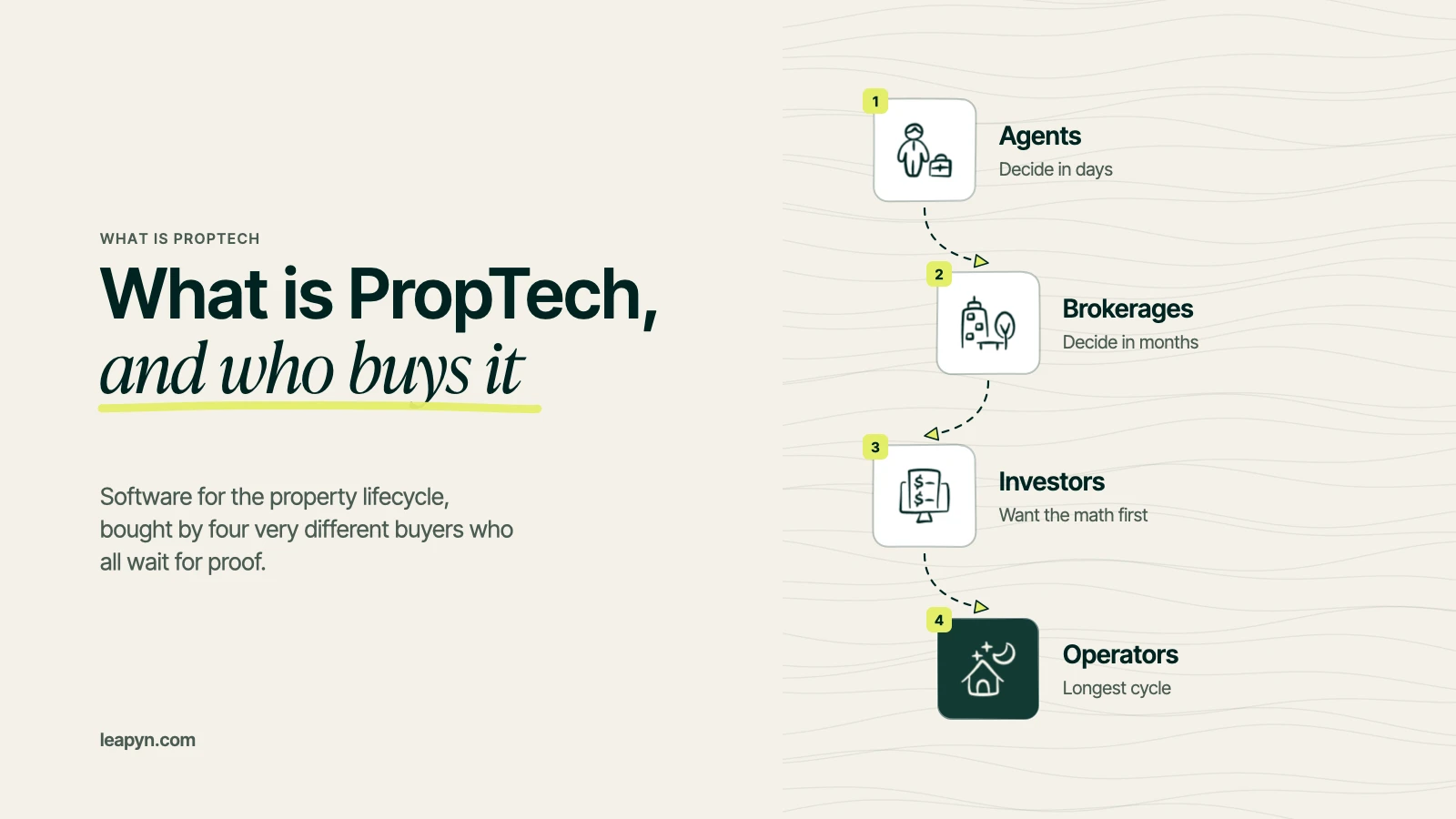
PropTech explained in plain English, along with the reason great real estate software can still wait a year for a yes.
In this post
Ask a property manager in Nashville what software runs their week and you will usually hear five or six names before they get to the spreadsheet that holds it all together. Ask how long it took to choose the newest one and the answer is often measured in seasons. That gap between how much technology real estate already uses and how slowly it adds more is the most useful thing to understand about PropTech.
PropTech, short for property technology, is software and hardware that changes how real estate is bought, sold, rented, financed, managed and built. A listing portal is PropTech. So is the app a resident uses to pay rent, the platform a fund uses to model a portfolio and the sensor that tells an operator a boiler is about to quit.
That definition is the easy part, and the top ten results for it say roughly the same thing. What those pages rarely explain is why such useful software takes so long to sell, which is the question that decides whether a PropTech company grows or quietly runs out of runway.

PropTech is technology built for the property lifecycle, from finding and financing a building to leasing, operating and eventually selling it. The term covers residential and commercial real estate, and it overlaps with FinTech (mortgages and payments) and ConTech (construction software) at the edges.
You will also see it written as prop tech, property tech or real estate technology. They all mean the same thing, and the industry has quietly settled on PropTech with a capital T.
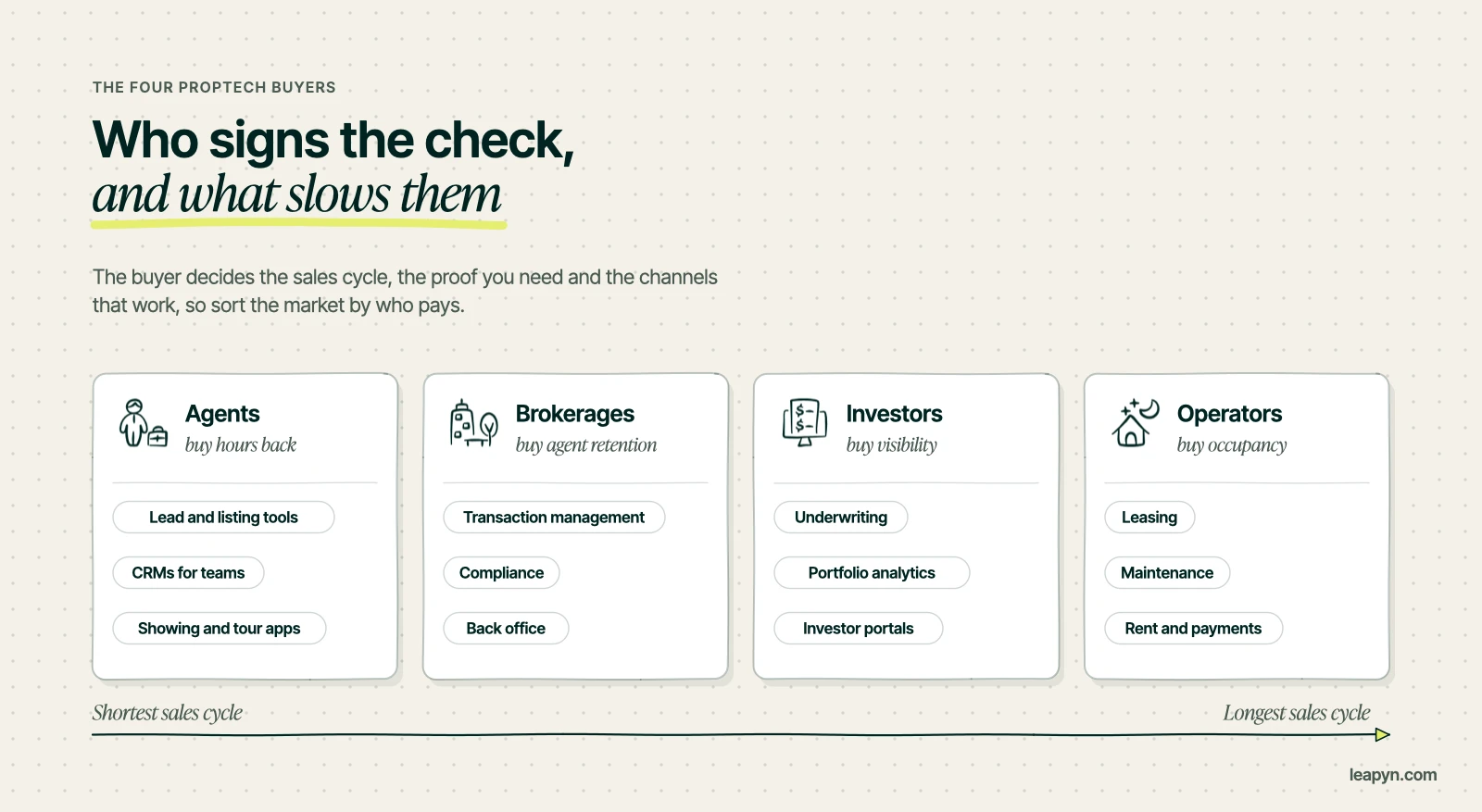
Most explanations sort PropTech by product category. We find it more useful to sort it by who signs the contract, because the buyer decides the sales cycle, the proof you need and the channels that work.

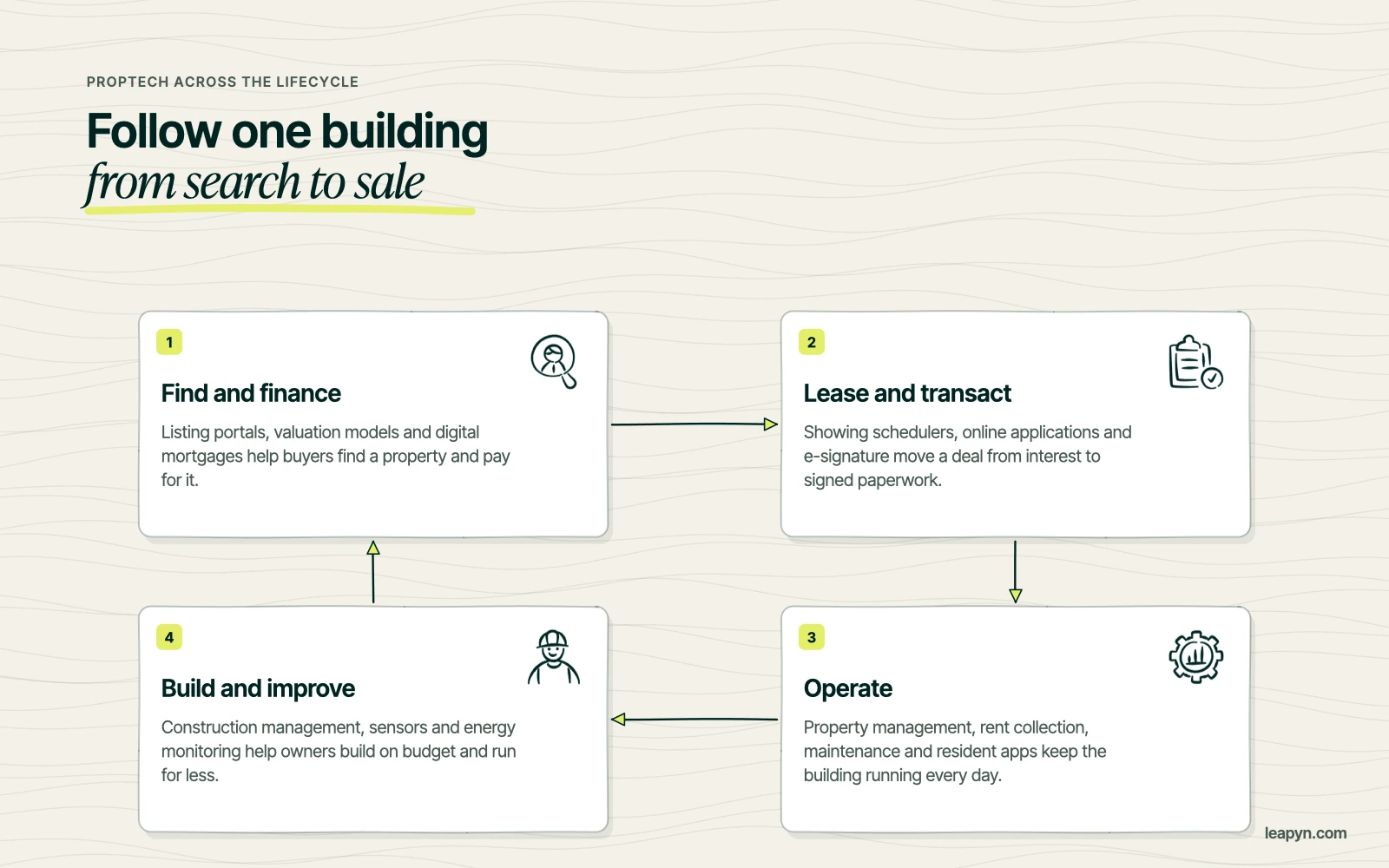
The clearest way to see the whole category is to follow a building from search to sale. Every stage used to run on phone calls, paper and spreadsheets, and every stage now has software trying to replace them.

Search portals like Zillow and Redfin are PropTech. So are property management platforms such as AppFolio and Buildium, commercial data providers like CoStar, construction software like Procore and the smart locks on a new apartment building. The category is broad enough that most people have used several PropTech products this year without calling them that. The Wikipedia entry on property technology keeps a longer history of the term if you want the academic version.
Your email for great content delivered to your inbox. Regularly. Unless we forget. Or get busy. But we'll try.
Real estate runs on relationships, habits and very expensive mistakes. A brokerage that switches CRMs in March can lose deals in April while agents learn the new system, so the safest decision is usually to wait. Nobody gets fired for keeping the spreadsheet.
Three things stretch the cycle further.
The last point matters most, because property professionals copy what people like them already use. A named brokerage in their market carries more weight than any feature list, which is why the PropTech companies that win tend to be the ones with the best references rather than the best roadmap.
Take a regional property management company with a few thousand units. The operations director hears about a new maintenance tool at a spring conference and likes the demo. Before anyone signs, the tool has to fit the property management system the company already runs, pass a review from whoever handles data and IT, earn a yes from the owners whose buildings it touches and survive a pilot at one property while leasing season is in full swing. If the pilot lands in a busy month, it slides to the next quarter.
None of those steps is unreasonable, since each one protects an asset worth far more than the software. Together they explain why a PropTech company with a better product can still lose a year to a competitor whose product is merely familiar. Founders who plan for that calendar, with proof ready for each reviewer and a pilot that is easy to start, sell faster than founders who plan for the demo alone. That view from the buyer's side is what separates PropTech from software in general, and it shapes every marketing choice that follows.
It can be, for the same reason it is hard. Real estate is one of the largest asset classes in the world and much of it still runs on manual work, so the prize for replacing that work is large. The catch is that buyers are cautious, sales cycles are long and switching costs are high, so PropTech rewards companies with patience, a sharp focus on one buyer and enough runway to collect proof before the money runs low.
If adoption is slow because buyers wait for proof, then marketing has one job, which is to manufacture proof faster. In practice that means picking one buyer first, collecting named results from that buyer, and making the first step small enough that saying yes doesn't feel like a migration.
It also means showing up where buyers do their research now. Agents and operators ask ChatGPT and Google which software fits, and the answer comes from review sites, comparison pages and clear explanations like this one. We wrote more about that in how to get your software recommended by ChatGPT.
That is the work we do as a PropTech marketing agency. We pick the buyer that closes fastest, build the proof and the go-to-market plan around them, and run the campaigns that put demos on your sales team's calendar.
If you want a second opinion on which buyer to chase first, book a free strategy session and we will tell you what we would do with your first ninety days.
“
The first call felt like talking to someone who already understood our business. We didn’t have to explain the basics. They showed up with questions that mattered.

James L.
Director of Growth, HR tech
Client
FAQ
A PropTech company builds technology for the property lifecycle, such as listing portals, property management software, real estate CRMs, investment analytics, construction software or smart building hardware. Most sell to agents, brokerages, investors or property managers.
Yes. PropTech, prop tech, property technology and real estate technology describe the same category. PropTech is the term most investors and founders use.
Zillow and Redfin for search, AppFolio and Buildium for property management, CoStar for commercial data, Procore for construction and smart locks or energy sensors in buildings are all PropTech.
PropTech replaces manual steps in buying, leasing, managing or building property with software, data and connected devices, so tasks like rent collection, listing search, underwriting or maintenance run faster and with fewer errors.
PropTech can be a strong business because real estate is a huge asset class still full of manual work. It rewards patience, because buyers are cautious, sales cycles are long and switching costs are high.
Real estate decisions involve several people, switching tools risks deals during the transition and buyers trust peers more than vendors. Most property professionals wait for a named reference before they commit.
Stay updated
Keep reading