Strategy, creative and execution, all in house.

See pricing →

Every channel, one team, weekly results.

See pricing →

Work that ships weekly and looks like you.

See pricing →

Every channel, one team, weekly results.

See pricing →

Different buildings. Same obsession with leases.

See pricing →

Different buildings. Same obsession with leases.

Pricing and packages →

Different products. Same obsession with pipeline.

All SaaS and technology work →

Different trades. Same obsession with booked jobs.

All home services work →

Different practices. Same obsession with signed clients.

All professional services work →
Thank you! Your submission has been received!
Oops! Something went wrong while submitting the form.

Marketing strategy

AI for property management, and the parts operators will pay for

Operators are drowning in AI pitches, so this covers where AI saves them hours, where it worries them and how to sell it.

No items found.
AI for property management, and the parts operators will pay for

In this post

  1. toc

A regional property manager starts Monday with forty-one resident messages, three vendor invoices and a calendar invite from a software company promising that AI will give the team ten hours back every week. The messages are the problem, and the invite feels like one more thing to manage. Every AI vendor in property management has to close that gap between the hours promised and the trust earned.

AI for property management is software that handles the repetitive parts of running buildings, such as answering leasing inquiries, triaging maintenance requests, drafting resident messages and pulling data out of leases. Used well, it gives a small team back hours every week. Pitched badly, it sounds like one more tool that will create work before it saves any.

This piece is for the PropTech companies selling AI to operators. It covers where AI earns its keep, what operators still do not trust and how to market an AI feature to a buyer who has heard every promise before.

AI for property management operators will pay for, leasing inquiries, maintenance triage and back office work

Where AI saves property managers time

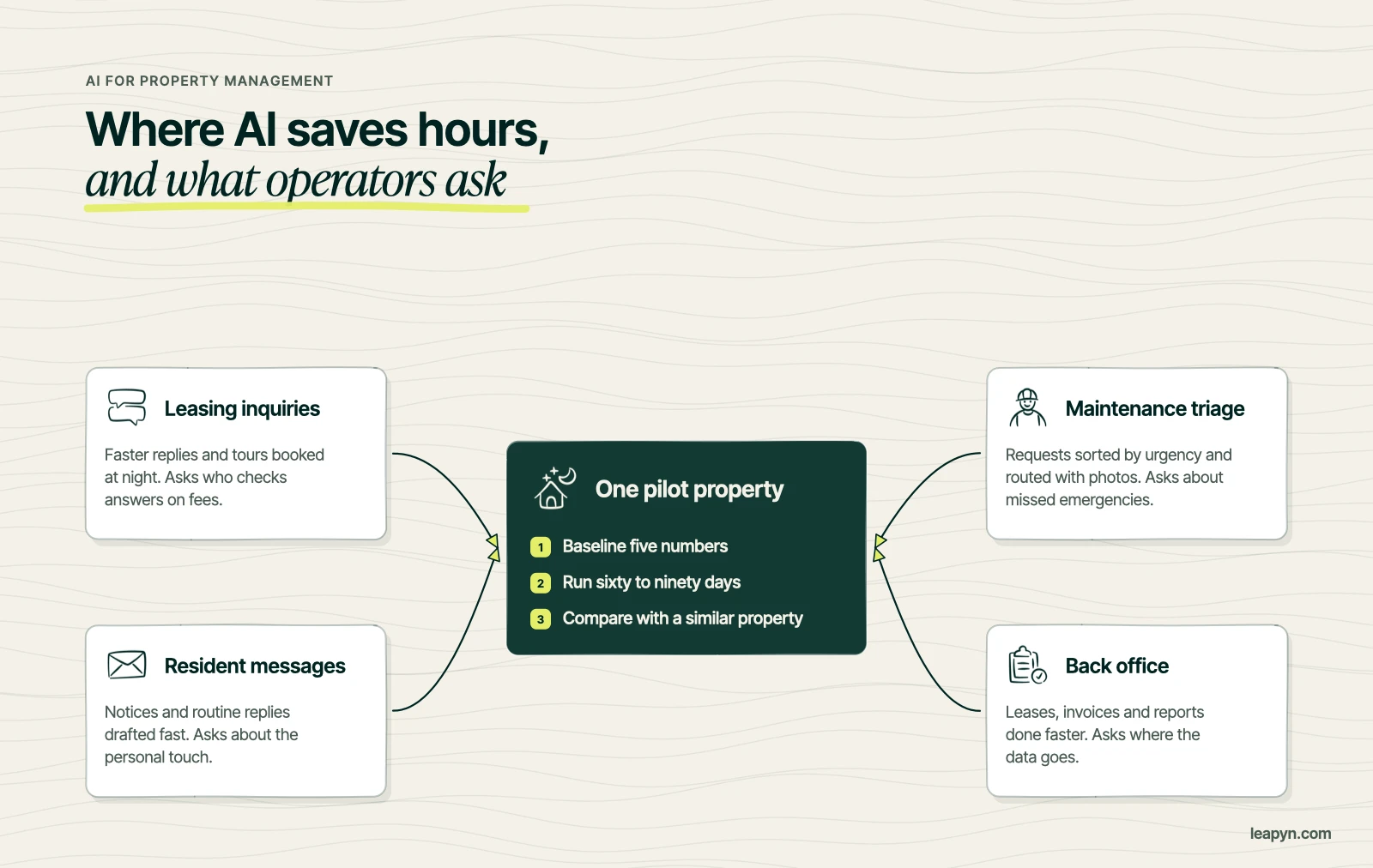
Where AI for property management saves time, leasing inquiries, maintenance triage, resident communication and back office work, with what operators ask about each
  • Leasing inquiries. AI leasing assistants answer questions, qualify prospects and book tours at any hour. Response time is one of the clearest drivers of leasing, so this is the use case operators understand fastest.
  • Maintenance triage. AI can sort requests by urgency, ask residents for photos and route work to the right vendor, which keeps technicians on urgent jobs instead of phone tag.
  • Resident communication. Drafting notices, answering routine questions and summarizing long threads saves staff time without taking the human out of sensitive conversations.
  • Back office work. Lease abstraction, invoice processing and reporting are dull, error-prone and perfect for automation, and they are often where the hours hide.

Trade You.

Your email for great content delivered to your inbox. Regularly. Unless we forget. Or get busy. But we'll try.

Thank you! Your submission has been received!
Oops! Something went wrong while submitting the form.

What operators do not trust yet

Operators worry about three things. They worry about residents getting wrong answers about rent, fees or fair housing topics, because those mistakes carry legal risk. They worry about losing the personal touch that keeps residents renewing. And they worry about pricing tools, which have drawn regulatory attention, including a 2024 Justice Department lawsuit over algorithmic rent pricing.

Any AI product sold to property managers has to answer those worries before it talks about features.

Is AI going to take over property management?

AI takes over tasks rather than the job. Property management still runs on judgment, relationships with owners and residents, vendor management and handling the situations no script covers. The teams that use AI well spend less time on repetitive work and more on the parts of the job that keep buildings full and owners happy.

How to measure AI for property management

Operators trust numbers they already track. Before a pilot starts, agree on a baseline for four or five of them.

  • Average response time to leasing leads
  • Tours booked per week
  • Work orders closed per technician
  • Hours spent on resident messages
  • Days to close the books each month

Measure the same numbers after sixty or ninety days on the pilot property and compare them with a similar property that did not get the tool. That simple before-and-after is the most persuasive sales asset an AI vendor can own, and it becomes the case study for the next ten deals.

Questions property managers ask before buying AI

Expect the same questions in almost every deal, and answer them on your website before the demo.

  • Who reviews what the AI says to residents?
  • What happens when it does not know the answer?
  • Where does our data go, and is it used to train anything?
  • How long does setup take, and who on our team has to do it?
  • What does it cost per unit or per property, and what happens if we stop?

Vendors who publish clear answers to these questions shorten sales cycles, because the operator's internal skeptic can read them without booking a call. They also give AI answer engines the plain facts they need to recommend you.

What a good AI pilot looks like at one property

Take a two-hundred-unit community where the leasing office answers every inquiry by hand. In a sixty-day pilot, an AI leasing assistant handles first replies after hours and on weekends, books tours into the team's calendar and hands any question about fees, deposits or fair housing to a person. The community manager reviews a sample of conversations each week and flags anything that sounded wrong. At the end, the operator compares response time and tours booked with the same months at a similar property nearby.

That structure answers most of the worries in one move. Residents get faster replies, sensitive topics stay with people and the operator judges the result with numbers they already track. AI for property management sells best when the pilot feels like a careful experiment instead of a leap, and a pilot designed this way is the easiest path from one property to a whole portfolio.

How to sell an AI feature to a skeptical operator

  1. Lead with the hours, then the risk controls. Show exactly which tasks the AI handles and how many staff hours that frees, then show the guardrails, such as human review for sensitive topics and clear escalation.
  2. Offer a pilot on one property. Let the operator see it work with their residents and their data before committing a portfolio.
  3. Use their vocabulary. Good AI for property management is described in operator terms. Talk about response time, tours booked, work orders closed and renewals rather than models and tokens.
  4. Bring a peer. A named operator of similar size who will take a reference call is worth more than any product video.

Property managers are also marketers in their own right, which we covered in property management marketing that fills units. And for where AI sits in the wider market, see our take on real estate technology trends. If you are selling AI to operators and want the campaign built around proof, that is the work we do as a PropTech marketing agency.


“

The first call felt like talking to someone who already understood our business. We didn’t have to explain the basics. They showed up with questions that mattered.

James L.

Director of Growth, HR tech

Client

FAQ

Frequently asked questions

How is AI used in property management?

+

AI answers leasing inquiries and books tours, triages maintenance requests, drafts resident communication and automates back office work such as lease abstraction and invoice processing.

What is the best AI for property management?

+

The best AI tool depends on where your team loses the most hours. Leasing assistants suit high inquiry volume, maintenance triage suits large portfolios and document automation suits lean back offices. Start with a pilot on one property.

Is AI going to take over property management?

+

AI takes over repetitive tasks rather than the job, while judgment, owner and resident relationships, vendor management and unusual situations still need people.

What are the risks of AI in property management?

+

Wrong answers about rent, fees or fair housing topics, loss of the personal touch residents value and regulatory scrutiny of pricing algorithms are the main risks operators weigh.

How do you market AI software to property managers?

+

Lead with the hours saved and the guardrails, offer a pilot on one property, use operator vocabulary such as response time and renewals, and provide a named reference from a similar operator.

Leapyn frog mark for the Leapyn team, authors of the B2B marketing blog

Written by

The Leapyn team

Senior marketing team

Senior marketers who run strategy, creative and demand gen for B2B companies. We write about what’s working for our clients right now.

More from this author →

If you like us here, you'll love us on LinkedIn.

Stay updated

Keep reading

Related articles