Real estate technology trends, sorted by who will pay for them
Most trend lists read like wishlists, so this one sorts real estate technology by whether anyone has budget for it yet.
Marketing strategy
Real estate
The Leapyn team
6 min read
No items found.
In this post
toc
Every January a new list of real estate technology trends arrives in an operator's inbox, and every January the same operator approves a budget that looks a lot like last year's. The trends are rarely wrong. They describe what is possible, while the budget describes what someone is willing to defend in a meeting with owners. If you sell PropTech, the second list is the one that pays.
Most lists of real estate technology trends read like a wishlist. Everything will change the industry, everything is coming next year and nothing has a price tag. If you sell PropTech, the more useful question is which trends a buyer will put in a budget, because that decides what you can sell this year and how you should talk about it.
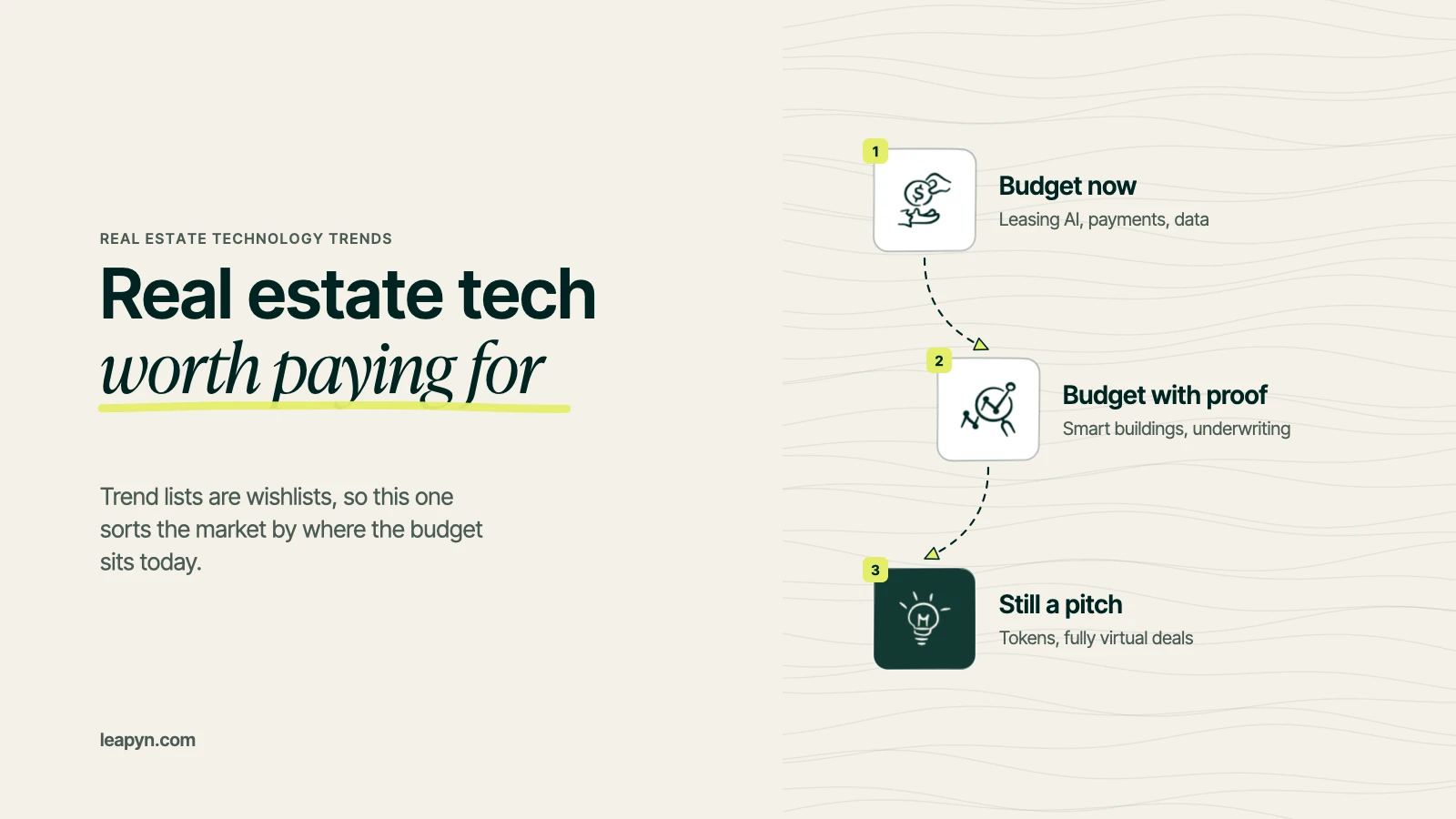
So we sorted the current real estate technology trends into three groups. Budget now, budget once there is proof, and still a pitch.
Trends with budget now
AI for leasing and resident communication. Answering inquiries in minutes, scheduling tours and handling routine resident questions saves operators staff hours they can measure, which is why it moved from pilot to line item so quickly.
Digital transactions. E-signature, online applications and transaction management are now expected rather than impressive. Buyers pay for them because the alternative is losing deals to firms that already have them.
Data and portfolio analytics. Investors and asset managers pay for clean data they can underwrite with. Anything that turns scattered spreadsheets into a reliable view of a portfolio has an easy business case.
Payments. Online rent collection and payment tools reduce late payments and admin time, so they pay for themselves in a way finance teams understand.
Trade You.
Your email for great content delivered to your inbox. Regularly. Unless we forget. Or get busy. But we'll try.
Thank you! Your submission has been received!
Oops! Something went wrong while submitting the form.
Trends with budget once there is proof
Smart building and energy tech. Sensors, energy monitoring and predictive maintenance can cut operating costs, and in some cities emissions rules add pressure. Owners buy once a building like theirs shows the savings.
AI in underwriting and valuation. Faster analysis is attractive, but investors want to see the model hold up on deals they understand before they rely on it.
Tenant experience apps. Landlords like the idea of happier residents and renewals, but they buy when renewal and satisfaction numbers move, not when the app looks good in a demo.
Construction technology. Developers adopt tools that keep projects on schedule once a peer has shown the savings on a comparable project.
Trends that are still mostly a pitch
Tokenized property ownership. Plenty of conferences, very few buyers with budget, and regulatory questions still open.
The fully virtual transaction. Virtual tours are useful and here to stay, but most buyers and tenants still want to walk the space before they sign.
Anything sold as "the operating system for real estate". Buyers have heard this promise too many times. Narrow tools that solve one painful job keep beating broad platforms that promise to solve all of them.
Real estate technology trends by buyer
The same trend looks very different depending on who signs the check, so it helps to read the market one buyer at a time.
Agents and teams buy tools that win listings and save evenings. CRMs with built-in follow-up, AI that drafts listing copy and social posts, and showing tools that cut back-and-forth all sell well, mostly on monthly plans an agent can cancel.
Brokerages buy to recruit and keep agents. Transaction management, compliance, back office and agent-facing apps are bought as a package, and the decision usually sits with a broker or operations lead who wants fewer tools rather than more.
Property managers and operators buy staff hours. Leasing automation, maintenance software, resident communication and payments win when the savings show up in payroll or occupancy.
Investors and asset managers buy confidence. Data platforms, underwriting tools and reporting that a limited partner can trust have the longest sales cycles and the largest contracts.
Developers and builders buy schedule. Anything that shortens approvals, keeps construction on time or speeds up pre-leasing has a direct line to the project budget.
How a trend moves from conference stage to budget line
Most real estate technology follows the same path. It appears first on a conference stage, presented by a founder and an early adopter. A year or two later a few operators run pilots, usually at one property and usually paid for out of an innovation or operations line instead of the main budget. The trend reaches the main budget only when someone outside the pilot can point to a number they already track, such as days vacant, maintenance cost per unit or hours spent closing the books, and show that it moved.
Smart building sensors, AI leasing assistants and resident apps all sit somewhere on that path, and the ones furthest along tend to be tied to a number the operator already reports. For a PropTech company, that means your marketing should name the metric your trend moves and the line of the budget it belongs in. Once a buyer can picture the line item, the trend has a chance of becoming a purchase.
How to tell a trend from a fad
Before you build a campaign around any real estate technology trend, ask four questions.
Is there a named buyer who owns the problem?
Does the trend replace a cost the buyer already pays, such as staff time, vacancy or software they would cancel?
Can a customer show a result within one leasing season or one deal cycle?
Would the buyer still want it if the word AI were taken off the box?
A trend that passes all four is ready for your marketing budget. A trend that fails two or more belongs in your roadmap deck for now.
What this means if you sell PropTech
If your product sits in the "budget now" group, compete on proof and speed of setup, because buyers are already shopping. If it sits in the "budget with proof" group, your marketing has one job, which is to make a credible result easy to find and easy to repeat. If it sits in the "still a pitch" group, sell the narrow, painful problem it solves today and save the vision for investor decks.
The first call felt like talking to someone who already understood our business. We didn’t have to explain the basics. They showed up with questions that mattered.
James L.
Director of Growth, HR tech
Client
FAQ
Frequently asked questions
What are the biggest real estate technology trends?
+
AI for leasing and resident communication, digital transactions, data and portfolio analytics, online payments, smart building and energy technology, AI in underwriting and construction technology are the trends with the most buyer attention.
What is the future of PropTech?
+
PropTech is moving toward narrower tools that solve one painful job well, more AI built into everyday workflows and more connected data across leasing, operations and investment, with buyers paying for proven savings.
What technologies are used in real estate today?
+
Listing portals, CRMs, transaction management, e-signature, property management software, online payments, virtual tours, data analytics platforms, AI leasing assistants and smart building sensors.
Which real estate technology trends are overhyped?
+
Tokenized property ownership, the fully virtual transaction and broad platforms promising to be the operating system for real estate attract attention but little budget so far.
How should PropTech companies market to trends?
+
Sell the specific problem the trend solves today, back it with named proof from a similar customer and keep the long-term vision for investors rather than buyers.
Written by
The Leapyn team
Senior marketing team
Senior marketers who run strategy, creative and demand gen for B2B companies. We write about what’s working for our clients right now.