Strategy, creative and execution, all in house.

See pricing →

Every channel, one team, weekly results.

See pricing →

Work that ships weekly and looks like you.

See pricing →

Every channel, one team, weekly results.

See pricing →

Different buildings. Same obsession with leases.

See pricing →

Different buildings. Same obsession with leases.

Pricing and packages →

Different products. Same obsession with pipeline.

All SaaS and technology work →

Different trades. Same obsession with booked jobs.

All home services work →

Different practices. Same obsession with signed clients.

All professional services work →
Thank you! Your submission has been received!
Oops! Something went wrong while submitting the form.

Content

Content marketing for HR tech that gets forwarded to the CFO

How HR software companies write content that practitioners use and champions forward to finance, and how to tell whether it's working.

Content marketing for HR tech that gets forwarded to the CFO

In this post

  1. toc

The email has one line of text above a link. An HR director has read a vendor's article on what broken shift schedules cost in overtime, and she forwards it to her CFO with a note saying this is the problem she keeps describing.

He reads it between meetings, fills in the worksheet at the bottom with his own numbers and replies asking who wrote it.

That forwarded email is content marketing for HR tech doing its job, and the vendor gets a meeting it never had to chase. Its analytics logged one visit, a short read and no form fill, which by most dashboards counts as a failure.

The reader is rarely the buyer, and the win rarely shows up in the report. This post is about writing for the second reader, the one who never visits your site.

Content marketing for HR tech, a vendor article forwarded from an HR director to the CFO with a worksheet attached

What makes content marketing for HR tech work?

Content marketing for HR tech works when it helps an HR practitioner do the job and gives that person something to forward to finance and IT. Practical pieces such as templates, compliance explainers and cost worksheets earn trust, and champion material such as business cases and security summaries turns that trust into meetings with the whole buying committee.

Everything else, from the trend post to the product announcement, is optional until those two jobs are covered.

Nobody reads vendor blogs for fun

HR people read to get through the week. There were 939,700 HR specialist jobs in the US in 2025, according to the Bureau of Labor Statistics, and most of those people go looking for a policy template, a compliance update or a benchmark to show their manager, rather than for software.

That gives an HR tech blog its opening. The vendor that publishes the most useful leave policy explainer in its category is the one the practitioner already trusts when the software question finally comes up.

Each type of content has a different reader and a different job, and most HR software companies publish only the bottom row.

Content typeWho reads itStageWhat it earns
Policy templates and checklistsHR generalists and managersEarly, long before a purchaseRepeat visits, email signups and a name they remember
Compliance and regulation explainersHR leaders and legalEarly and middleTrust, search traffic and citations in AI answers
Benchmarks and original survey dataHR leaders, analysts and the trade pressMiddleLinks, press mentions and a reason to talk to sales
Cost worksheets and business casesThe champion and the CFOMiddle to lateThe forward to finance, and often the meeting
Security, integration and implementation guidesIT, security and procurementLateFewer deals stalled in review
Product pages and feature announcementsBuyers already evaluating youLateClarity for people who have mostly decided

Product pages matter, though they only convince people who have already decided to look. Everything above them in the table decides whether anyone looks.

The top rows also travel further than they used to. When an HR leader asks an AI assistant how to write a remote work policy, the answer leans on whoever explained it most clearly, and a vendor cited there has introduced itself without buying a single ad.

What should an HR software company publish first?

Build in the order that reaches the committee fastest. This sequence assumes a small team publishing once or twice a week, and it front-loads the pieces sales can use the day they go live.

  1. The champion kit. A one-page business case, a cost worksheet and a security summary your buyer can forward without editing.
  2. Answers to sales questions. Every question prospects ask twice becomes an article, starting with pricing, implementation time and integrations.
  3. Practitioner tools. Templates and checklists for the HR tasks your product touches, such as onboarding, leave or scheduling.
  4. Compliance explainers. Plain-language posts on the regulation changes your buyers worry about, published before the deadline rather than after it.
  5. Original data. A yearly survey or an anonymized look at your own product data, which gives the press and AI answers something to cite.

That order is a sound HR tech content strategy for the first two quarters. Search mechanics and AI citations get their own treatment in SEO for HR tech, and original data happens to be the best thing you can hand a reporter, which HR tech PR covers in detail.

The champion kit comes first because it does the selling nobody on your team is in the room for. Each piece answers one reviewer, so the champion never has to translate.

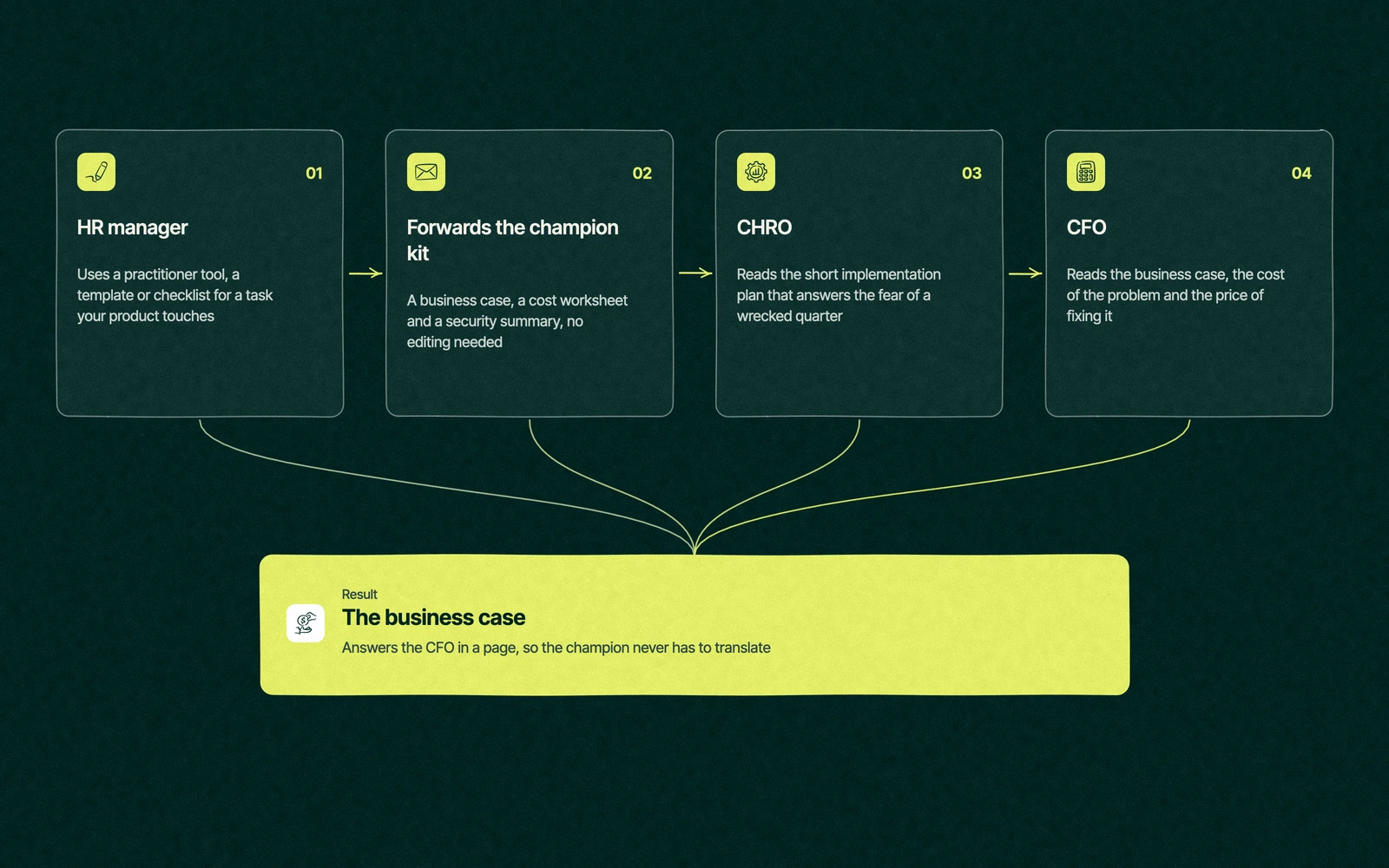
The business case answers the CFO in a page, with the cost of the current problem, the price of fixing it and the payback period in months. The security summary answers IT with where data is stored, who can reach it and which certifications you hold. A short implementation plan answers the fear everyone shares and few admit, which is that switching systems will wreck a quarter.

Write these with sales in the room. Reps know which objections end deals, and the kit should answer those before anyone raises them.

HR software content marketing flow, a practitioner article passed from HR manager to CHRO to CFO with the business case as the outcome

Trade You.

Your email for great content delivered to your inbox. Regularly. Unless we forget. Or get busy. But we'll try.

Thank you! Your submission has been received!
Oops! Something went wrong while submitting the form.

A year of trend posts and one worksheet

Take an HR software company that published a trend post every week for a year, on AI in HR, the future of work and what every CHRO should know about both. The traffic chart climbed nicely, and sales could not name a single deal it had touched.

The company was in good company. The Content Marketing Institute's B2B research for 2026 found 9 in 10 B2B marketers already use AI to produce content, and fewer than 4 in 10 say it improved performance. HR buyers had read every one of those trend posts already, under a different logo.

The new head of content cut the weekly cadence in half and spent the saved hours on one piece, a turnover cost worksheet built with the company's own customer success team. It took a month to make and looked plain next to the trend posts.

Within a quarter, sales reps were attaching it to follow-up emails, and prospects were sending it back filled in. The worksheet drew fewer visits than the average trend post and appeared in more deals than all of them together.

Volume impresses the dashboard. A buyer is impressed by the piece that saves them an afternoon.

Copy that sounds like HR wrote it

HR people write policies for a living, so they notice copy that sounds like nobody in HR has read it. A headline promising to reinvent your people strategy tells them the writer has never run open enrollment.

Good HR tech copywriting uses the words HR uses, names the task the product removes and counts the hours. Three in four AI users in HR measure its value by time saved, according to the latest HR Systems Survey by Sapient Insights Group, so time is the unit your buyer already reports in.

  • Write the task, such as approving shift swaps from a phone, instead of the abstract benefit.
  • Give hours saved only when a customer has confirmed them, and say whose numbers they are.
  • Name the compliance risk precisely, because HR readers can tell a lawyer's sentence from a marketer's guess.
  • Keep AI out of the headline unless the AI is the reason to buy.
  • Write the CFO paragraph in money and the IT paragraph in data flows.

Run a simple test on any headline. If a competitor could publish it unchanged, it says nothing about you, and an HR director will spot that before the subhead.

Compare a headline about modernizing workforce management with one that says managers stop rebuilding the schedule every time somebody calls in sick. The second one names a Tuesday morning HR people have lived through, and that's the one they forward.

An HR software copywriter who has worked in an HR seat starts ahead. A good writer who interviews your customers every month catches up quickly, and usually writes the sharper argument.

How often should an HR tech team publish?

Publish as often as you can keep the quality up, which for most small teams means one strong piece a week or two a month. A steady calendar beats bursts, because search and AI answers reward a site that keeps covering the same topics well.

Plan around the HR calendar too. Compliance pieces go out before deadlines, business case content lands while next year's budget is being drafted, and nothing important goes out during open enrollment.

Treat the blog as a library rather than a news feed. Updating last year's compliance explainer when a rule changes often does more than a new post, since the old one already has links and readers who trust it.

Then make every piece easy to forward, since forwarding is how it reaches the committee. That means a printable version, a two-sentence summary at the top the champion can paste into an email, and numbers a CFO can check.

How do you measure HR software content marketing in a long sales cycle?

A sale that runs for months makes last-click attribution useless for content, because the article that started the deal was read long before the form fill. Measure reach into accounts and use by sales instead.

The usual metricWhy it misleads in HR techTrack this instead
PageviewsA forwarded PDF or a pasted summary never registersTarget accounts with repeat visits
Gated content form fillsRewards templates that attract students and job seekersQualified demos where content was viewed before the meeting
Last-click attributionCredits the ad or branded search at the very endA "how did you hear about us" field on the demo form, read monthly
Time on pageA long read and a forgotten tab look the sameContent that sales attaches to emails and prospects open
Social likesHR leaders read quietly and share privatelyReplies, forwards and mentions on sales calls

Most of that tracking lives in the CRM. The HubSpot setup for HR tech post explains how to record content views by account, and HR tech lead generation covers the handoff once a piece starts producing demos.

The self-reported field deserves the most attention. Buyers will often write that a colleague sent them an article or that they found you in an AI answer, and neither shows up anywhere else in your reporting.

Content marketing for HR software is slow to prove and quick to cancel, which is why so many companies stop a quarter before it would have paid.

Who writes it, and where we come in

Whoever writes it, the method matters more than the résumé. The best HR software content comes from a monthly interview with someone who does the work, such as a customer's payroll lead, your implementation manager or a support rep who hears the same complaint every week.

One good interview feeds a practitioner article, a section of the champion kit and a handful of sales emails. Writers who skip it end up summarizing other vendors' blogs, which is how a whole category starts to sound like one company.

You can staff content with an in-house writer, a freelancer with HR experience or an HR tech content marketing agency. In-house writers learn the product deeply and agencies bring range across search, copy and design, so many companies pair one internal subject expert with outside help.

HR software is one of Leapyn's focus markets, and our content is written by senior marketers who deliver every week. Our content development and copywriting services are priced à la carte per month or within a retainer, with fixed prices quoted in writing.

The closest proof is another vertical software company. Organic search for Conduit Tech, an HVAC software company that ServiceTitan later acquired, grew 1,389% year over year.

More on how we work with HR software teams sits on our HR software marketing agency page, and the full guide to marketing HR software maps every other channel.

Forward us the article you wish you'd written. We'll plan the calendar that earns your next forward. Our free strategy session runs thirty minutes, and you'll walk out with the first three pieces worth writing.


“

The first call felt like talking to someone who already understood our business. We didn’t have to explain the basics. They showed up with questions that mattered.

James L.

Director of Growth, HR tech

Client

FAQ

Frequently asked questions

What is content marketing for HR tech?

+

It means publishing material that helps HR practitioners do their jobs and helps them sell your product inside their company. That covers templates, compliance explainers, benchmarks, cost worksheets and security guides, written for HR, finance and IT. The goal is trust before the first sales call and a champion who can make your case in meetings you never attend.

How often should an HR tech company publish blog posts?

+

One strong piece a week suits most small teams, and two a month is fine if each one is useful. Consistency matters more than volume, because search engines and AI answers reward steady coverage of a topic. Time compliance pieces before deadlines and business case content for budget season, and keep big launches away from open enrollment.

Should HR tech companies hire writers with HR experience?

+

HR experience helps with vocabulary and credibility, though it isn't the only route. A skilled B2B writer who interviews customers, sales reps and your in-house HR experts every month can learn the material within a quarter. The strongest setup pairs one subject expert who reviews every piece with a writer who knows search, structure and argument.

How do you measure content marketing with a long sales cycle?

+

Track whether content reaches target accounts and shows up in deals, rather than counting pageviews. Useful signals include repeat visits from target companies, content viewed before qualified demos, pieces sales attaches to emails and answers to a self-reported attribution question on the demo form. Review them each quarter, since a single month is too short to judge.

Which agency writes content for HR software companies?

+

Ask any candidate for HR or B2B software samples, how they interview subject experts and how they measure content across a long sale. Leapyn is one B2B agency that covers HR tech content, and freelancers with HR backgrounds are also worth a look. Strong answers mention champions, CFO material and sales use, with traffic as a side note.

Leapyn frog mark for the Leapyn team, authors of the B2B marketing blog

Written by

The Leapyn team

Senior marketers who run strategy, creative and demand gen for B2B companies. We write about what’s working for our clients right now.

More from this author →

If you like us here, you'll love us on LinkedIn.

Stay updated

Keep reading

Related articles