Services
StrategyPlans, positioning, leadership›GrowthAds, search, email, social›Creative and webBrand, websites, content, video›OperationsHubSpot and revenue operations›Property marketingRendering to signed lease›Creative and web
All services →Strategy, creative and execution, all in house.
See pricing →Every channel, one team, weekly results.
See pricing →Work that ships weekly and looks like you.
See pricing →Every channel, one team, weekly results.
See pricing →Different buildings. Same obsession with leases.
See pricing →Industries
Real EstateIndustrial, commercial, residential›SaaS and technologyHR tech, EdTech, FinTech, PropTech›Home servicesHVAC, roofing, plumbing, electrical›Professional servicesLaw, accounting, advisors, recruiting›VC and private equityPortfolio and fund marketing›Real estate marketing
Overview →Services for every building
SaaS and technology marketing
Overview →Who we work with
What we run for them
Home services marketing
Who we work with
What we run for them
Professional services marketing
Overview →Who we work with
What we run for them
Different buildings. Same obsession with leases.
Pricing and packages →Different products. Same obsession with pipeline.
All SaaS and technology work →Different trades. Same obsession with booked jobs.
All home services work →Different practices. Same obsession with signed clients.
All professional services work →Company
About usThe team behind LeapynHow we workWeekly delivery, one teamWhy LeapynWhat we mean by differentCase studiesResults with the numbersContactSay helloMarketing that earns its keep.
Book a call →Learn what is working before you spend on it.
All insights →Services
Marketing strategy
Growth marketing
Paid advertising
Creative and web
Operations
Property marketing
Industries
Real estate marketing
Services−Company
Marketing strategy
What an HR software company should spend on marketing at each stage, using public benchmarks and the math a board will check.
In this post
The board deck is finished except for one cell. It sits in next year's plan, on the row labelled marketing, and the CEO of a growing HR software company has typed a number into it and deleted it more times than she plans to admit when the board meets on Thursday.
Last year's figure was whatever was left after payroll. The head of sales wants it doubled, the CFO wants it defended, and a search for an HR tech marketing budget benchmark returns agency pages selling retainers and blog posts quoting each other.
This guide fills the cell with numbers you can check. It uses public benchmarks with their years attached, explains what pushes your number above or below them and shows the math that survives a board member asking why.

Most private B2B software companies spend about 8% of annual recurring revenue on marketing and 15% on sales, according to SaaS Capital's 2026 survey of more than 1,000 companies. HR tech companies that are raising money and teaching buyers a new category usually sit above that median, while profitable companies growing steadily sit near or below it.
Treat 8% as the middle of the road rather than a goal. It's the most useful public B2B SaaS marketing budget benchmark we've found, because the sample is private companies your size. The SaaS Capital 2026 spending benchmarks also show selling costs rising from 13% to 15% of ARR in a year, while the marketing median held still.
You'll also see a second number quoted almost everywhere. Gartner's 2025 CMO Spend Survey put the average marketing budget at 7.7% of company revenue, flat on 2024, but its roughly 400 respondents mostly run companies with more than $1 billion in revenue. That makes it a useful sanity check for a mature HR suite and a poor guide for a Series A payroll startup.
Benchmarks give you a median. Your company is not a median, so four things decide which side of it you land on.
The committee is also getting more senior. In Sapient Insights Group's 2026 to 2027 HR Systems Survey, 31% of HR system selections were led by executives, against 25% in 2024, and executives cost more to reach than HR coordinators do.
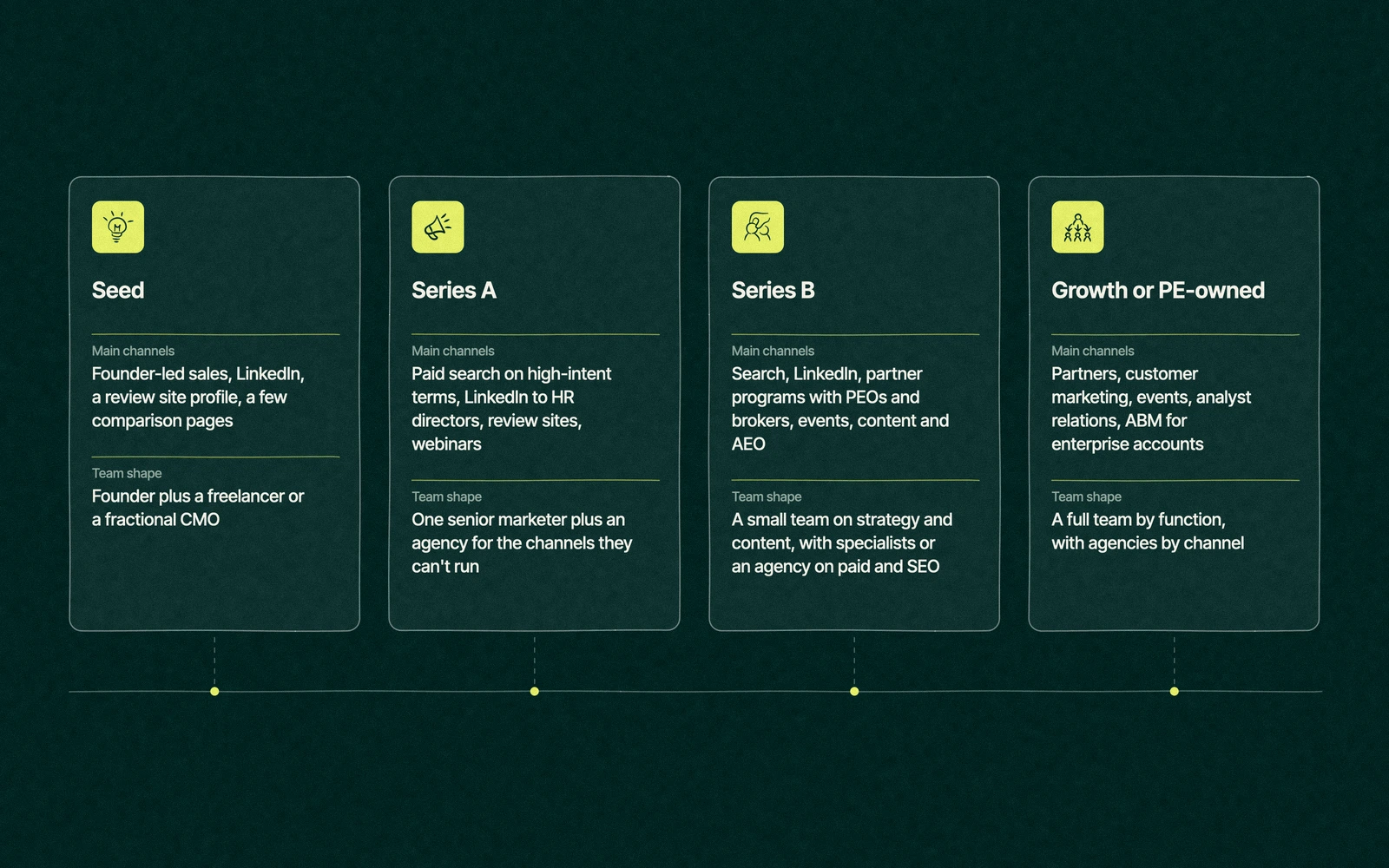
No public survey we could verify breaks marketing spend out for HR software by funding round. So the table anchors each stage to the SaaS Capital median and tells you which way to lean and why, without borrowing percentages nobody can source.

| Stage (rough ARR) | Marketing as a share of revenue | Main channels | Team shape |
|---|---|---|---|
| Seed, under $1M | Too early for a percentage to mean much. Set a fixed amount you can afford for two quarters of tests | Founder-led sales, LinkedIn, a review site profile, a few comparison pages | Founder plus a freelancer or a fractional CMO |
| Series A, $1M to $5M | Start at the median. SaaS Capital's $3M to $5M example spends 8% of ARR on marketing and 12% on selling | Paid search on high-intent terms, LinkedIn to HR directors, review sites, webinars | One senior marketer plus an agency for the channels they can't run |
| Series B, $5M to $20M | Above the median if the board has set an aggressive target, since equity-backed companies spend about double | Search, LinkedIn, partner programs with PEOs and brokers, events, content and AEO | A small team owning strategy and content, with specialists or an agency on paid and SEO |
| Growth or PE-owned, $20M and up | Drifts toward the median or below as renewals, partners and brand carry more of the pipeline | Partners, customer marketing, events, analyst relations, ABM for enterprise accounts | A full team by function, with agencies by channel |
Most companies set their HR tech marketing budget once a year, and almost all of them set it too late to change anything in the first quarter. If the board meets in December, the January campaigns were funded in October, whether anyone wrote that down or not.
Your email for great content delivered to your inbox. Regularly. Unless we forget. Or get busy. But we'll try.
Once the total is set, the split decides whether an HR tech marketing budget works. HR buyers do their homework in a few predictable places, and each one has a price you can check before you commit.
| Channel | What it buys you | A cost signal you can check | When to fund it |
|---|---|---|---|
| Paid search | Buyers who are already comparing products | US cost per click on Semrush in November 2026 was $189.01 for "hr software demo", $153.29 for "hris comparison" and $47.40 for "hr software pricing" | From Series A, on the narrow terms that mean a buyer |
| Review sites | Shortlists, because HR leaders check G2 before they take a demo | Listing tiers and per-lead fees, priced by each site | As soon as you have a dozen happy customers willing to write |
| Reach to HR directors and executives by title and company size | Your own cost per qualified demo after a test month | Once you know which titles sign | |
| Partners | Deals from PEOs, benefits brokers and payroll marketplaces | Referral fees and co-marketing funds agreed per partner | Series B, when someone can own the relationships |
| Events | Face time with buyers at the big HR conferences | Booth, travel and sponsorship quotes, plus the pipeline the last show produced | Once you can staff a booth and follow up within a week |
| Content, SEO and AEO | Answers that rank on Google and get quoted by ChatGPT | Writer and specialist hours, and the months before traffic compounds | Early, because it's the slowest channel to pay back |
Those CPCs are worth a second look. One click on "hr software demo" costs about what a decent conference lunch does, which is fine if the clicker is a VP of People and painful if it's a student writing a thesis on payroll.
Our guide to HR tech advertising goes channel by channel, and the Google Ads for HR software post covers how to keep search budgets on buyer terms.
We couldn't find a public HR tech customer acquisition cost benchmark with a method we'd stand behind, so we won't print one. The number that matters is your own, measured the same way every quarter and compared with what a customer is worth.
Add every sales and marketing cost for the period, including salaries, agencies, ad spend and software, then divide by the new customers you won in it. Then ask how many months of gross margin from one customer it takes to earn that cost back.
A tool sold per employee to small businesses needs a short payback because those customers churn sooner. A mid-market HRIS with multi-year contracts can afford a longer one, which is why its marketing can spend more per deal and still look sensible.
Watch the trend more than the level. A CAC that rises every quarter while win rates fall usually means marketing is paying for the wrong audience, and no benchmark would have told you that.
Imagine an HR tech company that books a big booth at the year's largest HR conference. It's the obvious move. The competitors will be there, the founders love the energy and the sponsorship package comes with a speaking slot.
The booth costs most of the annual program by the time travel, swag and the after-party are counted. The team comes home with a fat stack of badge scans, and sales starts calling.
Most of the scans are people who wanted the tote bag. A handful are buyers, and their deals take two or three quarters to close because they arrived with no budget and no committee yet.
By the summer board meeting the paid search test has been cut to pay for the trip, the content plan is on hold and the pipeline report shows a conference that may pay off by Christmas. Nobody made a bad decision, exactly. They made one big one with no reserve behind it.
The fix is boring and works. Fund the always-on channels first, cap any single bet so a miss can't stall the year and hold back part of the budget to double down on whatever the first quarter proves.
Boards don't argue with benchmarks for long. They argue with plans that don't connect to revenue, so build the number backwards from the target they've already approved.
Then compare your total with the SaaS Capital median for your stage. If you're far above it, the board will ask why, and the answer should be a growth target or a category that needs explaining, never "that's what last year cost."
Report the same few HR tech marketing metrics every month after that, namely qualified demos, cost per qualified demo, pipeline created, win rate and CAC payback. A board that sees those five lines each month stops treating marketing as the cell you fill in last.
Most HR tech companies spend part of the budget on people they don't employ. An agency runs channels, a fractional CMO sets direction and a freelancer fills gaps, and each one prices differently.
Our pricing page shows all three of our models. A project fee pays for a single scoped job, à la carte pricing covers one service a month, and retainers start at $150 an hour on a six-month commitment with performance outs.
Senior marketers do the work, delivery is weekly and every price is fixed and quoted in writing before anything starts. Our marketing strategy work usually starts with the backwards math above, because a budget built on it is easier to defend than one built on a hunch.
Our nearest proof sits in another niche software market. Conduit Tech, an HVAC software company later acquired by ServiceTitan, saw a 4.2x return on its Google Ads spend and a 94% lower cost per MQL.
If you're weighing leadership before channels, read fractional CMO for HR tech, and if you're comparing outside teams, the HR tech agency buyer's guide has the first-call questions. Once the budget is approved, HubSpot for HR tech covers how to track where it went. You can see how we work with this market on our page for the marketing agency for HR tech companies.
Bring us last year's numbers. We'll build next year's budget with you before Thursday. Book a free 30-minute strategy session and leave with the backwards math done for your target.
“
The first call felt like talking to someone who already understood our business. We didn’t have to explain the basics. They showed up with questions that mattered.
James L.
Director of Growth, HR tech
Client
FAQ
SaaS Capital's 2026 survey of more than 1,000 private B2B companies puts the median at 8% of ARR on marketing and 15% on sales. Equity-backed companies spend about twice as much on marketing as bootstrapped ones, and faster-growing companies spend more than slower ones. Use the median as a starting point, then adjust for your growth target and how much your buyer needs educating.
No public survey isolates HR software, so start from the general SaaS figure of about 8% of ARR and move from there. Venture-backed HR tech companies chasing aggressive targets, or selling a category buyers don't understand yet, usually spend more. Profitable companies with strong partner and renewal pipelines often spend less, because those sources cost less per deal than paid channels.
Add up every sales and marketing cost for a period, including salaries, agencies, ad spend and software, and divide by the new customers won in that period. Then work out how many months of gross margin one customer needs to repay that cost. Track the trend each quarter, because a rising CAC with falling win rates points to the wrong audience.


Raise it when a channel is producing qualified demos at a cost per deal you can afford and has room to grow, or when the board sets a growth target the current budget can't reach. Don't raise it to rescue a channel that isn't converting. Fix the targeting or the offer first, then fund the version that works.
Agency fees come in three shapes, a project fee for a single scoped job, a fee per service each month and a retainer for a team running several channels. Leapyn, for example, quotes fixed prices in writing, with retainers from $150 an hour on a six-month commitment with performance outs. Whoever you hire, agree in writing which numbers count as success before signing.
Stay updated
Keep reading