The quarter the CRM filled up with recruiters
Picture an HR tech company that hired a capable generalist agency in the spring. The agency did what it does well. It launched LinkedIn ads aimed at anyone with HR in their job title and wrapped a free PTO policy template in a landing page.
By the second monthly report the lead count looked wonderful. Then sales started calling. Many of the leads were HR coordinators who wanted the template, a few were recruiters looking for their next job and a couple were students writing a paper on employee benefits.
Nobody did anything wrong by the agency's own scorecard. The scorecard counted leads, and HR tech deals close on something narrower, a director or VP at a company the right size with a reason to switch this year.
A specialist would have built the audience around company size and seniority, kept the template for nurture rather than acquisition and judged the quarter on demos with buyers who could sign. Same budget, same channel, very different quarter.
Ask any agency you meet how it would have run that campaign. The answer tells you more than its logo slide.
What should you ask an HR tech agency on the first call?
Bring these to every agency on your shortlist and write the answers down. Vague answers to the first three are usually enough to end the call politely.
- Who signs an HR software contract at a company our size, and who can veto it?
- Which HR tech or B2B software companies have you worked with, and can we speak to one of them?
- What would you do in the first ninety days, and what would you leave alone?
- How would you keep recruiters, students and job seekers out of our ad audiences?
- What will you report every month, and how do you count a qualified demo?
- How do you handle review sites and AI answers, since our buyers ask both before they ask us?
- Who exactly will work on our account, and will those people change after we sign?
- What does it cost, how is that priced and how do we leave if it isn't working?
Listen for how they answer the first question. A strong agency asks you follow-ups about pilots, security reviews and who your champion has to convince, while a weak one starts describing its own process.
Then score every agency on the same sheet, so the one with the best slides doesn't win by default. The weights are our suggestion, so move them to match what your company needs most.
| Criterion | What a 5 out of 5 sounds like | Suggested weight |
|---|
| Knows the HR buying committee | Describes your HR, finance and IT reviewers before you do | 25% |
| Named proof | Software case studies with client names, numbers and dates | 20% |
| Reports on qualified demos | Defines a qualified demo in writing and reports it monthly | 20% |
| Channel range | Covers search, paid, review sites, AI answers and events | 15% |
| Senior people on the account | Names the people who will do the work, and they're on the call | 10% |
| Pricing and exit terms | A written price and a contract you can leave if results don't come | 10% |
If you want a more general checklist that works for any industry, our guide on how to choose a marketing agency covers the basics.
Red flags in an HR tech agency proposal
Proposals are where good intentions turn into a contract, so read them slowly. These are the lines that should make you put the pen down.
- Guaranteed rankings or a guaranteed number of leads, which Google's own guidance on hiring an SEO warns about.
- Lead volume as the main goal, with no definition of a qualified demo.
- Ad targeting described as "HR professionals" with no seniority, company size or exclusions.
- Nothing for the finance or IT reviewer, such as security, integration or ROI content.
- A twelve-month lock-in with no performance out.
- Case studies without client names or numbers you can check, or a results page with more logos than sentences.
None of these makes an agency bad. Together they tell you the proposal was written for a generic software company, and yours isn't one.
What does HR software marketing cost with an agency?
Agencies price in three ways. A project fee covers one defined piece of work, such as a website or a positioning sprint, and a monthly fee per service covers one channel run well.
A retainer covers a team that runs several channels together, usually with a minimum term. It's the cheapest per hour and the hardest to leave, so it should come after you've seen the agency work.
That's why a scoped first project is the safest way to start with any agency on your list. Pick something with a visible result inside a quarter, such as a demo page rebuild, a LinkedIn audience test aimed at HR directors or a set of comparison pages for the review site crowd. You'll learn how the agency thinks, how fast it ships and whether its reports make sense to your CFO, all before you commit to a retainer.
Whatever the model, ask for the price in writing before any work starts and agree what a good quarter looks like in demos and pipeline. For reference, our own pricing page lists all three, with retainers from $150 an hour on a six-month commitment that includes performance outs.
The cheapest option on a proposal is rarely the cheapest once you count the months spent teaching an agency who your buyer is.
Where Leapyn fits
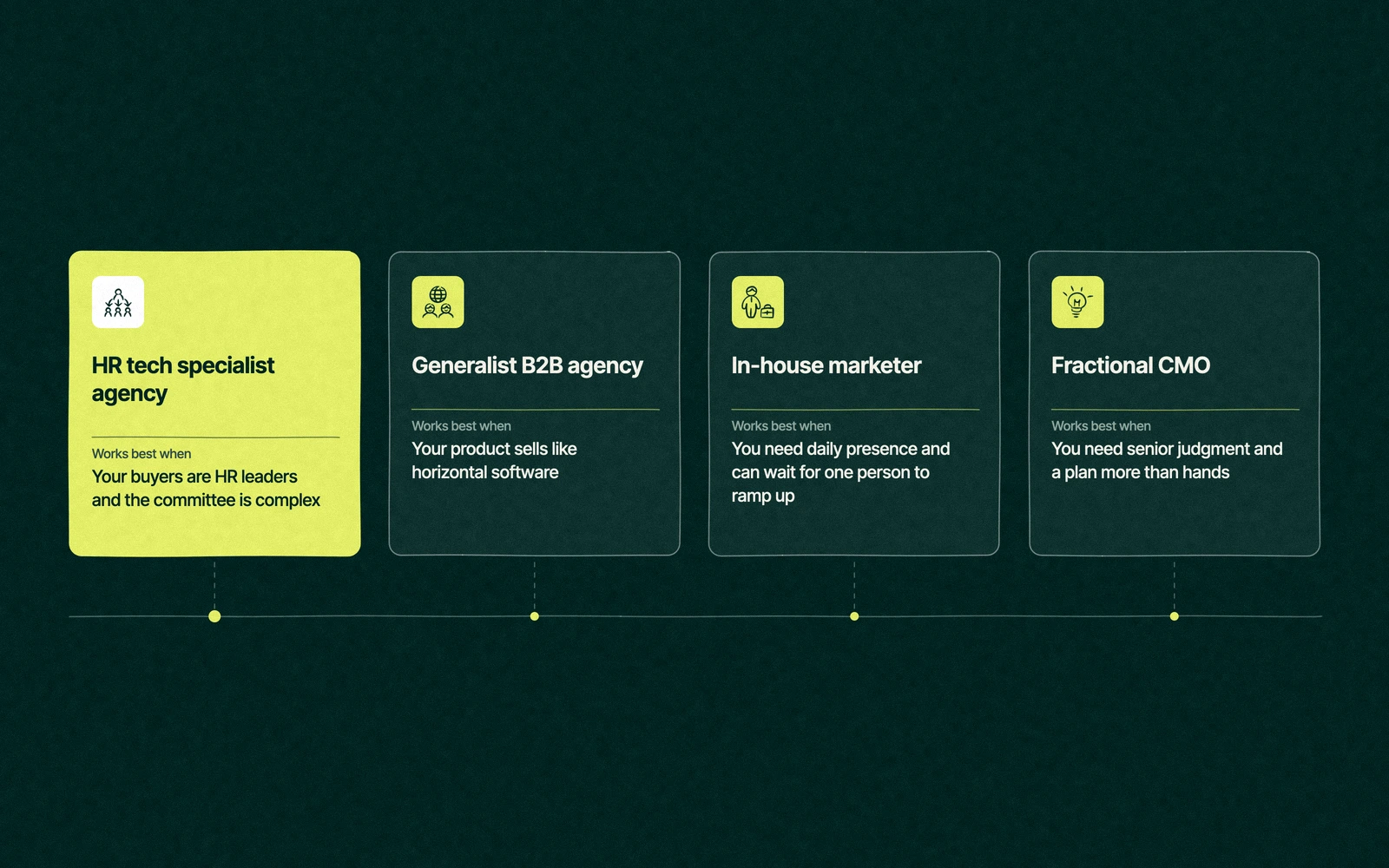
We're a B2B marketing agency, and HR tech is one of the industries we focus on. That puts us on some lists of the best HR tech marketing agencies and makes us one of the options on yours, so here are the plain facts you can check.
Senior marketers do the work, we deliver weekly, prices are fixed and quoted in writing, and we're a Certified HubSpot Solutions Partner, which matters when the CRM has to track a buying committee. We run lead generation, paid media, SEO and AEO, websites and HubSpot, and we can lead the whole program through a fractional CMO.
The closest proof we can show is vertical software. For Conduit Tech, HVAC software later acquired by ServiceTitan, marketing produced 338% pipeline growth from Meta Ads, a 4.2x return on Google Ads spend and a 94% lower cost per MQL.
You can read how we approach this market on our HR tech marketing agency page, and our guide to HR tech marketing covers the full program. If a PR firm or a single in-house hire would serve you better, we'll say so on the first call. Review sites matter for every option above, so our guide to software review sites is worth a read whoever you hire.
Send us your last three lost deals. We'll show you where the next three are hiding. Book a free strategy session and you'll leave with what we would do first, whether you hire us or not.