Strategy, creative and execution, all in house.

See pricing →

Every channel, one team, weekly results.

See pricing →

Work that ships weekly and looks like you.

See pricing →

Every channel, one team, weekly results.

See pricing →

Different buildings. Same obsession with leases.

See pricing →

Different buildings. Same obsession with leases.

Pricing and packages →

Different products. Same obsession with pipeline.

All SaaS and technology work →

Different trades. Same obsession with booked jobs.

All home services work →

Different practices. Same obsession with signed clients.

All professional services work →
Thank you! Your submission has been received!
Oops! Something went wrong while submitting the form.

Demand generation

Demand generation for HR tech when the buyer isn't shopping yet

How HR software companies get remembered by buyers who won't shop for a year, and how to tell when that memory turns into pipeline.

Demand generation for HR tech when the buyer isn't shopping yet

In this post

  1. toc

Halfway through a sandwich on a bench in a city plaza, the director of product marketing for a payroll software company takes a call from the sales VP. They lost the big mid-market deal, and the CHRO's reason fits in one sentence. They went with the vendor they had been hearing about for two years.

She puts the phone down and watches the pigeons. They ignore her completely and crowd around an older man at the next bench, who is there every day with a paper bag of seed.

Her team's demand generation for HR tech had been built for the month a buyer starts shopping. The rival had been showing up for the two years before that, and the pigeons had already worked out who to remember.

Demand generation for HR tech shown as a loop that gets an HR software company remembered before the buying window opens

What is demand generation for HR tech?

Demand generation for HR tech is the marketing that makes HR, finance and IT leaders know and trust your name before they need new software, then catches them when a contract ends or a problem forces a change. It pairs programs that build memory, such as content, events and peer proof, with programs that capture buyers once they start shopping.

Lead generation asks for a name today. Demand generation earns the call that comes next year.

Most of your market isn't buying this quarter

LinkedIn's B2B Institute puts it plainly on its 95-5 rule page, saying 95% of your potential buyers aren't ready to buy today. That's true across B2B, and it's sharper in HR software.

HR teams replace a core HRIS or payroll system about as often as they replace the office carpet, and with roughly the same enthusiasm. Contracts run for years, implementations hurt and no HR team wants to repeat one early.

So in any given month a handful of your target accounts are shopping and the rest are living with whatever they bought last time. The ones living with it are the ones you can still reach cheaply, because few competitors are bidding for their attention.

Buyers are also moving up the org chart. Sapient Insights Group's 2026 to 2027 HR Systems Survey found that executives now lead 31% of HR system selections, up from 25% in 2024, and executives rarely fill in forms.

Put those facts together and the job changes shape. Demand gen for an HR software company is mostly about being the obvious name on the day a contract ends, which means the work starts long before anyone on the committee knows that day is coming.

How is demand generation different from lead generation for HR software?

The two get mixed up because they share channels. What separates them is who they're aimed at and how you judge them.

Demand creationDemand capture
Who it's forThe buyers who aren't shopping yetThe few who are shopping now
What it asks forAttention and memory, usually with nothing gatedA demo, a trial or a pricing call
Typical programsOpen content, podcasts, events, promoted posts, peer communitiesSearch ads, review site profiles, comparison pages, retargeting
How you judge itBranded search, engaged accounts, how buyers say they found youQualified demos, pipeline and cost per opportunity
When it shows upQuarters laterWeeks later

Lead generation mostly lives in the right-hand column, and we cover it in our guide to lead generation for HR tech companies. Most of the demand generation HR software teams read about was written for horizontal SaaS with short sales cycles, which is why it tends to skip the left-hand column. For the general definition, see what is demand generation.

The programs HR buyers remember

Memory comes from showing up often in the places HR leaders already spend time, with something worth their attention. The table rates each program on what it costs in money and effort and how soon it tells you anything, without pretending there's a standard price.

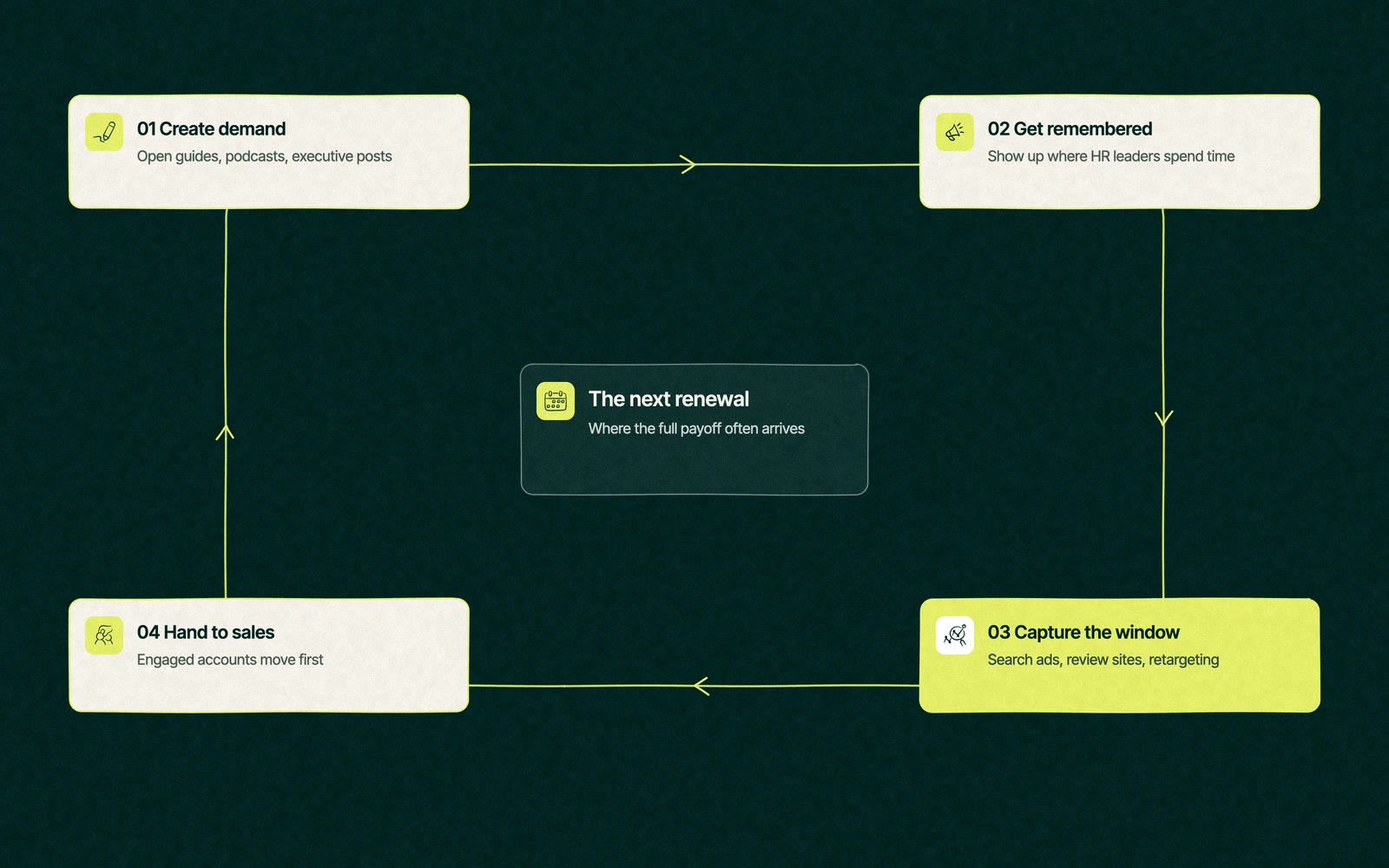
HR software demand generation loop from creating demand to being remembered to capturing the renewal window
ProgramCreates or capturesCost in money and effortTime to signal
Open guides and original researchCreatesLow money, high effortA quarter or two
Podcasts and recorded practitioner panelsCreatesLow to medium money, steady effortTwo quarters or more
Promoted posts from executives and customersCreatesMedium money, needs a willing authorWeeks for reach, quarters for pipeline
HR conferences and local chapter eventsBothHigh money and travelThe next quarter
Review site profilesCapturesLow to medium, mostly effort asking customersWeeks once reviews land
Search ads on buying termsCapturesHigh per clickWeeks
Retargeting engaged accountsCapturesLow, on a small poolWeeks

A few habits make the creation side work for HR buyers in particular.

  • Leave most content ungated. A gated ebook is a toll booth on a road nobody has chosen to travel yet.
  • Pick a message no other vendor in your category owns. Sapient found 75% of AI users in HR measure AI's value by time saved, which means "saves time" is the sentence every one of your competitors is already using.
  • Show up where HR leaders talk to each other, from SHRM chapter meetings to private online communities, with practitioners rather than salespeople.
  • Put customers on stage, in posts, panels and reviews, because an HR leader trusts another HR leader more than any vendor.
  • Keep going for longer than feels comfortable. Most programs get cut a quarter before they would have shown up in pipeline.

Events deserve their own plan, which our guide to HR tech webinars and events covers, and paid reach on LinkedIn is in LinkedIn ads for HR software buyers.

Trade You.

Your email for great content delivered to your inbox. Regularly. Unless we forget. Or get busy. But we'll try.

Thank you! Your submission has been received!
Oops! Something went wrong while submitting the form.

The vendor everyone had heard of

Go back to the deal from the plaza, where the CHRO's committee sat down to build a shortlist after their payroll contract came up for renewal.

The CFO had heard the rival's founder on a finance podcast. The HR operations manager had read its guide to switching payroll mid-year, and the IT director had seen a peer post about how painless its security review was.

The company that lost had a better product by most measures, and it had a lovely demo request page. It met the committee for the first time when the request for proposal arrived, by which point the shortlist had one name on it in ink and the rest in pencil.

The losing side did nothing wrong in the month that mattered. They just weren't there in the two years before it.

What budget split works for HR software demand gen?

No public benchmark tells an HR software company how to split creation and capture, so treat what follows as our recommendation rather than a rule. Fund capture first, because buyers already searching for your category are the cheapest demos you'll ever get.

Once capture stops growing, and more search budget no longer buys more demos, the market has run out of people who already know they want you. That's the signal to move money into creation, often until it holds half the program or more.

Executives leading more selections push the same way. They're harder to reach with a search ad and easier to reach with a peer, a podcast or a well-placed post, so a committee that skews senior needs a bigger creation budget than one run by an HR manager.

Stage matters too. A young company with little search demand for its category may have to fund creation sooner, simply because there's nothing to capture yet, while an established vendor with steady branded search can afford to start on the capture side and shift gradually.

Handing warm accounts to sales without calling them leads

Creation programs produce accounts that are warming up, rarely people who want a call. The handoff goes wrong when marketing treats a podcast listener like a demo request and sales opens with "I saw you downloaded our guide."

Agree with sales on what makes an account warm, such as several people from one company reading content within a few weeks, visits to pricing or security pages and a contract renewal date you know about. Then give sales a list of accounts and the topics each one cared about, and let reps open with something useful instead of a reminder that they were being watched.

Renewal dates are the most valuable field most HR tech CRMs leave empty. Ask every prospect which system they use and when the contract ends, log it on the account and plan the heaviest creation work for the year before that date.

Sales already has plenty of leads labelled warm. What it lacks is accounts that would happily take the call, and our guide to account based marketing for HR software companies shows how to run named accounts once the list is ready.

Which numbers show HR tech demand generation is working?

Creation programs rarely show up in last-click reports, so judge them on numbers that move when more of the market remembers you. Watch these in order, quarter over quarter.

  1. Branded search and direct traffic. Branded search is the only survey your buyers fill in without being asked.
  2. How buyers say they found you. Add an open "How did you hear about us?" field to the demo form and read every answer.
  3. Engaged target accounts. Count the accounts on your list where several people engaged this quarter, rather than the number of contacts.
  4. Pipeline from accounts that saw the program. Compare their opportunity rate and win rate with accounts that didn't.
  5. Where deals enter. More buyers arriving with a shortlist of one, and shorter cycles from first call to signature, mean the memory did its work.

If you hire an HR tech demand gen agency, ask which of these it will report every month. An agency that only reports leads will quietly cut the programs that make the rest work.

What we would build first

HR software is one of the markets we know best. Our demand generation work usually starts by fixing capture, then builds the creation programs above around the accounts sales wants most, with pipeline growth reporting that shows both sides in one view.

Most demand programs run on a retainer starting at $150 an hour, and our pricing page lists the project and monthly options too. Creation work takes quarters to pay off, so we ship something every week you can point to while the slower numbers build.

Our view of this market lives on our HR tech marketing agency page, and our guide to HR tech marketing shows where demand generation sits in the full plan.

Share your discovery call notes from last quarter. We'll build the program that gets you remembered before the next renewal window. Book a free strategy session and we'll show you which buyers already know your rivals' names.


“

The first call felt like talking to someone who already understood our business. We didn’t have to explain the basics. They showed up with questions that mattered.

James L.

Director of Growth, HR tech

Client

FAQ

Frequently asked questions

How does demand generation for HR tech work?

+

Demand generation for HR software works in two halves. Creation programs such as open guides, podcasts, events and customer posts make HR, finance and IT leaders remember you before they shop. Capture programs such as search ads, review sites and retargeting catch them when a contract ends. The halves feed each other, so cutting creation slowly starves capture of buyers who know your name.



How is demand generation different from lead generation?

+

Intent is the dividing line. Lead generation targets the few buyers ready to talk now and asks for a name, a demo or a form fill. Demand generation targets the much larger group that isn't shopping yet and asks only for attention, usually with nothing gated. Lead generation is judged on demos within weeks, demand generation on branded search and pipeline over quarters.

How long does demand generation take to work?

+

Expect two quarters before creation programs show up clearly in pipeline, and longer for podcasts or research. Branded search and engaged accounts usually move first, often within a quarter, while capture programs such as search ads show results in weeks. HR systems are replaced rarely, so the full payoff often arrives at the next renewal window rather than inside the current one.

What budget split works for HR tech demand gen?

+

Begin with capture, because buyers already searching for your category are the cheapest demos available. At Leapyn we move money into creation once more search budget stops buying more demos, often until creation holds half the program or more. Committees led by executives need a larger creation share, since peers and podcasts reach them better than search ads do. No public benchmark exists for this.

Which metrics show demand generation is working?

+

Measure branded search, direct traffic and the answers to an open how did you hear about us field on the demo form. Then count engaged target accounts, compare pipeline and win rates for accounts that saw the program against those that didn't, and watch whether deals arrive with shorter cycles. Lead counts alone will tell you the program failed even when it's working.

Leapyn frog mark for the Leapyn team, authors of the B2B marketing blog

Written by

The Leapyn team

Senior marketers who run strategy, creative and demand gen for B2B companies. We write about what’s working for our clients right now.

More from this author →

If you like us here, you'll love us on LinkedIn.

Stay updated

Keep reading

Related articles