Strategy, creative and execution, all in house.

See pricing →

Every channel, one team, weekly results.

See pricing →

Work that ships weekly and looks like you.

See pricing →

Every channel, one team, weekly results.

See pricing →

Different buildings. Same obsession with leases.

See pricing →

Different buildings. Same obsession with leases.

Pricing and packages →

Different products. Same obsession with pipeline.

All SaaS and technology work →

Different trades. Same obsession with booked jobs.

All home services work →

Different practices. Same obsession with signed clients.

All professional services work →
Thank you! Your submission has been received!
Oops! Something went wrong while submitting the form.

Marketing strategy

Selling HR software when HR is the buyer, the user and the skeptic

Why HR buys software more carefully than almost anyone in B2B, who they trust before a vendor and what that means for every page, demo and email you send them.

Selling HR software when HR is the buyer, the user and the skeptic

In this post

  1. toc

Stuck at the gate with a delayed flight, the account executive for a time and attendance app replays a demo recording. The HR director on the call said the product looked great and promised to circle back, and then went quiet.

On the second listen he hears what he missed. She asked how warehouse staff without work email would log in, who answers the phone when a manager gets stuck and whether payroll could see the notes. He had spent most of the hour on dashboards.

Selling HR software means selling to the person who will be blamed if employees ignore it. That afternoon she was deciding whether she could survive go-live, and the features barely came into it.

Selling HR software to an HR director who will answer for the launch to every employee

How do you sell software to HR departments?

Sell the launch plan as hard as the product. HR leaders buy for the whole company and answer for adoption, so they want proof that employees will use it, that finance and IT will approve it and that peers have done it before. Show the plan for week one, the support model and named customers like them.

Anyone asking how to sell to HR gets told to lead with outcomes, which is right and incomplete, because the outcome HR cares about most is a quiet first month.

The buyer who gets blamed for everyone else's login

Most software buyers choose tools for their own team. HR chooses for every employee and manager, and hears about it in every hallway when the new system goes wrong.

The Bureau of Labor Statistics tracks HR specialists and HR managers as separate occupations, and your deal needs both. Specialists run the system every day and remember the last bad launch in detail, while their managers answer for it upstairs.

The Sapient Insights Group 2026 to 2027 HR Systems Survey found executives lead 31% of HR system selections, up from 25% in 2024, and that 36% of AI users adopted AI ahead of their HR processes and data. Plenty of HR teams are still cleaning up after their last fast decision.

Who do HR leaders trust before a vendor?

By the time HR books a demo, these sources have mostly written the shortlist.

  • Peers. Former colleagues and private HR communities answer the one question every vendor wants answered, which is whether the thing works.
  • Review sites. HR teams read reviews on G2 and Capterra, and the one-star reviews about support often get read first.
  • Brokers and consultants. Benefits brokers, PEOs and software advisers recommend tools to companies with no time to research.
  • Analysts and AI answers. Larger buyers check analyst research, and a growing number ask an AI assistant which tools fit a company their size.

Your own website comes after all of these, which is humbling and also useful, because every page can assume the reader already heard something and wants to check it.

Trade You.

Your email for great content delivered to your inbox. Regularly. Unless we forget. Or get busy. But we'll try.

Thank you! Your submission has been received!
Oops! Something went wrong while submitting the form.

The questions sales never hears

HR asks its hardest questions of peers, after the demo and out of your earshot, and these tend to decide the deal.

  1. How long did implementation take, compared with what the vendor promised?
  2. Did managers use it, or did HR end up entering the data for them?
  3. What happens when an employee calls support, and who picks up?
  4. What did the price look like at renewal?

Selling to HR gets easier when marketing answers all four in public, with realistic timelines, named customers, a support page and pricing that doesn't need a call.

Who signs off when selling HR software?

HR usually chooses but rarely decides alone, and every other seat in the deal needs its own reason to say yes.

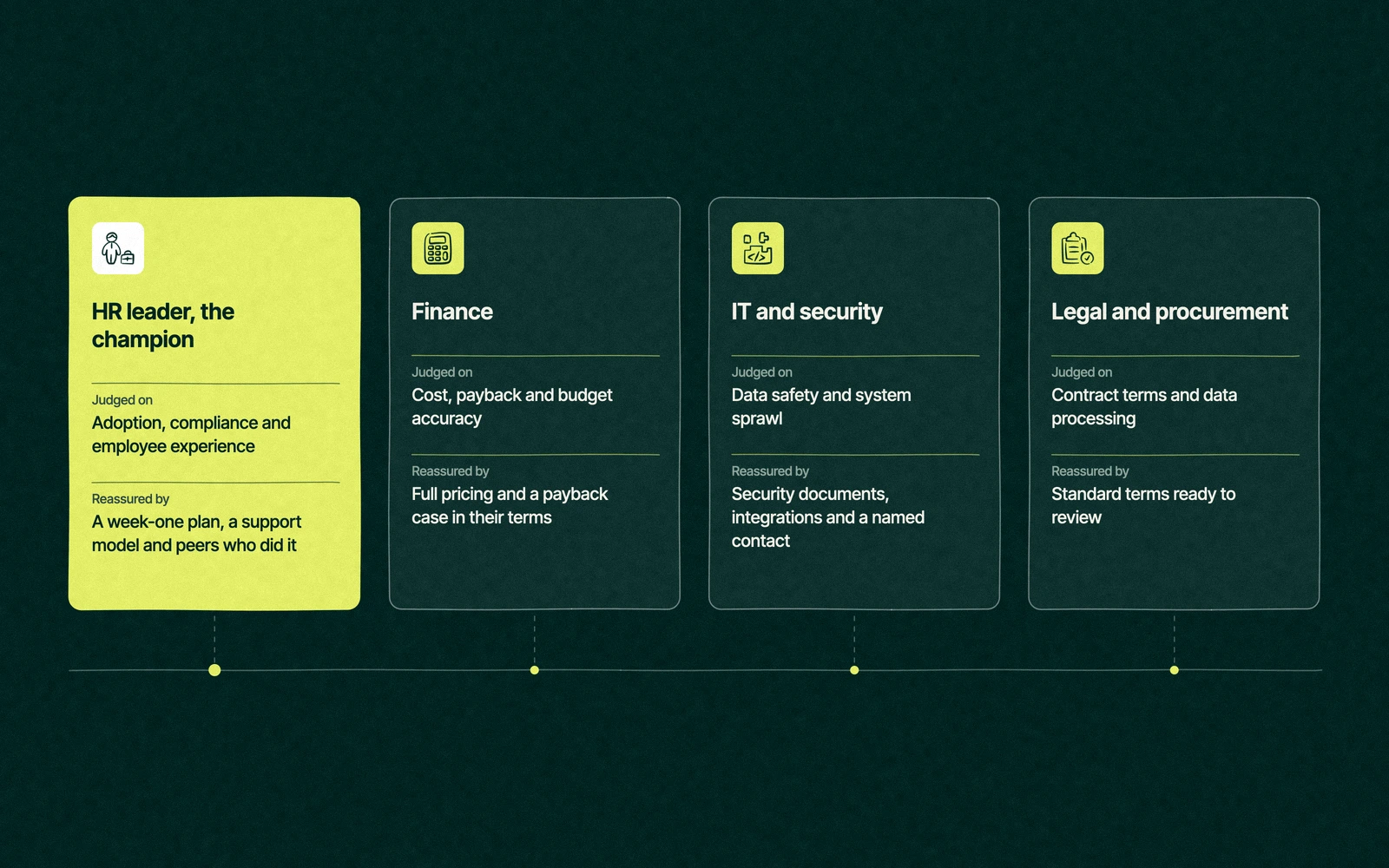
Comparison of the HR, finance, IT and legal seats in an HR software buying decision, with the HR champion highlighted, for selling to HR
Person in the dealWhat they're judged onWhat scares themWhat reassures them
HR leader, the championAdoption, compliance and employee experienceA launch employees ignore, with their name on itA week-one plan, a support model and peers who did it
FinanceCost, payback and budget accuracyFees that appear at renewalFull pricing and a payback case in their terms
IT and securityData safety and system sprawlSalary and medical data in a weak systemSecurity documents, integrations and a named contact
Employees and managersGetting their work doneOne more loginA mobile experience and a two-minute setup

The champion carries all of this into rooms you'll never enter, and our guide to ABM for HR tech shows how to reach every seat directly.

The shortlist decided by one sheet of paper

Two HR software vendors make the final round at a regional hospital group. Both demos went well, both prices fit and both passed security.

The HR director asks each how night-shift nurses will be trained. The first sends a feature sheet and a help center link, and the second sends one page with a week-one schedule, a sample email for managers and the name of the trainer who will be on site.

She forwards the second page to her CFO that afternoon. Selling HR software well looks a lot like that page, because it does the champion's internal selling for her.

How should you market to HR professionals?

Marketing to HR professionals works when it respects how careful they are. Publish pricing or a range, show customers with names and roles, and describe implementation plainly, including what goes wrong.

Skip the AI fireworks, since HR buyers have heard every vendor promise to change the future of work. Write content the champion can forward instead, such as launch plans, cost cases for finance and security summaries for IT. Our HR tech content marketing guide covers formats, and positioning for HR tech covers the message for each seat.

If your champion needs backup

We help HR software companies build the material that sells when the rep isn't there. Our marketing strategy work maps the buying committee, and our positioning work writes what each seat needs to hear.

Every price is fixed and written down before work starts, as our pricing page lays out, and new material reaches your reps every week. See how we work as a marketing agency for HR tech companies, or read our HR tech marketing playbook.

Send us the launch plan you give new customers. We'll turn it into the page that wins the final round. Book a free 30-minute strategy session and leave knowing which seat in your deals is going unanswered.

“

The first call felt like talking to someone who already understood our business. We didn’t have to explain the basics. They showed up with questions that mattered.

James L.

Director of Growth, HR tech

Client

FAQ

Frequently asked questions

What works when selling HR software to HR departments?

+

Every HR software deal turns on whether the HR leader believes the launch will work, so sell the adoption plan alongside the product. Show a week-one schedule, the support model and named customers like them. Then give your champion material for finance and IT, because HR chooses the tool but rarely approves the spend alone.

Who makes HR software buying decisions?

+

Committee members vary by company size, but most deals include an HR leader who chooses, a finance leader who approves the spend and IT reviewers who can stop it. Larger deals add legal and procurement. Executives now lead 31% of HR system selections, up from 25% in 2024, according to Sapient Insights Group.

Why are HR buyers so cautious?

+

Users across the whole company feel every HR software decision, and HR gets blamed when the new system confuses managers or loses an employee's leave request. HR also holds salaries, medical leave and personal data, so a weak vendor creates legal risk. Many HR teams have lived through a painful implementation and would rather wait than repeat one.


How do HR leaders research software?

+

Three places usually come before a vendor's website, which are peers and private HR communities, review sites such as G2 and Capterra, and advisers like benefits brokers or HR software consultants. Larger buyers add analyst research, and more of them now ask AI assistants which tools to consider. By the time HR books a demo, most of the shortlist is already written.

What do HR buyers want from a vendor?

+

Proof that the tool will work for people like them, delivered without pressure. That means named customers, honest implementation timelines, clear pricing, security answers and a support model with a human in it. Agencies such as Leapyn help vendors publish that proof before the first call, when most HR buyers decide whether a demo is worth their time.

Leapyn frog mark for the Leapyn team, authors of the B2B marketing blog

Written by

The Leapyn team

Senior marketers who run strategy, creative and demand gen for B2B companies. We write about what’s working for our clients right now.

More from this author →

If you like us here, you'll love us on LinkedIn.

Stay updated

Keep reading

Related articles