Services
StrategyPlans, positioning, leadership›GrowthAds, search, email, social›Creative and webBrand, websites, content, video›OperationsHubSpot and revenue operations›Property marketingRendering to signed lease›Creative and web
All services →Strategy, creative and execution, all in house.
See pricing →Every channel, one team, weekly results.
See pricing →Work that ships weekly and looks like you.
See pricing →Every channel, one team, weekly results.
See pricing →Different buildings. Same obsession with leases.
See pricing →Industries
Real EstateIndustrial, commercial, residential›SaaS and technologyHR tech, EdTech, FinTech, PropTech›Home servicesHVAC, roofing, plumbing, electrical›Professional servicesLaw, accounting, advisors, recruiting›VC and private equityPortfolio and fund marketing›Real estate marketing
Overview →Services for every building
SaaS and technology marketing
Overview →Who we work with
What we run for them
Home services marketing
Who we work with
What we run for them
Professional services marketing
Overview →Who we work with
What we run for them
Different buildings. Same obsession with leases.
Pricing and packages →Different products. Same obsession with pipeline.
All SaaS and technology work →Different trades. Same obsession with booked jobs.
All home services work →Different practices. Same obsession with signed clients.
All professional services work →Company
About usThe team behind LeapynHow we workWeekly delivery, one teamWhy LeapynWhat we mean by differentCase studiesResults with the numbersContactSay helloMarketing that earns its keep.
Book a call →Learn what is working before you spend on it.
All insights →Services
Marketing strategy
Growth marketing
Paid advertising
Creative and web
Operations
Property marketing
Industries
Real estate marketing
Services−Company
Email marketing
How HR software companies use email to stay in a long, quiet sale, with tracks for every reviewer, a champion kit and a send calendar built around HR's year.
In this post
The unsubscribe report is the least loved file in HR tech email marketing, and once a quarter the marketing manager at a performance review platform exports it anyway. This time she sorts it by job title and stops at an HR director who joined a webinar in the spring, asked two sharp questions and never booked a call.
The director left a reason in the little box at the bottom. She was still shopping, she wrote, just not from a vendor that emailed her twice a week about features built for enterprise payroll teams.
Her record in the CRM says nurture. In practice that meant the company newsletter, three product updates and a run of check-in notes from sales, none of which mentioned the problem she raised on the webinar.
Between the first conversation and the signed contract, email has one job. It keeps your name in the room through months of silence without becoming the reason the buyer leaves, and this guide covers the tracks, the champion kit, the calendar and the sends to retire.

HR software companies should use email to stay useful to every person on the buying committee through the long middle of the sale. That means separate tracks for HR leaders, finance and IT, a champion kit the buyer can forward, sends timed to the HR calendar and far fewer product announcements than most teams send today.
Email rarely closes an HR software deal on its own. It decides who the buyer calls first when she comes back.
Most nurture programs treat silence as lost interest and respond by sending more. In HR tech, silence usually has a calendar reason behind it.
Each of those reasons calls for a different email, and none of them calls for "just bumping this to the top of your inbox."
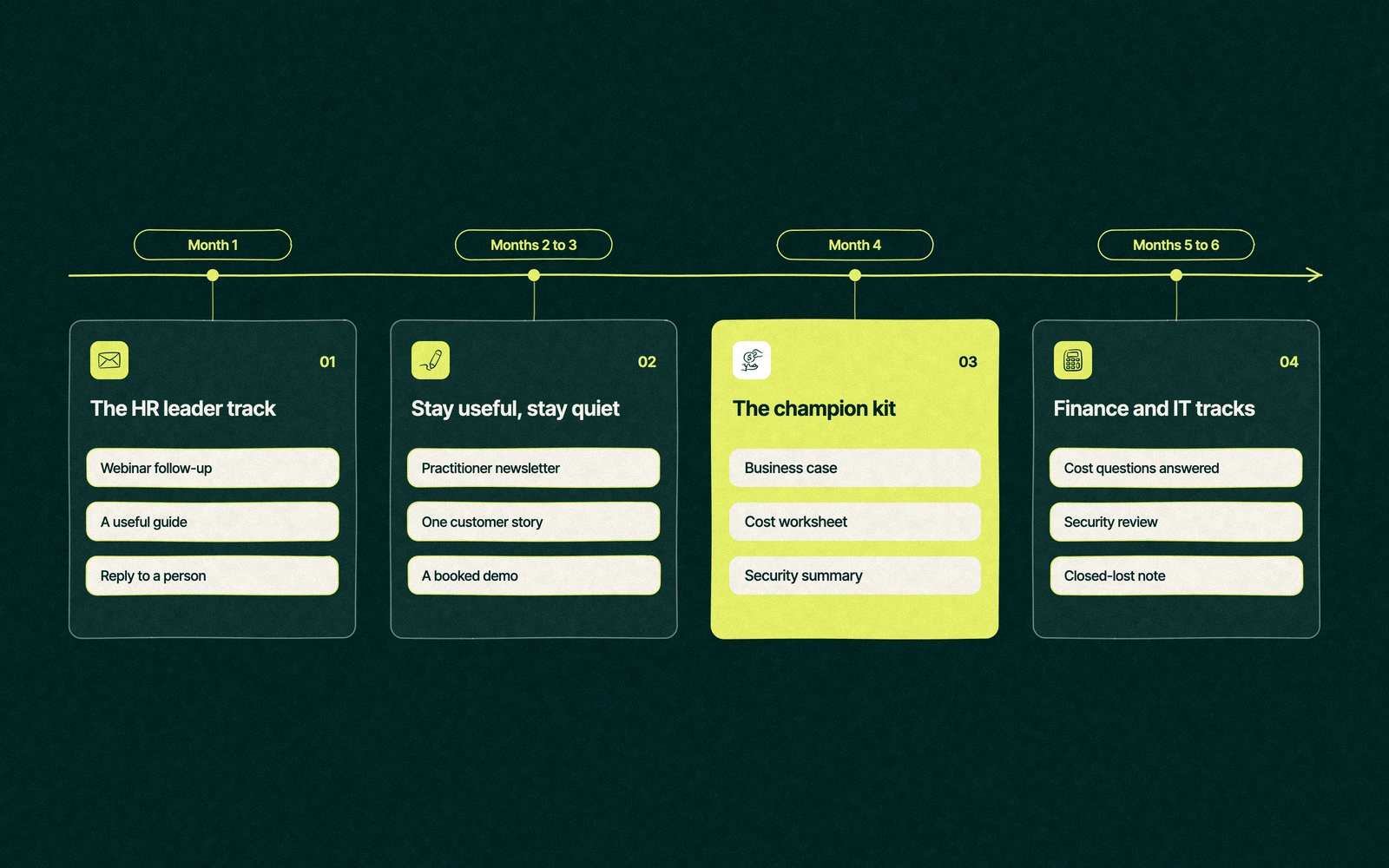
One newsletter for everyone is the most common setup we see and the least effective. HR leaders, finance reviewers and IT reviewers read for different reasons, so each one gets a track with its own trigger and its own finish line.
| Track | Who gets it | Trigger | Length | Goal |
|---|---|---|---|---|
| HR leader | HR directors, VPs of people, CHROs at target accounts | Webinar attendance, a pricing page visit or a guide download | Six to eight emails over about three months | A reply to a named person or a booked demo |
| Finance | CFOs and controllers on an open deal | The champion shares a business case, or finance joins a call | Three or four emails | Cost questions answered before the pricing call |
| IT and security | IT directors and security reviewers | A security questionnaire or an integration question | Three emails | A review that starts from your documents |
| Practitioner | HR managers, generalists and coordinators | A template or checklist download | A monthly newsletter with no end date | Goodwill now and an internal advocate later |
| Closed lost | Deals lost to no decision or a rival | The deal is marked closed lost | One short note per quarter | A second look at the next renewal window |
Every track should end with a person, never with a longer track. The last email in the HR leader track comes from the rep who met her, in plain text, with one question about her timeline.

This sits inside a wider plan for demand generation for HR tech, where email does the keeping and other channels do the finding.
Your email for great content delivered to your inbox. Regularly. Unless we forget. Or get busy. But we'll try.
An HR operations manager at a manufacturer with a few hundred employees loved the demo, told the rep so and then went silent for most of a quarter.
The vendor's automation kept her busy with webinar invites and a customer story from a retail chain. Meanwhile she was building slides for a CFO who wanted a cost comparison and an IT director who wanted to know where employee data would live.
She already liked the product. What she lacked was something to say in a meeting the vendor would never be invited to.
That's the champion kit email, sent by the rep within a day of the demo. It should hold five things.
When the kit arrives, the quiet stretch turns into weeks of her doing your selling for you. The finance and IT tracks then pick up the reviewers she forwards it to.
Match the send calendar to HR's year rather than to your sales quarter. Most US HR teams move through the same seasons, and each season wants a different kind of email.
| Window | What HR is busy with | What to send |
|---|---|---|
| January and February | Year-end payroll close, tax forms and a new plan year | Practitioner help such as checklists, and no sales asks |
| March to May | Planning the year's projects once budgets settle | Business case material, webinar invites and champion kits |
| June to August | Evaluations aimed at a January go-live | Comparison guides, references and implementation timelines |
| September to November | Open enrollment and benefits elections | Short, useful notes that don't ask for a meeting |
| December | Holidays and year-end close | One friendly note at most |
Renewal season matters more than any month on that table. Ask in discovery when the current contract renews, store the date as a CRM property and start the closed-lost track about six months before it, which our guide to HubSpot for HR tech shows how to set up.
Cutting emails is the cheapest improvement in most HR tech email marketing programs. These are the ones we'd switch off first.
For the full B2B version of this cleanup, our B2B email marketing strategy guide covers list health and sending rules beyond HR.
Open rates mean less every year, because privacy features in popular mail apps load images automatically and count opens nobody made. Measure what a person had to choose to do.
That's replies to a named sender, meetings booked from a track, new contacts from the same account after a forward and how fast nurtured deals move between stages compared with the rest. A track that produces replies and forwards is working, even when its dashboard looks quiet.
Webinars feed most of these tracks, so pair this with our guide to HR tech webinars and events and the follow-up week that turns attendees into conversations.
Some teams have the strategy and no one to write five tracks, while others have the writer and a CRM that can't trigger anything. Our email automation work covers both, from the first draft of the HR leader track to the renewal date property that starts the closed-lost one.
Because Leapyn is a Certified HubSpot Solutions Partner, we build the tracks inside HubSpot and tie every trigger to a deal stage your reps already use. For Conduit Tech, an HVAC software company later acquired by ServiceTitan, our marketing cut cost per MQL by 94%.
Every option has a fixed price agreed before we start, whether it's a single project, an à la carte monthly fee or a retainer, and our pricing page lists them all. More on how we work with HR software teams is on our HR tech marketing agency page, and the HR tech marketing guide covers every other channel.
Export your unsubscribe report for us. We'll rebuild your nurture around what it says. Book a free 30-minute strategy session and leave with the first track we'd fix.
“
The first call felt like talking to someone who already understood our business. We didn’t have to explain the basics. They showed up with questions that mattered.

James L.
Director of Growth, HR tech
Client
FAQ
Email that HR buyers keep opening is sent by a named person, written for one role and timed to the HR calendar. Good programs run separate tracks for HR leaders, finance and IT reviewers, send a champion kit after every demo and cut product updates to prospects. They judge success on replies, forwards and meetings rather than opens, which privacy features now inflate.
Nurture for an HR leader usually runs six to eight emails over about three months, then hands off to a person. Finance and IT tracks are shorter, three or four emails tied to a stage of the deal. Practitioner newsletters can run indefinitely at a monthly pace, because their job is goodwill and future advocates rather than a booked demo this quarter.
Weekly is the upper limit for most HR software prospects, and every two to three weeks suits the long middle of a deal. Frequency matters less than relevance, since one useful email a month beats four generic ones. Slow down during open enrollment in the fall, and speed up only when the buyer has shown fresh interest, such as a pricing page visit.
Send it within a day of a good demo, from the rep, to the person who has to sell your product internally. It packages a plain problem summary, a cost worksheet for finance, a security summary for IT, two references and a suggested meeting agenda. The goal is giving your champion everything she needs for the internal meeting you won't attend.
Newsletters and nurture copy work best when written by someone who understands how HR, finance and IT each read a vendor email. That can be a senior in-house marketer, a freelancer with HR software experience or an agency such as Leapyn. Whoever writes it, the rep's own emails should stay in the rep's voice and come from the rep's name.
Stay updated
Keep reading