HR tech go to market, from founder sales to a repeatable channel
A stage-by-stage go-to-market plan for HR software startups that takes them from founder-led deals through brokers, PEOs and marketplaces to the first channel that runs without the founder.
Marketing strategy
Tech and SaaS
The Leapyn team
November 7, 2026
8 min read
In this post
toc
The two cofounders of an HR software startup are packing the hatchback in a hotel parking garage after two days at a regional SHRM chapter conference. The banner rolls up crooked, and the badge scanner holds a respectable stack of contacts, most of them from the vendors at the neighboring booths.
One business card matters. It belongs to a benefits broker who asked whether the product works with the payroll system most of her clients use, and neither founder knew the answer.
That card is the most useful HR tech go to market research they did all year. It points at a channel most software startups never plan for, where the buyer arrives already trusting the person who sent them.
What is an HR tech go to market strategy?
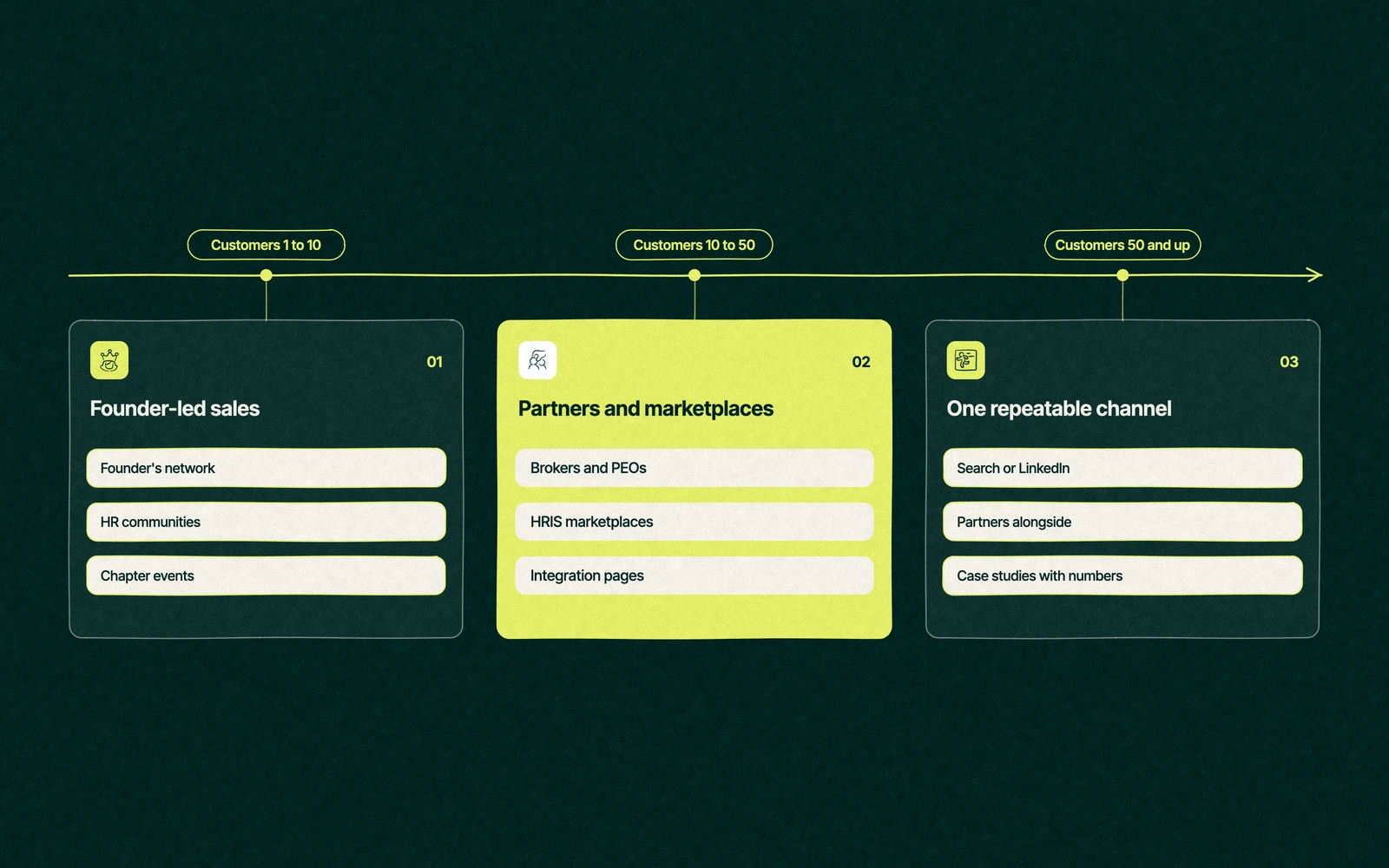
It is the plan for who buys first, how they hear about you and who sells to them, staged by company size. Most HR software companies start with founder sales to one narrow buyer, add partners such as brokers, PEOs and HRIS marketplaces, and then build one channel that produces demos without the founder in the room.
The stages overlap, and the order matters more than the speed. Most advice on GTM for HR tech jumps from the first customer straight to paid ads and skips the partners in between.
Pick one buyer and disappoint everyone else
Every HR leader has problems, which is why young HR software companies that sell to "HR teams" end up selling to nobody in particular. The first buyer has to be narrow enough that a founder can name ten of them before lunch.
Who feels the pain every week, rather than once a year at review time?
Can that person sign, or does every purchase go to the CFO?
Is it an HR team of one or an HR operations team, since they buy in completely different ways?
Which payroll or HRIS system do they already run, so you know which integration to build first?
Is there a date that forces the decision, such as open enrollment or a new compliance rule?
Investors sometimes answer a narrow buyer with "the market is too small". Founders can size the niche themselves from the Bureau of Labor Statistics occupation pages, but the stronger reply is that a narrow buyer is a first door rather than a ceiling. The integration and case studies built for one niche carry straight into the next.
How do HR tech startups get their first ten customers?
Founders sell them, one conversation at a time, and HR startups that skip this step skip the lesson. Anyone researching how to start an HR tech company hears "talk to customers", and in HR that means former colleagues, HR communities, local SHRM chapters and the peers of every person who takes a call.
This stage is for learning the words buyers use and the objections finance raises. Marketing here is a clear one-page site, a short demo video and a founder who posts about the problem in public.
Hold off on paid ads. Ten customers bought from a person, and an ad has no idea what that person said.
Trade You.
Your email for great content delivered to your inbox. Regularly. Unless we forget. Or get busy. But we'll try.
Thank you! Your submission has been received!
Oops! Something went wrong while submitting the form.
The broker card in the cup holder
Back in the parking garage, suppose the cofounders take the broker seriously. They build the payroll integration she asked about, publish a page explaining how it works and offer her a simple referral arrangement she can explain to clients in a sentence.
Her clients are small and mid-size companies that already trust her with benefits. When she mentions the product during renewal season, the founders get warm introductions, and the first calls open with the broker's name instead of a pitch.
A single broker won't make a company. A dozen brokers, a listing in the right marketplace and an integration page each partner can point to start to look like a channel.
Which channels work at each stage of HR software go-to-market?
Between roughly ten and fifty customers, other companies' front doors do the heavy lifting. Marketplaces such as the Rippling App Shop, which lists apps from more than 1,500 partners, put you where HR teams already go looking for add-ons.
Software advisers who help HR teams shortlist vendors are another door. OutSail says more than 200 software vendors have closed business through its network, a figure it reports about itself. PEOs and payroll providers can also resell or recommend you, as our post on PEO marketing explains from their side.
Stage
Sales motion
Best channel
Proof you need
Marketing hire
Customers 1 to 10
Founder sells every deal
Network, HR communities, chapter events
A working product and a founder who understands HR
Named customers, a security answer, one integration that works
A senior generalist or fractional leader
Customers 50 and up
A sales team with a defined process
One proven demand channel, such as search or LinkedIn, plus partners
Case studies with numbers, review site presence
A marketing lead, with an agency or specialists running channels
Fifty and up, and the first channel that runs without you
A company is ready for a repeatable channel when the founder is the bottleneck on every deal. Pick one channel, give it a full quarter and judge it with this test before adding a second.
It produces qualified demos every month without the founder in the email thread.
The cost per demo is known and stays roughly steady for a quarter.
Someone other than the founder owns it and can explain why it works.
Sales accepts most of what it sends.
Spending more brings more demos, rather than the same demos at a higher price.
Search and LinkedIn are the usual candidates. Our fractional CMO for HR tech post covers who should own this stage when the founder steps back.
Does an HR tech company need product marketing?
Yes, once the product has more than one buyer to convince. HR tech product marketing writes the positioning for each seat on the committee, plans launches, builds integration and comparison pages and arms sales with answers for finance and IT.
A founder searching for product marketing HR tech advice mostly finds SaaS advice with the word HR added. The difference lies in the committee, since HR picks the product, finance signs and IT can stop the deal, which our guides to selling HR software and HR tech positioning cover in depth.
It also keeps an HR tech go-to-market strategy honest, by updating the website, partner material and sales deck in the same week as each launch.
When the founder wants weekends back
We build go-to-market plans for HR software companies at the partner stage and the repeatable channel stage, and senior marketers handle the work from the first plan to the last campaign. Our go-to-market service covers the plan and the channels, and our positioning work sets the message for each buyer first.
Send us the badge scans from your last event. We'll sort the buyers from the booth neighbors.Book a free 30-minute strategy session and leave with the next stage of your plan, whether you work with us or not.
“
The first call felt like talking to someone who already understood our business. We didn’t have to explain the basics. They showed up with questions that mattered.
James L.
Director of Growth, HR tech
Client
FAQ
Frequently asked questions
How do HR tech startups get their first customers?
+
Founders sell them personally, usually through former colleagues, HR communities, local SHRM chapters and introductions from early users. The goal of the first ten deals is learning the buyer's words, the finance objections and the integration that keeps coming up. Paid advertising rarely works this early, because the founders don't yet know which message turns a conversation into a signed contract.
What is an HR tech go to market strategy?
+
Repeatable demand is the end goal of an HR tech go to market strategy, and the plan gets there in stages. It starts with founder sales to one narrow buyer, adds partners such as benefits brokers, PEOs and HRIS marketplaces, and then builds one channel that books demos without the founder. Each stage needs different proof and a different marketing hire.
Should HR tech sell to SMB or enterprise first?
+
Two things decide it, the length of the sales cycle you can afford and who feels the pain most. Small and mid-size companies buy faster and often through brokers or PEOs, which suits a young startup. Enterprise deals pay more but bring security reviews, procurement and longer pilots, so they usually suit a team with funding and patience.
Do PEO and broker partnerships work for HR tech?
+
Owners of small companies often take software advice from their benefits broker or PEO, so these partnerships can bring in buyers who already trust the referrer. They work when the product integrates with the systems the partner's clients use and the referral terms are simple. For outside help with that stage, Leapyn quotes fixed prices in writing.
What does product marketing do at an HR tech company?
+
Hiring a product marketer gives one person ownership of positioning, launches and sales enablement. In HR tech that means a message for each seat on the buying committee, integration and comparison pages, review site profiles and answers to security questions. A good product marketer also keeps the website, partner material and sales deck saying the same thing after every launch.
Written by
The Leapyn team
Senior marketers who run strategy, creative and demand gen for B2B companies. We write about what’s working for our clients right now.