HR tech positioning when every homepage says all-in-one
How an HR software company picks its buyer, names the thing it replaces and writes one claim a competitor can't borrow.
Marketing strategy
Tech and SaaS
The Leapyn team
November 7, 2026
8 min read
In this post
toc
The sales enablement lead at a workforce scheduling company runs role-plays with every new class of reps. She plays a skeptical HR director who asks what the product does and why she should care.
Every rep gives a version of the same answer, an all-in-one HR platform that's easy to use. That's an HR tech positioning problem, because the competitors in last month's lost deals say exactly the same thing.
So she opens the company homepage, and there's the sentence, word for word, in the headline. The reps learned it from the website, which is where most positioning problems start and where very few get fixed.
What is HR tech positioning?
HR tech positioning is the set of choices that tells a buyer who your product is for, what it replaces and why it's the better pick for that buyer. It covers the target customer, the competitive alternative, the one claim only you can make and the proof behind it. Messaging, websites and sales decks all come after it.
Good positioning makes some buyers lose interest on purpose. That's how the right ones recognize themselves.
Everyone is all-in-one, so nobody is
Count the HR platforms that call themselves all-in-one and you run out of fingers before you run out of homepages. The phrase describes a category, and a category can't be the reason someone picks you over the vendor next to you on the shortlist.
A simple test catches most of it. If your headline still works after you swap in a competitor's logo, it belongs to them as much as you.
Typical homepage line
What it claims
Who it's for
The sharper version
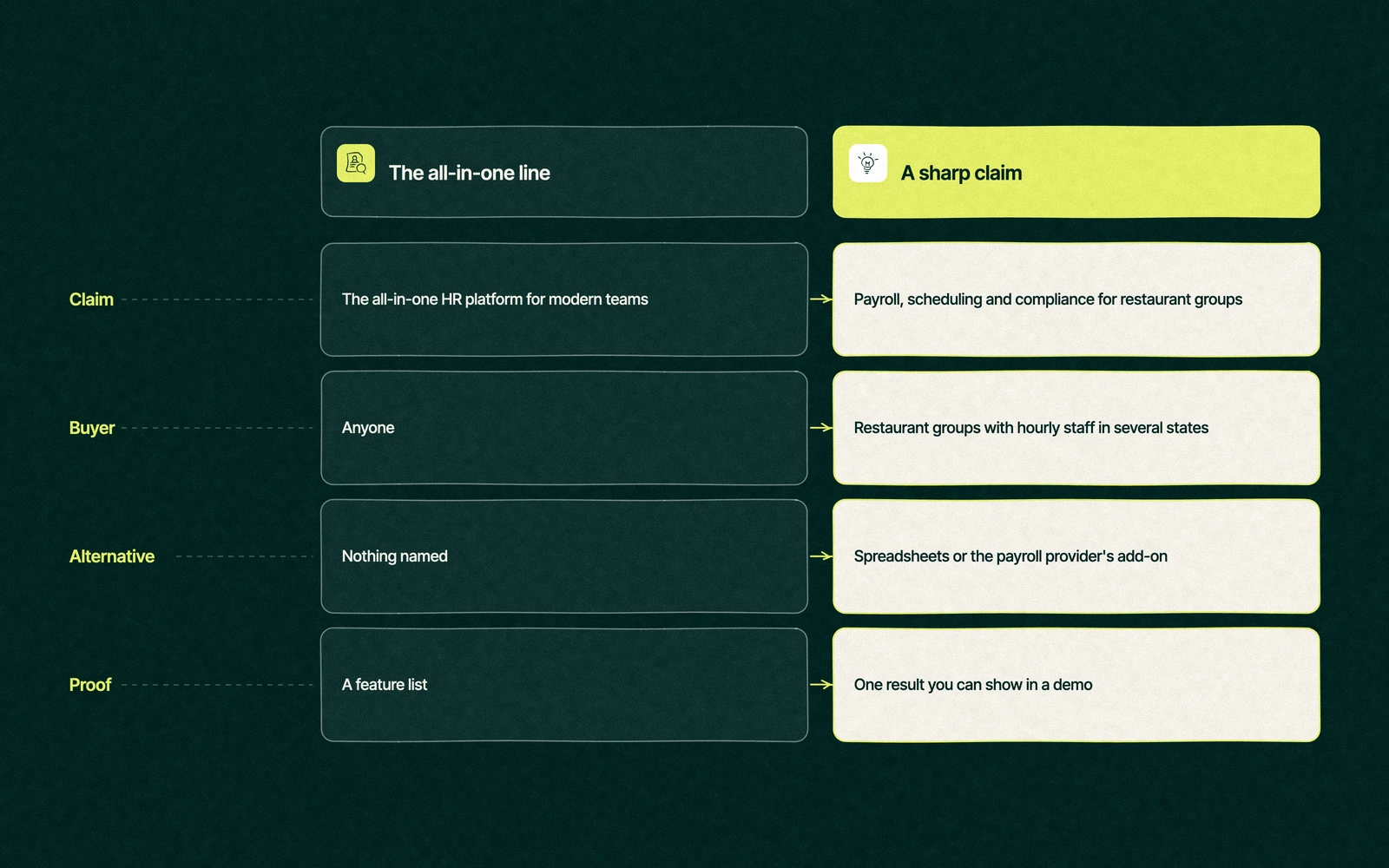
The all-in-one HR platform for modern teams
Breadth
Anyone
Payroll, scheduling and compliance for restaurant groups with hourly staff in several states
HR made easy
Ease of use
Anyone who dislikes hard things
Onboarding that new warehouse hires finish on their phone before the first shift
AI-powered people management
Technology
Investors, mostly
Performance reviews that take managers an afternoon instead of a week
Your people are your greatest asset
A feeling
Every HR conference keynote
Benefits enrollment your employees finish without a single email to HR
Every line on the right excludes someone, and that's the point. Every HR platform is easy to use, according to every HR platform.
How do you differentiate HR software?
The clearest method we know comes from April Dunford's Obviously Awesome, which starts with what customers would do if you didn't exist. Applied to HR software, it comes down to four decisions made in this order.
Name the alternative. Most HR buyers aren't choosing between you and a rival. They're choosing between you and spreadsheets, their payroll provider's add-on module or doing nothing until open enrollment is over.
List what you do that the alternative can't. Specific capabilities, such as multi-state tax filing or shift swaps approved in the app.
Turn each one into a result the buyer can measure. Hours saved, errors avoided or audits passed.
Pick the buyer who cares most about that result. Company size, industry and the job title of the person who feels the pain every week.
Then write the claim, and back it with one proof point you can show in a demo. A claim without proof is a slogan, and HR buyers have heard plenty of those.
The buyer you win most
Most HR software positioning starts too wide, because "HR" is too big to be a buyer. The Bureau of Labor Statistics files HR managers and HR specialists as separate occupations, and the specialist running benefits at a hospital has almost nothing in common with the HR director at a fifty-person software company.
Look at your last ten wins instead of your total addressable market. The pattern in company size, industry and the champion's title is usually sharper than anything in the pitch deck.
Proof has a unit, too. Sapient Insights Group's 2026 to 2027 HR Systems Survey found 75% of organizations using AI in HR measure its value by time saved. If you make an AI claim, put it in hours, because that's the unit your buyer will use to check it.
Trade You.
Your email for great content delivered to your inbox. Regularly. Unless we forget. Or get busy. But we'll try.
Thank you! Your submission has been received!
Oops! Something went wrong while submitting the form.
What's the difference between positioning and HR tech messaging?
Positioning is the decision, and HR tech messaging is how you say it to each person who has to agree. The positioning stays put for years, while the messages change by audience, channel and season.
Positioning
Messaging
What it answers
Who it's for, what it replaces and why it wins
What each reader needs to hear to agree
Who owns it
The CEO, with product and sales in the room
Marketing, with sales feedback
How often it changes
Every few years, or after a big market shift
Every campaign, if needed
Where it shows up
The homepage headline, the sales deck's first slide, the elevator answer
Ads, emails, landing pages, the CFO one-pager, the IT security brief
One positioning statement usually feeds three sets of messages in HR tech, one each for HR, finance and IT. Our guide to selling HR software shows how sales carries those messages through a deal.
Test the sentence before you buy the logo
A payroll startup decides it needs a rebrand because prospects keep mixing it up with two competitors. The designers are booked and the budget is approved when the head of marketing asks the awkward question, which is what the new brand is supposed to say.
Instead of guessing, the team writes two candidate homepage lines. One leads with the breadth of the platform and the other names a buyer, hourly-heavy employers, and the problem it fixes for them.
They run both as LinkedIn ads to the same audience for a few weeks, use each line to open sales calls and read the replies. The narrow line wins on clicks and, more tellingly, on the number of prospects who repeat it back on calls.
The rebrand still happens, and now it has something to say. A positioning statement that pleases the whole leadership team has usually been sanded down until it pleases no buyer, so let buyers vote first.
Two versions of a LinkedIn or search ad, sent to the same audience.
Two opening lines on sales calls, tracked in the CRM.
Five interviews with recent wins, asking why they picked you, in their words.
A homepage headline test, if traffic is high enough to read the result.
Once the sentence wins, the brand work follows from it. Our post on HR tech branding picks up from there, and HR software website design shows where the new line has to land first.
Getting an outside ear on it
HR tech positioning is hard to do from inside the company, because everyone in the room has heard the product described the same way for years. An outside team asks the questions the leadership team stopped asking.
At Leapyn, the senior marketers who run your buyer interviews are the same people who write the final statement, and positioning work is a scoped project with a fixed fee agreed up front. Our pricing page explains how a project fee works. You can see how positioning fits the wider program in our HR tech marketing guide, or on our HR tech marketing agency page.
Copying a giant is the usual trap. Workday can afford to describe itself broadly, and a smaller company that copies that breadth ends up sounding like a smaller Workday, and buyers who want Workday will simply buy Workday.
Bring us your homepage headline. We'll find the buyer it forgot to name.Book a free strategy session and you'll leave with two sharper lines to test.
“
The first call felt like talking to someone who already understood our business. We didn’t have to explain the basics. They showed up with questions that mattered.
James L.
Director of Growth, HR tech
Client
FAQ
Frequently asked questions
What does HR tech positioning include?
+
Four decisions make up HR tech positioning. You pick the buyer you win most often, name the alternative they would use without you, choose the one claim only you can make and back it with proof you can show in a demo. Messaging, the website and the sales deck are built from those decisions afterwards, so they all say the same thing.
How do you differentiate HR software from competitors?
+
Clear differentiation starts with what the buyer would do without you, which is often spreadsheets, a payroll add-on or waiting a year. List what you do that the alternative can't, turn each item into a measurable result and aim it at the buyer who cares most. Avoid claims every rival makes, such as easy to use or all-in-one.
What is the difference between positioning and messaging?
+
Positioning is the strategic choice of buyer, alternative and claim, and it changes every few years at most. Messaging is how you express that choice to each audience, such as the HR champion, the CFO and the IT reviewer, and it can change with every campaign. Weak messaging is often a positioning problem that hasn't been named yet.
How often should an HR tech company revisit positioning?
+
Category shifts are the usual trigger, along with a new product line, a move upmarket or a run of lost deals to the same alternative. Without one of those, a review every year or two is enough. Leapyn runs positioning as a scoped project with a fixed price for that reason, since it shouldn't become a permanent meeting on the calendar.
Can a small HR tech company compete with Workday on messaging?
+
Messaging is the one place a small company can beat a giant, because a big platform has to speak broadly to everyone. Pick a buyer the giant serves as an afterthought, such as hourly-heavy employers or companies under two hundred people, and speak to that buyer's week in detail. Specific beats big when the reader recognizes their own problem.
Written by
The Leapyn team
Senior marketers who run strategy, creative and demand gen for B2B companies. We write about what’s working for our clients right now.