3D rendering cost in 2027, what you pay for and what you shouldn't
What sets the price of a 3D rendering for a commercial building, where budgets slide, and how to get quotes you can compare line by line.
Content
Real estate
The Leapyn team
November 10, 2026
11 min read
In this post
toc
An asset manager has three rendering quotes spread across a conference table for a tired suburban office building her fund wants to reposition. The first is a single line, the second runs four pages, and the third quotes by the hour without saying how many hours.
Her investment committee wants to see the new lobby, the new entry canopy and the building from the highway. Few people on that committee will read a scope of work, but most of them will ask why the 3D rendering cost on three quotes for the same building is so far apart.
That question is where rendering budgets get confusing. The price on the quote is the easy part to compare, and it's rarely the number that decides what the images end up costing her.
How much does a 3D rendering cost?
A 3D rendering cost is set by the number of views, the state of your drawings, the amount of neighbouring site to model and the revision rounds written into the quote. A set is cheaper per view than single images, since every camera reuses one model. As one published reference, Leapyn charges $1,000 for a view added to a model we've already built.
Most guides that answer how much do renderings cost open with a wide range copied from other guides, which tells you the market is wide and not much else. We don't repeat those ranges here, because we can't check where they came from.
A more useful answer to how much does a rendering cost for a commercial building starts with what the images are for. A zoning view, a leasing flyer and a fence wrap along a highway ask for different cameras, different sizes and a different amount of polish.
What moves a rendering price up or down?
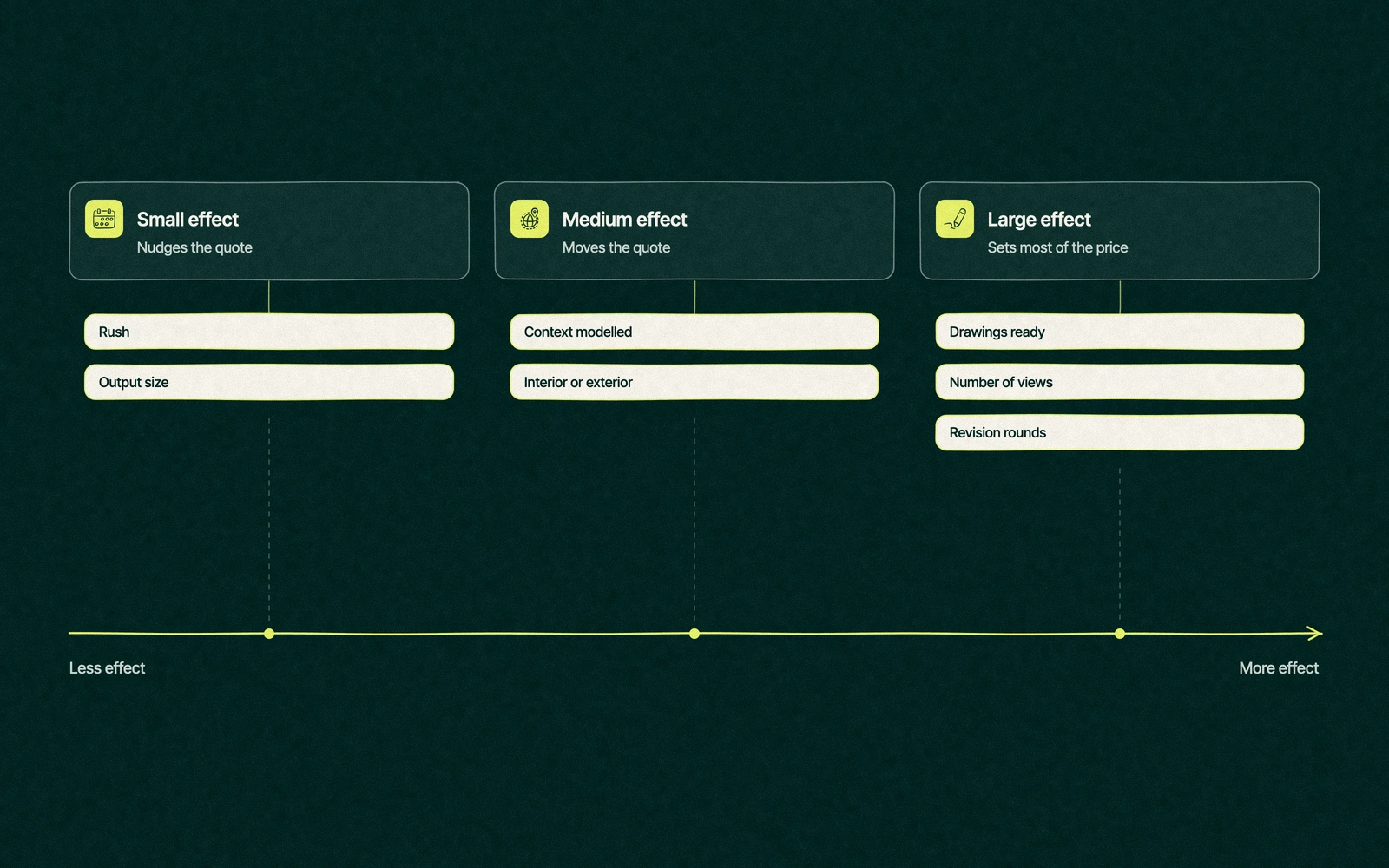
Six things move a rendering price more than the software or the studio's zip code. They're listed roughly by how much control the buyer has, starting with the one you control completely.
Drawings that are finished. A dimensioned CAD or Revit set lets the artist model once. A sketch and a site plan mean the studio is designing as it goes, and you pay for the guessing.
The number of views. Each extra camera on the same model costs far less than the first one, so a set is cheaper per image than a run of single orders spread over months.
How much context gets modelled. A building on a plain ground plane is quick. Neighbouring buildings, roads, an interchange and accurate planting can take days.
Interior or exterior. Interiors need furniture, fixtures and lighting, which adds modelling even when the room is smaller than the parking lot outside it.
Revision rounds. Two rounds is a common inclusion. The third and fourth rounds are where budgets slide, usually because the design moved under the image.
Rush. A compressed schedule puts more people on the model at once, and most studios charge for that.
The table sets those factors side by side with what pushes each one toward the cheaper or the pricier end. We've kept dollar figures out of it on purpose, since a range with no project attached is a guess wearing a tie.
Factor
Toward the cheaper end
Toward the pricier end
How you control it
Drawings
Final CAD or Revit set with dimensions
PDF sketches and a verbal brief
Freeze the sheets you'll render before kickoff
Views
Several cameras on one model in one order
Single images ordered months apart
Brief every audience's views at once
Context
Building on a simple ground plane
Neighbours, roads and accurate trees modelled
Ask which views need context and which don't
Interior or exterior
One exterior from street level
Furnished lobby or spec suite with lighting
Pick the one interior that sells the space
Revisions
Two rounds with comments batched
Rounds with no limit and comments trickling in
Name one person who approves
Schedule
Standard turnaround
Rush against a fixed event date
Book renderings when the drawings freeze
Output size
Screen sizes for web and email
Print sizes for a fence wrap or lobby wall
Ask for print sizes once, at the start
Rendering pricing per view, per set or per project
Studios price in a few common ways, and each one suits a different kind of building. The model matters less than knowing which costs it leaves out of the headline number.
Per view. Clean for a single listing that needs one hero image, and the priciest way to build a library one picture at a time.
Per set. A fixed number of views from one model, which is how most commercial teams buy for a building that has to lease, finance and get approved.
Per project. One fee through completion, useful for phased developments where buildings two and three reuse the model from building one.
Per hour. Common with freelancers and fair when the scope is unknown. When the scope is known and simply left out of the quote, hourly 3D rendering pricing is a blank check with a logo on it.
For a building that will raise money first and lease later, per set pricing usually keeps the 3D rendering cost lowest, because the investor views and the leasing views come from one model.
How much do rendering revisions cost?
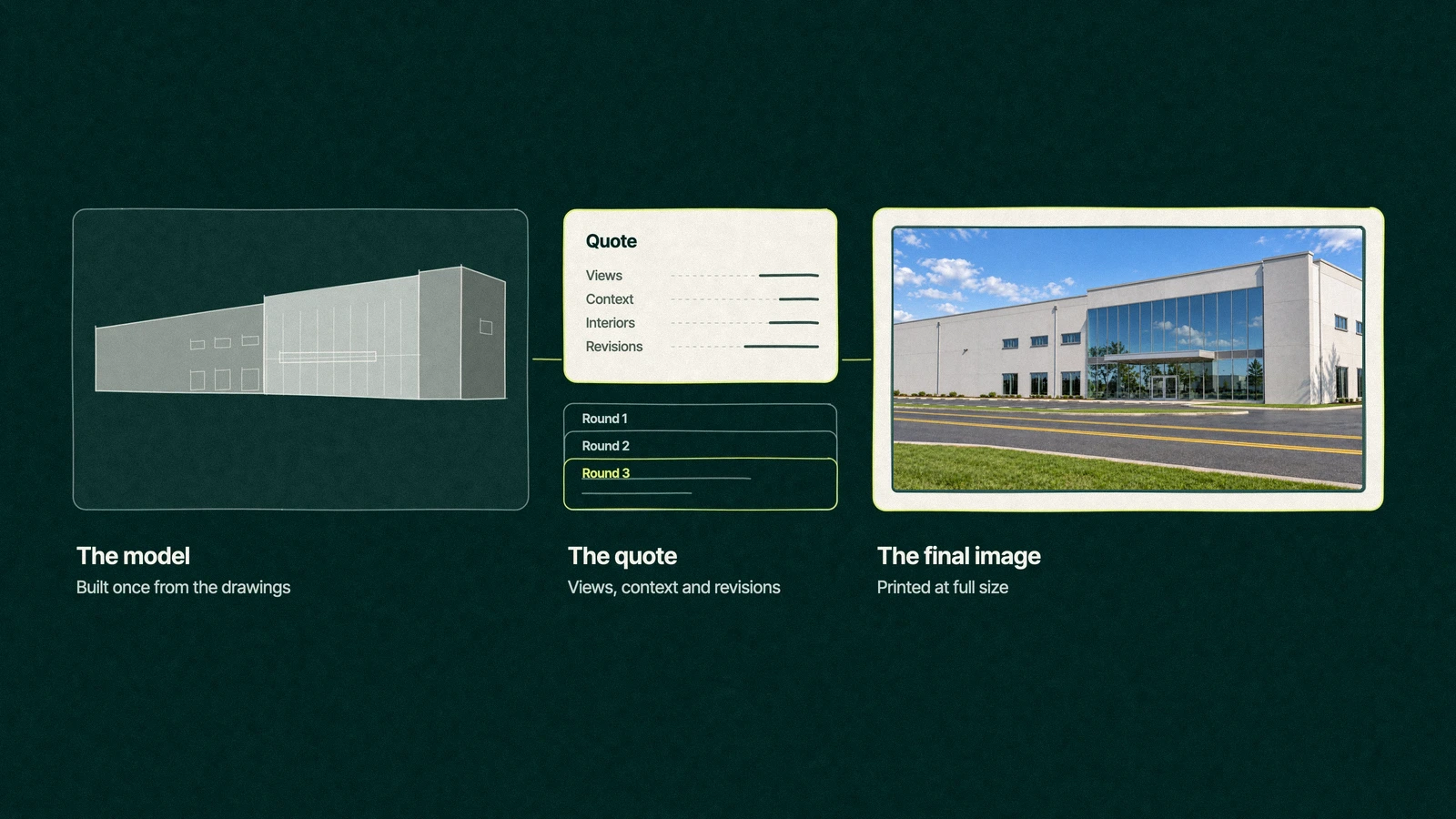
Revisions are where the cost of renderings drifts most, and they're the line in a quote that buyers read least. A round means one batch of comments answered with one new draft, and the count matters more than the price per image.
Two rounds on the colour draft is a common inclusion. Moving the camera after the model is lit can cost close to a new view, because the lighting, the shadows and the planting get rebuilt around the new position.
The cheapest revision happens on the gray model. Bring the broker, the architect and whoever signs the check to that review, since moving a camera at that stage costs an email rather than a change order.
The other expensive revision is a design change after finals. If the facade gets value engineered, budget to update the images, because tenants remember the picture they agreed to.
The lowest rendering price on the table, and the lease it cost
Back at the conference table, imagine the asset manager takes the one line quote because it's the lowest. The images arrive on time and look lovely on a laptop.
Then the leasing broker asks for the lobby view at poster size for a broker open house, and the files are sized for screens. Rendering them again at print size is a new order, from a model the studio built quickly and didn't keep tidy.
The prospect at that open house is a medical group that wants to see a ground floor suite. There's no suite view, because the quote didn't include an interior and the team didn't think to ask until a tenant did.
None of that is a disaster on its own. Together it's a second invoice, a few lost weeks and a prospect who leaves with a brochure that doesn't show the space they came to see.
The four page quote would have cost more up front. It listed the views by audience, the print sizes and the revision rounds, which is why it looked expensive and why it would have been the cheaper 3D rendering cost by the end.
Trade You.
Your email for great content delivered to your inbox. Regularly. Unless we forget. Or get busy. But we'll try.
Thank you! Your submission has been received!
Oops! Something went wrong while submitting the form.
Exterior, interior, aerial and animation rendering cost side by side
Different deliverables carry different amounts of work, so they price differently even from the same studio. The table lists what commercial teams usually buy, what makes each one heavier and Leapyn's published price where our hub lists one.
Deliverable
Where it gets used
What makes it heavier
Leapyn's published price
Single exterior view
Flyer, listing, website header
Context, season, people and cars
$1,000 on an approved model
Concept set, 3 views
Investor deck and early leasing
Drawings still moving
$3,000, credited toward a campaign set
Campaign set, 6 views
OM, brochure, website and ads
Mix of interiors and aerials
$5,500
Flagship set, 12 views
Large or phased developments
Several buildings and amenities
$10,000
Interior or spec suite view
Leasing tours, office and medical suites
Furniture, fixtures and lighting
$1,250
Floor plate and spec graphics
Brochure and leasing plans
Number of floors and suite layouts
$1,000
Branded site plan graphic
Industrial and retail leasing
Dock counts, parking and access
$1,250
Animated site plan build
Website and pitch meetings
Phases and moving parts
$3,500
Video montage, 15 seconds
Social ads and email
Number of source images
$4,500
Rendering flythrough, 30 to 45 seconds
Launch, groundbreaking and website
Camera path length and interiors
$9,000
An exterior rendering cost runs lowest per image when it shares a model with the rest of the set. Aerials and interiors cost more because there's more to build, and the architectural rendering cost of animation climbs with every second the camera keeps moving.
When you compare 3D rendering prices from other firms against this table, compare the row, not the total. A quote with no interior and no print sizes will look cheaper right up to the day you need either.
The rendering cost of putting an artist on payroll
Developers with a steady pipeline sometimes ask whether to hire. The Bureau of Labor Statistics puts the median annual wage for special effects artists and animators at $102,030 in May 2025, before benefits, software licences, a workstation that can render and a desk to put it on.
The same agency's figure for architects' median pay was $99,280 in May 2025. That's a useful reminder of what it costs when a project architect spends a week adjusting sunlight instead of finishing the drawings.
A staff artist makes sense when the work is constant. Most owners need a burst of images before financing, another before leasing and a refresh at completion, and a salary paid between those bursts buys plenty of idle render time.
AI image tools sit at the other end of the scale. They're cheap and fast for mood boards, and they get expensive the moment an image shows the wrong window count to a tenant. Our post on AI architectural rendering covers where they fit.
Our 3D rendering prices, in public
We publish our prices because the hardest part of buying renderings is comparing quotes that don't describe the same thing. Our single view on an approved model is $1,000, and sets run from $3,000 for three views to $10,000 for twelve.
The three view concept set is credited toward the six view campaign set later, so a developer who buys early images for the investor deck doesn't pay twice when leasing starts. Every image is rendered at a resolution that holds up on a fence, a monument sign or a lobby wall.
We're a senior team, so you talk to the people doing the work. We're also full service, which means the same images go into the brochure, the property website, the fence wrap and the ads, with a single lead in charge of the lot.
An accurate quote comes from an accurate brief. Send these with the first email, and the quotes that come back will describe the same job, which is most of the battle.
The drawing set, with the sheets that are final marked as final.
The views you need for each audience, such as investors, tenants and the planning board.
Where each image will be used, especially anything printed larger than a poster.
How many revision rounds you expect, and the one person who approves them.
The date the images are due and the date the drawings freeze.
Who owns the files and what you're allowed to do with them.
That last line deserves its own sentence in the contract. The US Copyright Office explains in its circular on works made for hire that a commissioned work counts as made for hire only in a short list of categories and with a written agreement signed by both sides, so spell out usage rights instead of assuming them.
Once the brief is ready, our guide to the best architectural rendering companies compares the types of firm you could send it to. For the basics of the image itself, start with what an architectural rendering is, and for timing on a building that isn't built yet, read about new construction renderings.
Price the set before the picture, and the 3D rendering cost you approve is the one you'll pay.
Forward us the quote that confused you. We'll price the same views beside it.
“
The first call felt like talking to someone who already understood our business. We didn’t have to explain the basics. They showed up with questions that mattered.
James L.
Director of Growth, HR tech
Client
FAQ
Frequently asked questions
How much does 3D rendering cost for a commercial building?
+
Price follows the work behind the image. A single exterior on a finished model sits at the lower end, while sets with interiors, aerials and modelled surroundings cost more in total and less per view. Unfinished drawings, extra revision rounds and rush dates add to any quote. Ask each studio to price the same list of views so the numbers can be compared fairly.
Why do rendering prices vary so much?
+
Quotes differ because studios include different things under the same word. One price might cover two revision rounds, print sizes and modelled context, while another covers a screen sized image on a blank background. Experience with commercial buildings, accuracy checks against the drawings and who you talk to during the project also change the number, even when two portfolios look alike.
How much does an exterior rendering cost?
+
A street level exterior is usually the least expensive view to produce, since the camera sees fewer surfaces than an aerial and the scene needs no furniture. The price rises with modelled neighbours, roads, people, cars and seasonal planting. Leapyn publishes its single exterior view on an approved model at $1,000, and the per view price falls when several exteriors share one model.
Are revisions included in the price of a rendering?
+
Most quotes include a set number of revision rounds, often two on the colour draft, and charge for anything after that. Read how a round is defined, since a batch of comments counts differently from studio to studio. Camera changes after lighting and design changes after approval usually cost extra, so settle the views on the gray model first.
Is it cheaper to buy renderings in a set?
+
Buying a set usually costs less per image, because the model, materials and site context get built once and every extra camera reuses them. Ordering one view now and two more later often means paying for setup twice, especially if the drawings changed in between. Brief the views for investors, tenants and the planning board together to get the set price.
Written by
The Leapyn team
Senior marketers who run strategy, creative and demand gen for B2B companies. We write about what’s working for our clients right now.