Strategy, creative and execution, all in house.

See pricing →

Every channel, one team, weekly results.

See pricing →

Work that ships weekly and looks like you.

See pricing →

Every channel, one team, weekly results.

See pricing →

Different buildings. Same obsession with leases.

See pricing →

Different buildings. Same obsession with leases.

Pricing and packages →

Different products. Same obsession with pipeline.

All SaaS and technology work →

Different trades. Same obsession with booked jobs.

All home services work →

Different practices. Same obsession with signed clients.

All professional services work →
Thank you! Your submission has been received!
Oops! Something went wrong while submitting the form.

Renderings

How long does 3D rendering take, counted back from your leasing launch

Why the computer is the fastest part of a rendering project, and how to plan the drawings, approvals and print deadlines backwards from the day the brochure has to exist.

How long does 3D rendering take, counted back from your leasing launch

In this post

  1. toc

A retail broker is at lunch with the developer of a new neighbourhood center, and the conversation turns to ICSC Las Vegas in May. She says she'll have a leasing brochure on the table at the show, then remembers that the center doesn't exist yet and neither does a single image of it.

Back at her desk she types how long does 3D rendering take into her phone. The first page of answers is about graphics cards, render farms and the number of hours a computer needs for one frame.

None of that tells her when to send the drawings. The computer is the most punctual member of a rendering team and the least consulted, and her schedule depends on the people around it.

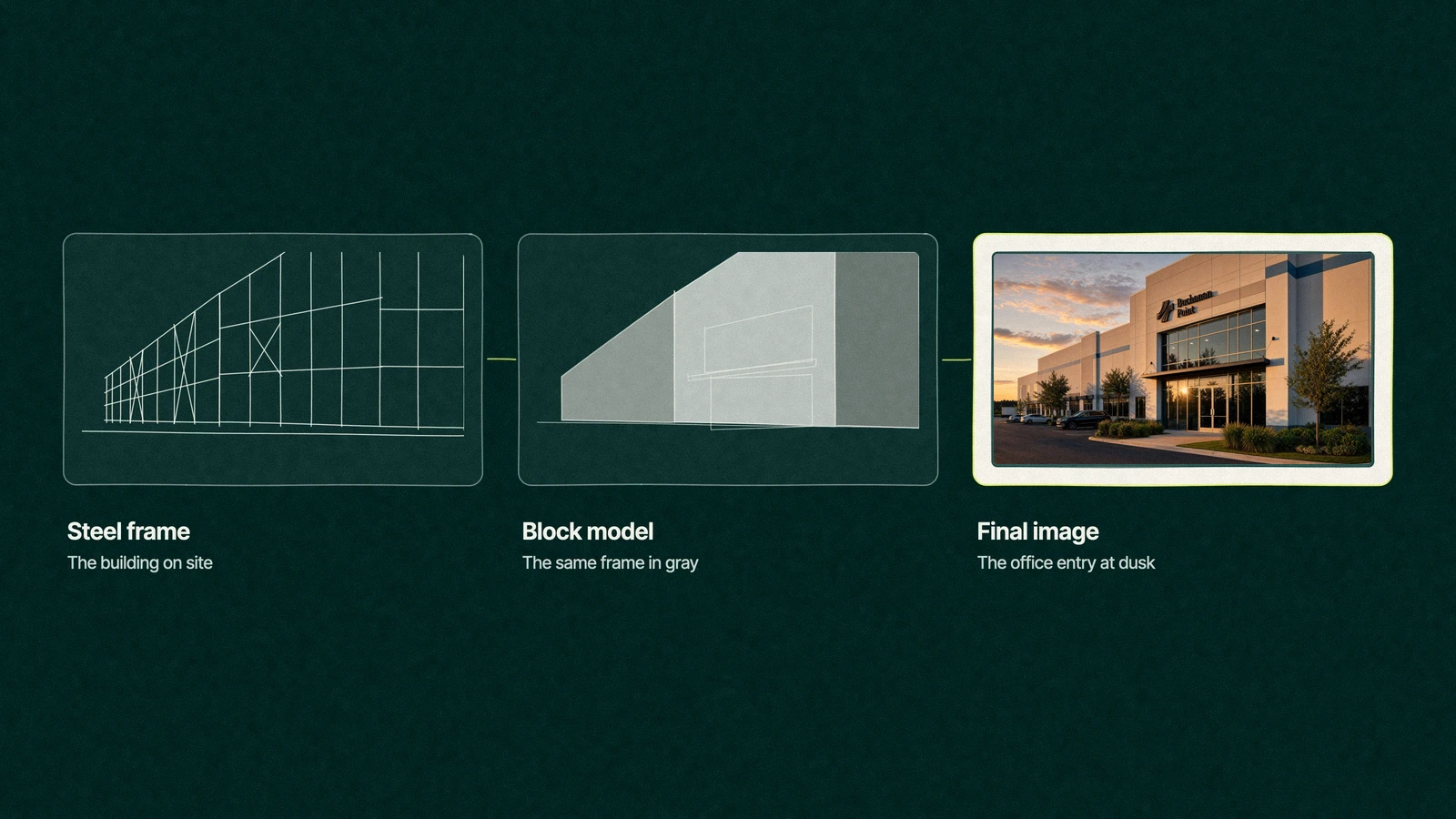
Rendering timeline shown as a pen drawn steel frame warehouse under construction, a gray block model of the same frame and a framed photoreal image of the finished building at its office entry at dusk

How long does 3D rendering take?

Computer render time for one still image runs from minutes to a few hours, while project time, from drawings in to approved finals, is usually measured in weeks. Most of those weeks go to modelling, feedback and approvals, so the drawings you send and the speed of your sign offs set the date more than the software does.

Animation and large sets take longer on both clocks. More frames mean more computer time, and more views mean more decisions, which tends to be the slower of the two.

Two clocks in every rendering timeline

Studios talk about render time and buyers care about turnaround, and the two get mixed up in most answers online. Render time is the machine calculating light on a finished scene. Turnaround is the whole project, and the machine's share of it is small.

The useful question for a broker or owner is narrower. It's when the image has to exist, and what has to happen before then, in which order.

The rendering schedule, counted back from the launch date

Start from the one date that won't move. A trade show is ideal, because ICSC Las Vegas runs May 24 to 26, 2027 whether your renderings are ready or not, and the same logic works for a groundbreaking, a planning hearing or an investor meeting.

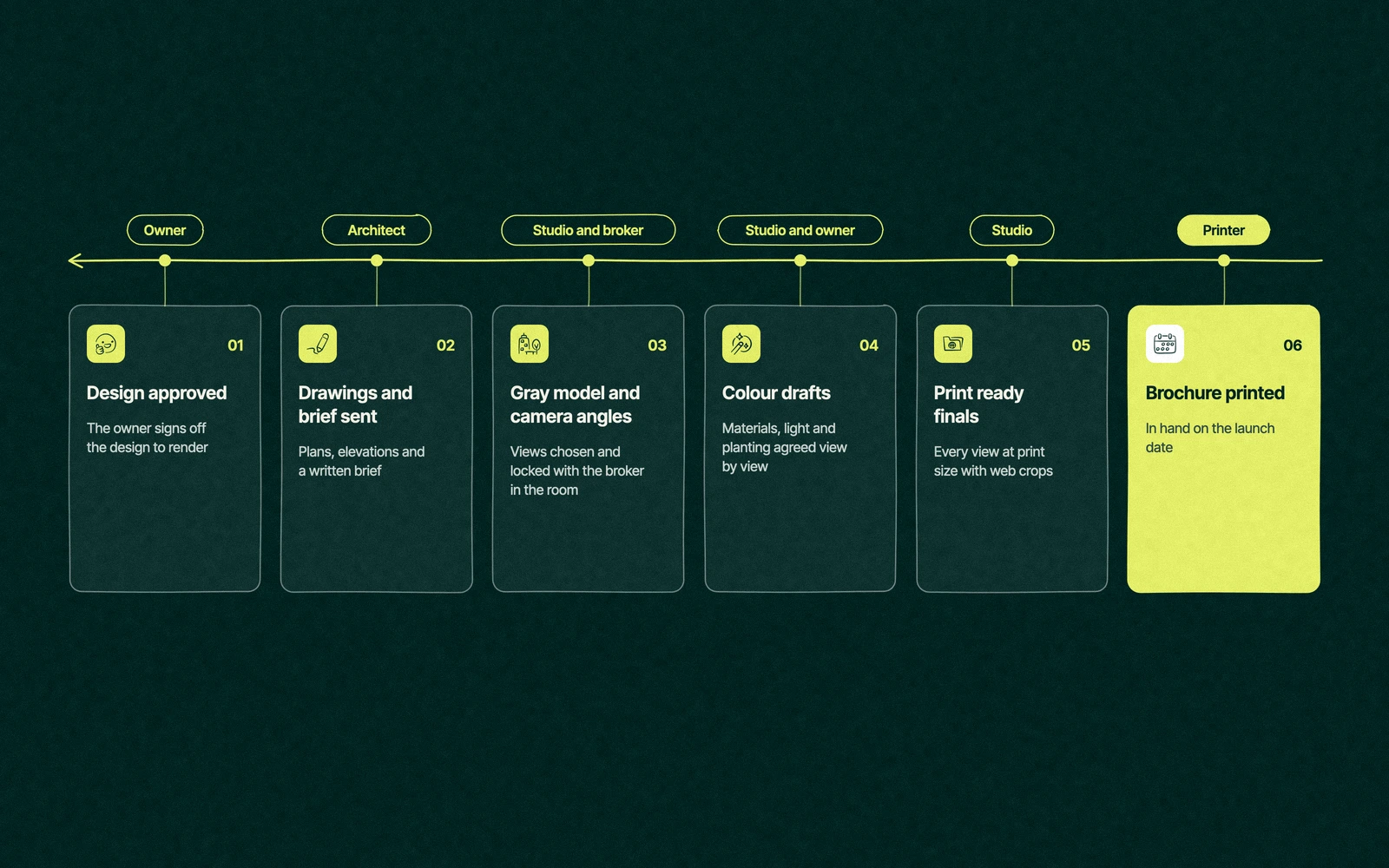
Then walk backwards one stage at a time. The table lists the stages in reverse, with the person who usually holds each one up and what moves it along.

Counting back from launchWhat has to be trueWho usually holds it upWhat speeds it up
Launch dayBrochures, website and booth graphics are in handShipping and the venueDelivering to the hotel or office, not the booth
Print and productionFiles are at the printer and proofs are signedThe printer's queue in the busy weeks before a showBooking the press slot when you book the renderings
Brochure and website layoutFinal images are placed and the copy is approvedWhoever writes the leasing copyDrafting copy while the renderings are still in progress
Print ready finalsEvery view is delivered at print size with web cropsLate comments on materialsOne person who consolidates every comment
Colour draftsMaterials, light and planting are agreed view by viewThe owner's partners and the architectReviewing drafts together on one call
Gray model and camera anglesThe views are chosen and lockedThe broker, if they're not invitedBringing the broker to this review
Drawings and brief sentThe studio has the plans, elevations and a written briefThe architect's other deadlinesFlagging the sheets that are still in design
Design approvedThe owner has signed off the design to be renderedOwnership and the design teamRendering from design development, not from schematic sketches

The bottom row is the one schedules forget. The American Institute of Architects, in its description of the design phases, notes that design development often ends with a formal presentation to the owner and the owner's approval, and that sign off is the earliest sensible start for marketing renderings.

Rendering timeline counted back from a leasing launch, from design approval and drawings to the gray model, colour drafts, print ready finals and the printed brochure

To build your own version, fill the table in this order.

  1. Write down the fixed date and the item that has to exist on it, such as a printed brochure, a live website or a fence wrap on site.
  2. Ask the printer or web team how much lead time they need, and mark their deadline as the day finals are due.
  3. Ask the studio for its schedule from drawings to finals for your exact set, including how many review rounds it assumes.
  4. Book every review on the calendar now, with every approver invited, so sign offs don't wait for someone to come back from vacation.
  5. Check the design date against the start date. If design development won't be approved in time, render a smaller set now and the rest later.

Trade You.

Your email for great content delivered to your inbox. Regularly. Unless we forget. Or get busy. But we'll try.

Thank you! Your submission has been received!
Oops! Something went wrong while submitting the form.

How many revision rounds come with a rendering?

One or two rounds of changes per stage is common, usually once on the gray model and once or twice on the colour drafts. Studios count rounds differently, so read the proposal for what counts as one round and what happens after the last one.

A revision is a change to how the image shows the design. Darker mullions, fewer trees on the left or a later sun all count as revisions.

A design change is different, because the building itself moves. A new entry canopy after camera angles are locked means new modelling, and it pushes every later stage back by however long that takes.

The cheapest place to change your mind is the gray model. Comments there cost a camera move, while the same comment on a final costs a re render and a new round of approvals.

Can renderings be rushed for a trade show deadline?

Some can. A single exterior from finished drawings, with the camera agreed on day one and one approver, can move quickly, because most of the project time was approval time anyway.

A rush rarely helps a large set, an aerial with a lot of surrounding context, or an animation. Those take modelling and frames that no rush fee shortens, and compressing them usually means fewer views or fewer review rounds.

DeliverableWhat you sendWhat usually moves the dateCan it be rushed?
Single exteriorElevations, site plan, material picksLate material choicesOften, with one approver
Aerial in contextSite plan, survey, neighbouring buildingsHow much surrounding area gets modelledPartly, by cropping the context
Lobby or spec suiteFloor plans, finish schedule, furniture directionFinish decisions and furniture picksRarely, unless finishes are final
Rendered site planSite plan with parking and dock countsCounts that change during leasingUsually
Six to twelve view setThe full drawing set and a written briefThe number of people approvingBy splitting it into two releases
FlythroughEverything above plus a camera pathFrame count, editing and musicSeldom without cutting length

A rush fee buys the studio's evenings. It doesn't buy a faster CFO, which is why the approval chain decides whether a rush is possible at all.

If the date is truly fixed, reduce the scope before you compress the schedule. One hero exterior and a rendered site plan in time for the show beat six views that land the week after.

Five people in one rendering approval chain

Back to the broker and her neighbourhood center. The developer sends the drawings, the studio builds the gray model, and the camera angles get approved on a call with the developer and the architect.

The colour drafts go out for comment, and the developer forwards them to his capital partner, who forwards them to the anchor grocer's real estate team, who would like to see their own storefront in the hero view. Each of them has a fair point, and the schedule hasn't heard about any of it.

The grocer's comments arrive after the second round, along with a note from the partner about the colour of the sky. The storefront change is a design change, so the studio goes back to the model for that view.

The broker does the useful thing and splits the set. The two views with no grocer frontage go to final and into the brochure on time, and the hero view follows a few weeks after the show as a direct email to the tenant contacts she met in Las Vegas.

Next time the invite list for the gray model review has five names on it. Trade show dates don't move for anyone, which is the most helpful thing about them.

How do you shorten a rendering turnaround without touching the software?

Most of the time you can save sits on the client side of the table. These habits shorten almost any rendering timeline.

  • Send the files the studio asked for, with final sheets marked. Drawings set up to the US National CAD Standard, now in Version 7 from the National Institute of Building Sciences, are quicker to read because the layers and sheets follow a common logic. Our guide to how to prepare CAD files for rendering lists what to send.
  • Name one approver who collects comments from partners, tenants and the architect and sends one list.
  • Invite the broker to the camera review, because the broker knows which view a tenant will ask for.
  • Decide materials before the colour draft, or label them provisional so a placeholder doesn't get treated as approved.
  • Order the set at once, so the model is built one time and every view shares it.

Buying the set at once also lowers the price per view, as the breakdown in what 3D renderings cost shows.

How we set rendering dates with a client

We start from your fixed date and work backwards with you, so the schedule names the printer's deadline, every review and every approver before the first file arrives. If the design won't be approved in time for the full set, we say so on the first call and plan a smaller first release.

For a show deadline, three views often do the job. Our concept set of three is $3,000, and when the other three views follow, that $3,000 comes off the $5,500 campaign set. Film needs more lead time, and pricing an architectural animation by shot shows how much.

Because the same senior team builds the leasing brochure and offering memorandum, the website and the signage, the layout starts while the renderings are still in draft. The pillar on architectural rendering covers how a set gets made from start to finish.

Circle your launch date. We'll plan every rendering stage back from it. Commercial real estate renderings built around a fixed deadline.


“

The first call felt like talking to someone who already understood our business. We didn’t have to explain the basics. They showed up with questions that mattered.

James L.

Director of Growth, HR tech

Client

FAQ

Frequently asked questions

How long does 3D rendering take for a commercial building?

+

On the computer, a single still renders in minutes or hours. The project around it usually takes weeks, because the studio has to model the building from drawings, agree camera angles, produce colour drafts and work through revision rounds. Larger sets, detailed aerials and animation take longer, and slow approvals add more time than any part of the software process does.

How long should rendering take for one image?

+

One exterior from finished drawings, with a clear brief and a single approver, is the quickest kind of rendering project, and the studio's queue sets much of the wait. Interiors with custom finishes and aerials with a lot of surrounding context take longer. Ask the studio for its schedule for your exact view before you commit to a date.
How long does an architectural animation take?

+

Animation runs longer than stills on both clocks. The studio has to model more of the site, plan a camera path, render many frames and then edit, add music and revise. Even a short flythrough takes noticeably longer than a still set, and longer films take more. Build the stills first, since the animation reuses the same model and the same approved materials.



What slows a rendering project down?

+

Approvals cause most delays. Drawings that keep changing, comments arriving from several people at different times, a new approver joining at the colour draft stage and design changes after camera angles are locked all push the date. Missing files matter too, such as elevations, a site plan or material selections, so the studio isn't left guessing while it waits for answers.

How far ahead should I order renderings for a leasing launch?

+

Count back from the launch date, allowing time for printing or website build, then for finals, colour drafts, the gray model and the drawings to arrive. Leapyn plans that schedule with owners and brokers on the first call, naming every review and approver. If design development isn't approved yet, start with a small set now and add views as the design settles.

Leapyn frog mark for the Leapyn team, authors of the B2B marketing blog

Written by

The Leapyn team

Senior marketers who run strategy, creative and demand gen for B2B companies. We write about what’s working for our clients right now.

More from this author →

If you like us here, you'll love us on LinkedIn.

Stay updated

Keep reading

Related articles