Services
StrategyPlans, positioning, leadership›GrowthAds, search, email, social›Creative and webBrand, websites, content, video›OperationsHubSpot and revenue operations›Property marketingRendering to signed lease›Creative and web
All services →Strategy, creative and execution, all in house.
See pricing →Every channel, one team, weekly results.
See pricing →Work that ships weekly and looks like you.
See pricing →Every channel, one team, weekly results.
See pricing →Different buildings. Same obsession with leases.
See pricing →Industries
Real EstateIndustrial, commercial, residential›SaaS and technologyHR tech, EdTech, FinTech, PropTech›Home servicesHVAC, roofing, plumbing, electrical›Professional servicesLaw, accounting, advisors, recruiting›VC and private equityPortfolio and fund marketing›Real estate marketing
Overview →Services for every building
SaaS and technology marketing
Overview →Who we work with
What we run for them
Home services marketing
Who we work with
What we run for them
Professional services marketing
Overview →Who we work with
What we run for them
Different buildings. Same obsession with leases.
Pricing and packages →Different products. Same obsession with pipeline.
All SaaS and technology work →Different trades. Same obsession with booked jobs.
All home services work →Different practices. Same obsession with signed clients.
All professional services work →Company
About usThe team behind LeapynHow we workWeekly delivery, one teamWhy LeapynWhat we mean by differentCase studiesResults with the numbersContactSay helloMarketing that earns its keep.
Book a call →Learn what is working before you spend on it.
All insights →Services
Marketing strategy
Growth marketing
Paid advertising
Creative and web
Operations
Property marketing
Industries
Real estate marketing
Services−Company
Renderings
A shot list worksheet for pricing an architectural animation, with what each camera move costs, when a short montage beats a long flythrough and our published animation prices.
In this post
The developer presses play in a lender's conference room. The film opens on clouds, then a slow glide over treetops, then a highway, then more treetops, while a piano works its way through something hopeful.
The building arrives around second twenty five. By then the credit officer has checked his phone, and the developer has learned more about architectural animation cost than any quote taught him, because he paid for ninety seconds and the room watched twenty.
Most of that budget went on the camera path over the trees. The lobby, which was the reason for the film, got four seconds near the end.

For commercial real estate, an architectural animation usually costs a few thousand dollars for a short format and five figures for a long film. Our published prices are $3,500 for an animated site plan, $4,500 for a 15 second montage and $9,000 for a flythrough of 30 to 45 seconds. Price follows shots and camera paths more than length.
Ranges published online run much wider, from under a thousand dollars a minute to tens of thousands, and most come from the studios selling the work. They're quoting different scopes. A minute of slow drone style footage over one building and a minute that visits six rooms with people in them are different jobs that happen to share a running time.
So the useful way to budget is the way the studio quotes behind the scenes. List the shots, describe what the camera does in each one, and count how many places the model has to be finished for the camera to see them.
Some studios quote per second and some per finished minute, and both numbers are a shorthand. The architectural animation cost per second looks precise, but it hides the fact that a second of lobby with moving people costs far more than a second of sky.
A 3D animation cost per minute quote has the same problem in reverse. It rewards padding, since adding twenty seconds of a slow orbit costs the studio little and looks like value on the invoice.
Per project pricing tied to a shot list is the honest version. You agree what the film shows, the studio prices the work behind it, and a longer cut of the same shots shouldn't cost much more than a shorter one.
This worksheet is how we'd scope a leasing film for a new office building. Copy the columns, change the shots to suit your project, and you'll have most of what a studio needs to give you a firm number.
| Shot | What the camera does | What must be modelled | Seconds | Cost weight |
|---|---|---|---|---|
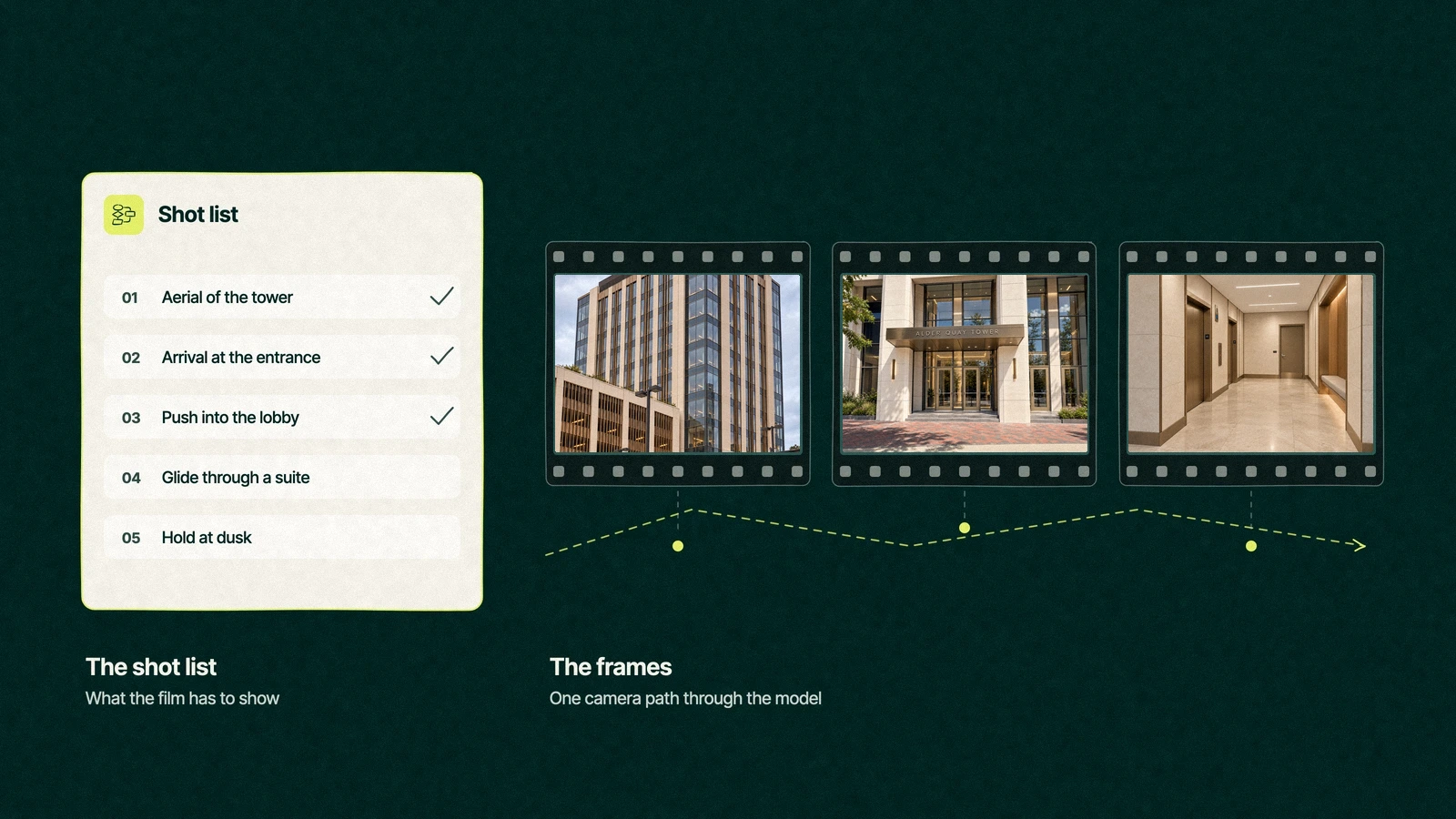
| 1. Location | High aerial that settles on the site from the nearest highway | Roads, neighbours and landmarks in context | 4 to 6 | High |
| 2. Arrival | Ground level move from the entry road to the front door | Planting, parking, signage, cars | 5 to 7 | Medium |
| 3. Lobby | Slow push through the doors to the reception desk | Full interior, furniture, lighting, people | 5 to 8 | High |
| 4. Typical floor | Glide through a furnished suite to the window | A second interior and the view outside | 5 to 8 | High |
| 5. Amenity | Short pan across a terrace or lounge | A third environment, often reused from a still | 3 to 5 | Medium |
| 6. Hero | Hold on the building at dusk with the logo and contact | Reuses the exterior from shot 2 | 3 to 4 | Low |
Six shots run about 30 to 40 seconds, which is the length most leasing films land on anyway. The cost weight column is what moves the quote, and the seconds column mostly doesn't.
To fill in your own version, work through it in this order.

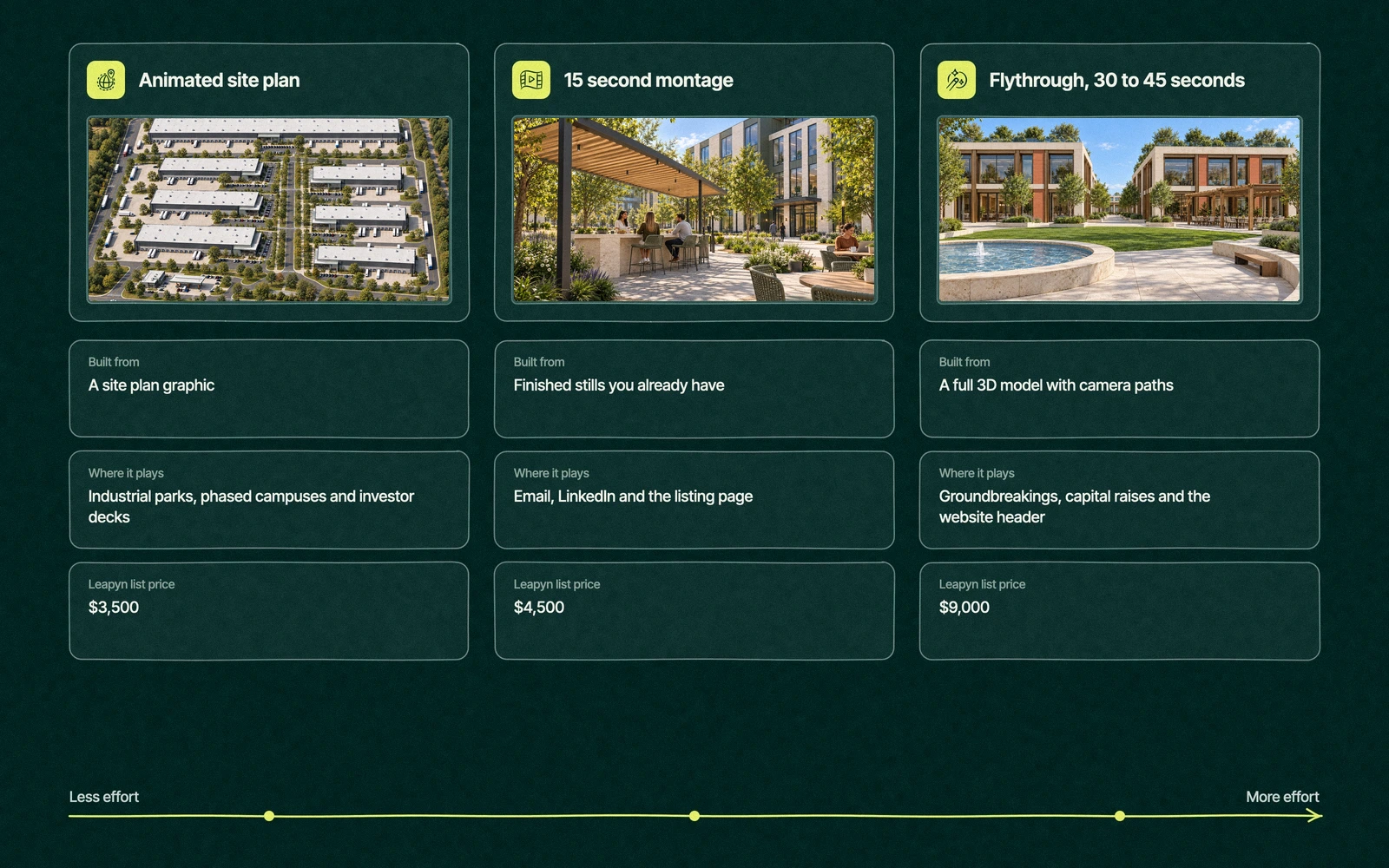
Most commercial projects don't need a full film first. Three shorter formats cover most leasing and capital raise needs, and they're built from very different amounts of work.
| Format | What it is | Typical length | Leapyn list price | Best use |
|---|---|---|---|---|
| Animated site plan | The site plan builds itself on screen, with roads, buildings, docks and parking appearing in order | 15 to 30 seconds | $3,500 | Industrial parks, phased campuses, investor decks |
| Video montage | Finished stills cut together with slow camera moves, titles and music | 15 seconds | $4,500 | Email, LinkedIn, the listing page, the leasing center screen |
| Flythrough | A camera path through the full 3D model, outside and in | 30 to 45 seconds | $9,000 | Groundbreakings, capital raises, the property website header |
The montage is the format people underestimate, and the one that cuts architectural animation cost the most. Because it's cut from stills you already paid for, it costs half a flythrough and fits the places a film gets watched, which are mostly small screens with the sound off.
Your email for great content delivered to your inbox. Regularly. Unless we forget. Or get busy. But we'll try.
The same few things push every quote up, and most of them are decisions the owner makes before a frame is rendered. Ranked by how much they move the 3D walkthrough animation cost on a commercial project, they look like this.
Voiceover deserves one more line of caution. A narrator explaining what the picture already shows adds cost and rarely adds a tenant, so most leasing films run on music and a few words of on screen text.
Resolution matters less than people expect. Rendering at a size that holds up on a lobby screen adds computer time, while the hours of modelling stay the same.
Back in the lender's conference room, picture the same budget spent from a shot list instead of a mood board.
The developer writes down what the credit officer needs to believe. The site is easy to reach, the building looks finished and expensive, and the first floor lobby will impress a tenant. That's three shots, plus a hold on the exterior at the end.
The film now opens on the building at the corner, not the clouds. The aerial comes second and lasts long enough to show the highway exit. The lobby gets eight seconds instead of four, with people at reception so it reads as a place people work.
The cut runs 35 seconds. The developer also gets a 15 second montage from the stills for LinkedIn, and spends the savings on a rendered spec suite he can show the next tenant. The trees, to their credit, take the cut in screen time well.
A film is a great way to show movement through a place, and a poor way to show a facade that looks best standing still. Before paying for camera paths, check where the film will be watched and for how long.
Viewers drop off fast. In Wistia's analysis of more than 13 million videos for its 2026 State of Video report, videos under a minute averaged a 52% engagement rate, meaning viewers typically watched about half.
The platforms say the same thing in their own specs. LinkedIn's video ad specifications recommend 15 to 30 seconds, and its in stream ads cap at 90. On YouTube Shorts, most songs from its audio library can run for up to 90 seconds, so even the music has a clock.
A short montage or a few strong stills often win when the goal is a click, and a flythrough earns its price when the arrival or the site is the argument. For the wider menu of stills, films and tours, read our explainer on architectural visualization. If the space already exists and the question is a walkthrough, read when a scan does the job for less in our guide to virtual tours for commercial real estate.
Timing follows the same logic as price. A film takes longer than stills because every frame needs the care of a still, and the schedule moves at the speed of your approvals, and the stage by stage schedule is in how long 3D rendering takes.
We make real estate renderings and animation from the same model, so the stills and the film agree on every brick, and the architectural animation cost starts from work you've already approved. Our list prices run $3,500 for an animated site plan, $4,500 for a 15 second montage cut from stills and $9,000 for a flythrough lasting 30 to 45 seconds.
A still costs $1,000 per view once the model is approved, and our 3D rendering cost guide breaks down what moves a still price. Films reuse the stills' model, so ordering both together costs less than ordering them a month apart.
As a full service team, we cut the montage for email and LinkedIn and put the flythrough at the top of the property website, while our real estate photography and video crew adds drone and progress footage as the building rises. The stills behind every film are explained in our pillar on architectural rendering.
Hand us the shot list, even a rough one. We'll price every second of it. Price your animation before anyone films a single cloud.
“
The first call felt like talking to someone who already understood our business. We didn’t have to explain the basics. They showed up with questions that mattered.
James L.

Director of Growth, HR tech
Client
FAQ
For a commercial building, budgets usually start in the low thousands for an animated site plan or a montage cut from stills, and reach five figures for a full flythrough with interiors. The biggest variables are how many environments the camera visits, how much surrounding context needs modelling, moving people and vehicles, music and voiceover, and how many revision rounds are agreed upfront.

Thirty seconds of architectural animation can cost very different amounts depending on what the camera sees. Thirty seconds circling one exterior is far cheaper than thirty seconds that enter a lobby and a suite. As a reference, Leapyn publishes $9,000 for a flythrough running 30 to 45 seconds, and $4,500 for a 15 second montage cut from stills.
Two minutes of film usually means more shots and more environments, so expect a price well above a 30 second flythrough rather than a simple multiple of it. Ask for a quote built on a shot list, since a long cut that revisits the same rooms costs less than one that keeps adding new spaces. Many commercial projects find a shorter film watched in full beats a longer one.
Studios often quote per second or per finished minute, but those numbers are a shorthand for the work behind each shot. A second of moving people in a furnished lobby takes far more modelling and rendering than a second of sky. Asking for a per project price tied to an agreed shot list gives you a firmer number and fewer surprises at the revision stage.
A flythrough earns its price when the argument is movement, such as how tenants arrive, how close the highway is or how a campus connects. For a single building with a strong exterior, a montage cut from stills often does the job for about half the cost. Plan the film with the stills so both come from one model and match.
Stay updated
Keep reading