HR software selection, seen from the vendor's side of the table
How HR teams choose software, step by step, and the asset an HR tech vendor should put in front of each reviewer before the deal goes quiet.
Marketing strategy
Tech and SaaS
The Leapyn team
November 17, 2026
11 min read
In this post
toc
The sales engineer for an employee onboarding platform is still on the bleachers after her daughter's volleyball practice has cleared out, an RFP binder open on her lap, when the email lands. The demo went well, the HR director said so on camera, and the deal has now moved to a stage the prospect calls IT and finance review.
Neither the IT director nor the controller was on the call. They have a security questionnaire, a scoring grid with three vendors on it and a deadline, and they'll decide from whatever the vendor's website and the champion's notes can tell them.
That's how most HR software selection works once you see it from the buyer's side. It's a relay with five or six handoffs, and the vendor only gets to run one lap of it in person.
This guide walks the process the way HR teams run it, then turns the table around to show what each reviewer needs from the vendor at every step.
How does HR software selection work?
HR software selection usually runs in six steps. HR defines the problem and the budget, builds a longlist from peers and review sites, sends an RFP or a requirements list, scores scripted demos, passes the finalist through IT security and finance review, then takes a business case to leadership for signature.
Each step has a different reader with a different question. The vendors that win plan an asset for every one of them, and the ones that lose send the same deck to all six.
Most of that process happens before a vendor hears a word. In 6sense's 2025 Buyer Experience Report, as CustomerThink summarized the study of nearly 4,000 B2B buyers, first contact with a seller came 61% of the way through the buying process, down from 69% in earlier studies. Buyers then bought from their top-ranked vendor 77% of the time.
The longlist is written before you get the email
HR teams rarely start from a blank page. They start from whatever names are already in their heads, then check those names in a handful of places that most vendor marketing plans underrate.
Peers. Private HR communities, local SHRM chapters and group chats where someone will say exactly what broke in their first year on a system.
Review sites. HR buyers read G2 category grids and filter reviews by company size, so a vendor with three glowing reviews from much bigger companies looks less relevant than it should.
AI assistants. A people ops lead asks which HRIS suits a few hundred employees with hourly staff in several states, and the answer arrives with three names already chosen.
The systems they already own. Payroll providers and HRIS platforms run integration marketplaces, and a listing there puts you in front of buyers who are halfway through a decision.
Consultants and brokers. On bigger deals, an HR tech advisor or benefits broker often writes the longlist and runs the process.
If you're missing from those five places, the first sign of an evaluation is an RFP from a company that already has a favorite. Your job at that point is to be a very convincing second choice, which is a hard way to make a living.
Comparison pages earn their keep at this stage. A buyer who types an HR software comparison into Google is building the list that day, and a fair page comparing you with the two names they already know is often how a third name gets added.
What goes into an HR software RFP?
An HR software RFP asks the same handful of things in a different order every time. Larger companies send a formal document, while smaller ones send a requirements spreadsheet and call it a day.
Either way, the evaluators score your answers against your competitors' in a grid. Every question in that grid already has a page somewhere on a vendor's website, and the vendor whose page is clearest gets scored before it's even asked.
RFP section
What HR is checking
The page that should answer it first
Functional requirements
Whether each module does the job without a workaround
Product pages with screenshots of the workflow, written in HR's words
Integrations
Payroll, benefits, ATS and identity connections, and who maintains them
An integrations directory that marks native connectors and partner-built ones
Security and privacy
Certifications, data residency, access controls and retention
A trust or security page with a downloadable security pack
Implementation
Timeline, who does the work, what the customer must supply
An implementation page with a sample plan by company size
Pricing and contract
Total cost over the term, fees outside the subscription, exit terms
A pricing page that shows the model and what changes the price
References
Customers like them who will take a call
Case studies sorted by company size and industry
Integration answers deserve extra care, because they decide which category of system HR thinks it's buying. If the evaluator is still sorting HRIS from HCM, our guide to HRIS vs HCM vs HRMS covers the definitions your product page should match, and our post on the HR tech stack shows where your product sits next to the rest of their systems.
What questions do HR teams ask in a software demo?
Search for demo questions to ask HR software vendors and you'll find buyer's guides telling HR to hand every vendor the same script. TechTarget's 2026 advice on HR software selection goes as far as telling buyers to control the demonstration, and good evaluators do.
The questions below come up in most scripted demos, roughly in this order.
Show me a manager approving time off from a phone, start to finish.
Which integrations are native, and which belong to a partner?
How long did implementation take for a customer our size, and who did the work?
What happens to our data if we leave, and in what format do we get it back?
What will this cost in year two, after any first-year discount ends?
Can we speak to a customer who switched from the system we use now?
The demo that follows the script beats the demo that shows the roadmap, because evaluators score what they saw. A roadmap slide is a promise with a font.
Marketing can help here more than most teams realize. Short recorded clips of the six workflows above, posted on the product pages, let the evaluator rewatch the answer when they fill in the scorecard that night.
Trade You.
Your email for great content delivered to your inbox. Regularly. Unless we forget. Or get busy. But we'll try.
Thank you! Your submission has been received!
Oops! Something went wrong while submitting the form.
The IT director who arrived after the demo
Say a shift scheduling app for hospital groups wins over a nursing operations director in the spring. She runs the evaluation, her team loves the mobile app and the vendor is the clear favorite after the scripted demo.
Then the hospital's IT security lead joins, weeks into the process. He sends a long questionnaire about single sign-on, audit logs, data retention and where patient-adjacent schedules are stored, and the vendor's sales team spends a fortnight gathering answers from engineering.
The champion keeps asking for an update she can pass on. By the time the answers arrive, the budget meeting has moved, and the deal slides into the next quarter with a new competitor added to the list.
The product didn't change and neither did the price. What changed the outcome was a missing security page, a missing pre-filled questionnaire and a champion left holding the silence. Security questionnaires don't get shorter because the champion likes you.
Who joins late and can still say no
HR leads most evaluations, but HR rarely signs alone. Sapient Insights Group's 2026 to 2027 HR Systems Survey found executives now lead 31% of HR system selections, up from 25% in 2024, so the person who decides is often the one who skipped the demo.
If you've ever searched what does a CHRO do, the useful answer for a vendor is that the CHRO owns the people strategy and spends political capital on very few software bets. They'll back yours when it makes them look prudent to the CEO and the CFO in the same meeting.
Two more seats fill late in HR software selection at bigger companies. Procurement wants the contract terms in its own template, and legal reads the data processing agreement, so both should get a clean document set the day they're added to the thread.
Selection stage
Who is in the room
What they ask the vendor
The asset that answers it
Longlist
HR manager or HR operations lead
Do you serve companies like ours?
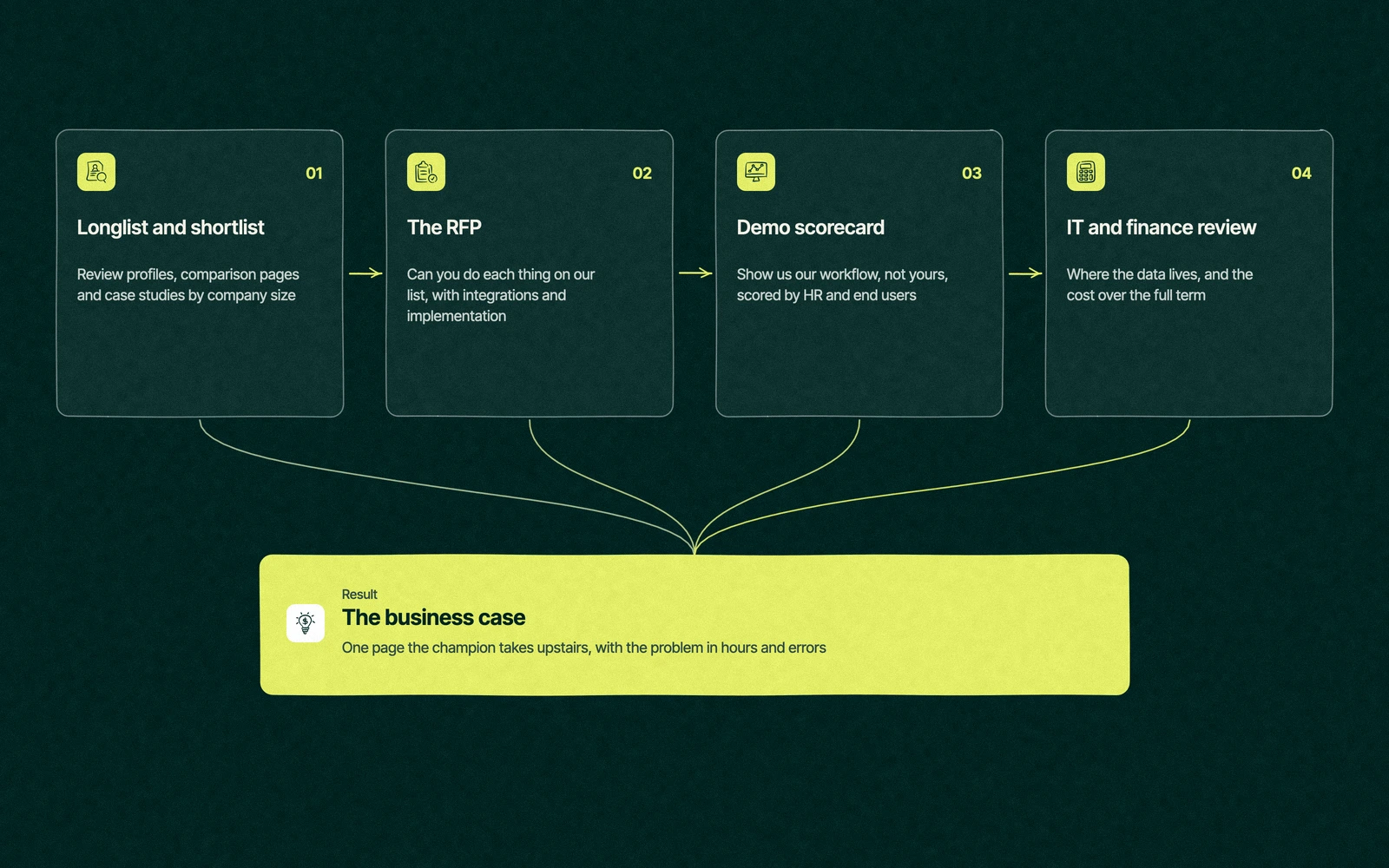
Review profiles, comparison pages and case studies by company size
RFP or requirements
HR team, sometimes procurement
Can you do each thing on our list?
Product, integrations and implementation pages
Scripted demo
HR team and a few end users
Show us our workflow, not yours
Workflow clips and a demo built from their script
IT review
IT or security lead
Where does the data live, and who can see it?
Security pack and a pre-filled questionnaire
Finance review
Controller or CFO
What does this cost over the full term?
Written pricing with every fee and a payback case
Final approval
CHRO, CEO or an executive sponsor
Is this the safe choice?
A one-page business case and a peer reference
The finance column is where many deals stall, so price it like you expect to be read closely. Our guide to HR software pricing covers the fees buyers find after the demo.
Write the business case your champion can't
The HR director who chose you now has to sell you upstairs, and most HR leaders didn't take the job to write ROI models. The vendor that drafts the business case for them gets to frame the decision.
A good one fits on a page and covers five things.
The problem in hours and errors, using the buyer's own numbers from discovery.
What staying put costs over the next year, including the workarounds and the spreadsheets.
Total cost across the term, with implementation and any services listed separately.
The implementation plan, the internal people it needs and when they're needed.
The risk if it goes wrong, and the exit terms that limit it.
The CFO reads a business case the way an auditor reads a receipt, line by line and looking for what's missing. Leave the confetti for the onboarding email.
The packet that travels without you
After the demo, the vendor goes quiet and the documents keep selling. Everything you send in the first few days will be forwarded to people you've never met, so write each piece for a stranger.
The strongest follow-up packets include a recap mapped to the buyer's own scorecard, the clips of the workflows they asked to see, the security pack, written pricing with year two spelled out, a reference customer of the same size and a draft of the business case above. Sales sends it, but marketing should build it once and keep it current, because every deal needs the same six pieces.
If you use HubSpot, our post on HubSpot for HR tech shows how to track each reviewer as a contact on the deal, so nobody on the committee is a surprise. For accounts with a larger committee, our guide to ABM for HR tech plans content for each seat at the table.
Building the pages buyers score you on
Most of what wins a selection is marketing work that sales gets credit for. That's the comparison pages, the security and integrations pages, the workflow clips and the business case template, and we build them as part of our product marketing work for software companies.
The senior marketers you meet at Leapyn write those pages themselves, and new assets ship every week, so the packet is ready before your next RFP lands. For a named list of accounts, our account-based marketing program puts the right page in front of each reviewer.
Send us the last RFP you lost. We'll mark every question your website should have answered before it arrived.Book a free strategy session and leave with the three pages we'd build first.
“
The first call felt like talking to someone who already understood our business. We didn’t have to explain the basics. They showed up with questions that mattered.
James L.
Director of Growth, HR tech
Client
FAQ
Frequently asked questions
How do companies choose HR software?
+
A typical process starts with HR defining the problem and budget, then building a longlist from peers, review sites and AI assistants. The team sends an RFP or requirements list, runs scripted demos with a scorecard, puts the finalist through IT security and finance review, and takes a business case to an executive. Larger companies add procurement and legal before signature.
What should HR ask vendors in a software demo?
+
Expect questions about the exact workflows HR runs every week, such as time off approval from a phone, plus integrations, implementation time for a company of the same size, data export on exit and the price in year two. Good evaluators hand every vendor the same script and score what they saw, so vendors should demo the script and skip the roadmap.
Who makes the final decision on HR software?
+
HR leads most evaluations, but the signature often belongs to someone else. Executives now sign off on a growing share of HR system purchases, often after skipping every demo. IT and security can veto on data handling, and the CFO or controller approves the spend, so vendors need an answer ready for each of them.
How long does HR software selection take?
+
Smaller companies replacing spreadsheets can finish in a quarter, while mid-market and enterprise evaluations with an RFP and security review take longer. Across B2B purchases, the 6sense 2025 Buyer Experience Report put the average buying cycle at 10.1 months, down from 11.3 in 2024. Missing security answers and late executive reviews are the usual causes of delay in HR deals.
How do you sell to a CHRO?
+
CHROs respond to proof that a system lowers risk and frees their team's time, presented in terms the CEO and CFO will accept. Give them a one-page business case, a peer reference at a similar company and clear exit terms. Agencies such as Leapyn build those assets for HR tech vendors, but the vendor's own customer stories carry the most weight with a CHRO.
Written by
The Leapyn team
Senior marketers who run strategy, creative and demand gen for B2B companies. We write about what’s working for our clients right now.