Strategy, creative and execution, all in house.

See pricing →

Every channel, one team, weekly results.

See pricing →

Work that ships weekly and looks like you.

See pricing →

Every channel, one team, weekly results.

See pricing →

Different buildings. Same obsession with leases.

See pricing →

Different buildings. Same obsession with leases.

Pricing and packages →

Different products. Same obsession with pipeline.

All SaaS and technology work →

Different trades. Same obsession with booked jobs.

All home services work →

Different practices. Same obsession with signed clients.

All professional services work →
Thank you! Your submission has been received!
Oops! Something went wrong while submitting the form.

Website development

HR software pricing, from PEPM to the fees buyers find later

What HR software costs per employee according to vendors' own pricing pages, the models behind those numbers and the pricing page that finance will forward.

HR software pricing, from PEPM to the fees buyers find later

In this post

  1. toc

There's a red circle on page three of the order form the sales lead hands over at the office copier. The head of product marketing for a benefits administration platform knows the deal well, since it has been a verbal yes for most of the quarter.

The prospect's CFO drew the circle around the implementation fee and wrote a single question mark beside it. The HR director had budgeted from the HR software pricing on the vendor's website, which showed a per-employee rate and nothing else, and the fee first appeared with the paperwork.

The fee is reasonable and covers weeks of setup work. The trouble is that the buyer met it last, which is the most expensive place for any price to appear.

This guide answers the buyer's question first, with prices taken from vendors' own pricing pages. Then it switches sides, for the companies deciding how to price and show their product.

Contract page with one red pen circle lifted from an office copier, the moment HR software pricing gets checked

How much does HR software cost per employee?

Most HR software is priced per employee per month. Published list prices for core HR start around $8 to $10 per employee per month, payroll and benefits modules add to that, and small companies often pay a flat monthly rate instead. Many vendors publish no price at all and quote after a demo.

The table below shows what four vendors list on their own pricing pages, checked on November 9, 2026. Prices change, so treat it as a snapshot of how vendors present the number as much as the number itself.

Vendor and planPublished priceWhat the page leaves to a quote
BambooHR Core, Pro and Elite$10, $17 and $25 per employee per month, or a flat $250, $425 and $650 a month for 25 or fewer employeesPayroll, benefits administration, time and attendance and global employment
Rippling plansFrom $8 per employee per month, plus a monthly base feeThe base fee and the price of each product, set by products chosen and headcount
Deel contractors, US PEO and EORFrom $49 per contractor, $125 per US PEO employee and $599 per EOR employee each monthA separate price for HR and payroll, which the page names but doesn't list
HiBob modulesNo published priceEverything, through a demo request that asks for employee count

So how much is an HRIS for a company of two hundred people? On BambooHR's published Core rate it's about $2,000 a month before payroll or benefits, and on any quote-only vendor it's whatever the first sales call says. Third-party guides put the typical range higher, and G2's 2025 HR software pricing guide lands on $15 to $30 per employee per month once common modules are added.

The useful habit for buyers is to price the HRIS cost per employee for the full bundle they need, then multiply by the headcount they expect in year two, because the contract will.

Which HR software pricing models do vendors use?

HR software pricing uses a short list of models, often combined on one order form. Most of them are standard SaaS pricing models with a headcount twist, because HR software counts people rather than seats.

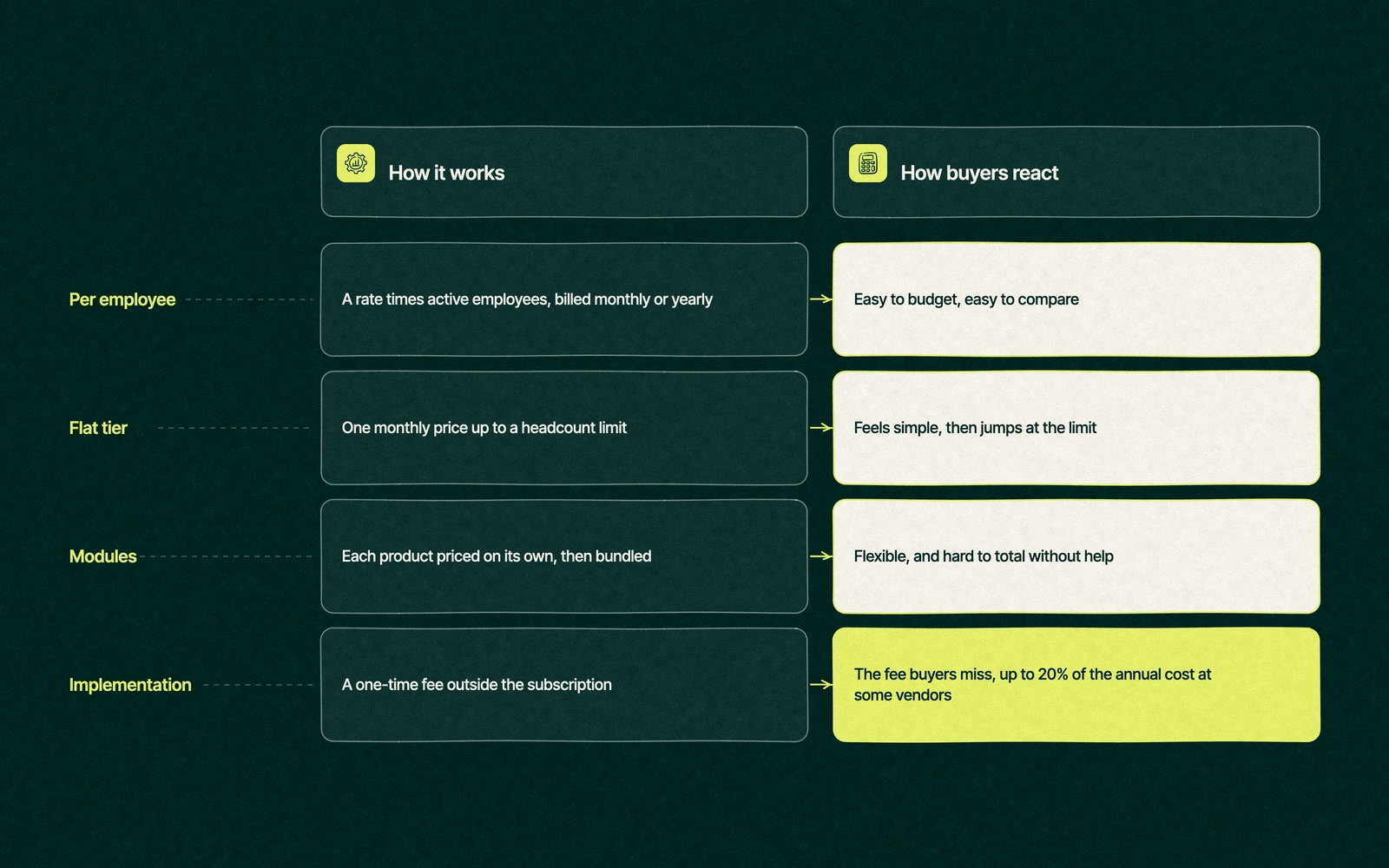
Comparison of PEPM, tiered and modular HR software pricing models with the implementation fee highlighted
Pricing modelHow it worksWho uses it (public pricing only)Buyer reactionPricing page tip
Per employee per monthA rate times active employees, billed monthly or yearlyBambooHR plans, Rippling productsEasy to budget, easy to compareSay who counts as an employee, including part-time and terminated staff
Flat tier for small teamsOne monthly price up to a headcount limitBambooHR for 25 or fewer employeesFeels simple, then jumps at the limitShow the limit and the price on the other side of it
Modules or productsEach product priced on its own, then bundledRippling, BambooHR add-onsFlexible, and hard to total without helpOffer a sample bundle for a typical company size
Base fee plus per employeeA fixed platform charge plus a rate per personRipplingFine once the base fee is visiblePublish the base fee, or at least its range
Per worker typeDifferent rates for contractors, PEO employees and EOR employeesDeelClear for global teams, confusing for one-country buyersLead with the worker type the visitor came for
Quote onlyPrice set after a demo and discoveryHiBobAssumes it's expensiveAt least show what changes the price

PEPM pricing wins on comparability, which is also its weakness. When every vendor quotes a rate per employee, buyers line them up in a spreadsheet and the cheapest rate gets the first call, whatever sits behind it.

For the vendor, the choice of model follows the customer. A tool sold to small employers with high turnover does best with a flat tier, because the buyer wants one number and hates a bill that moves every month. A mid-market HRIS sold with payroll and benefits usually needs modules, since no two customers buy the same bundle.

Global employment products price by worker type because the cost to serve a contractor and an employer of record employee is wildly different. Whatever the model, pick the unit your buyer already counts in their own budget, which for HR is almost always people.

The fees that show up after the demo

The subscription is the number buyers compare, and it's rarely the number they pay. These are the charges that tend to surface between the demo and the signature.

  • Implementation. G2's guide, citing OutSail, notes that some vendors charge implementation fees of up to 20% of the annual software cost.
  • Base or platform fees. A monthly charge on top of the per-employee rate, which Rippling's pricing page mentions without listing.
  • Modules sold separately. Payroll and benefits are often quoted apart from core HR, as on BambooHR's page.
  • Minimums. A floor on headcount or monthly spend, which hits small and seasonal employers hardest.
  • Term commitments. Deel's page notes that its PEO promotion for order forms signed from July 15 to December 31, 2026 requires a two-year minimum term.
  • Year two. First-year discounts end, and headcount growth raises the bill with them.

None of these is unfair on its own. They become a problem when the champion has already promised her CFO a single number, and the order form shows a different one.

Marketing can defuse most of them before sales ever sends a quote. Put the one-time fees on the pricing page, describe what implementation includes on its own page and give the year-two price in writing, so the CFO meets every number once, early, from you.

Trade You.

Your email for great content delivered to your inbox. Regularly. Unless we forget. Or get busy. But we'll try.

Thank you! Your submission has been received!
Oops! Something went wrong while submitting the form.

Discounts that come back for the renewal

Most HR software deals carry a first-year discount, and many carry a ramp, where the customer pays for part of its headcount while the product goes live one location or one module at a time. Both make the first invoice smaller and the second one larger.

Procurement teams know this, which is why they ask for a cap on renewal increases and a price lock for a set term. A buyer who has been burned by a renewal letter once will ask in the first meeting.

Vendors gain more from answering that question early than from avoiding it. State the renewal terms on the pricing page or in the proposal template, explain how headcount true-ups work and say what happens to the price when a customer shrinks, because seasonal and hourly employers do.

A discount that isn't in writing tends to expire in the customer's memory first. Finance remembers the higher number, and the next deal starts with that story.

The order form that cost a quarter

Say an employee recognition app shows one friendly per-employee price on its website. The HR director multiplies it by headcount in the elevator, gets the budget approved and tells her CFO the project is covered.

Then the order form arrives with a platform fee, an onboarding package and an annual minimum. Each line is fair, and together they make the HR director look careless in front of the person who approves her next request.

Finance asks for time to review. The vendor waits, offers a discount to restart the conversation and closes a quarter late at a price that gives back most of the fees.

The same deal with every fee on the pricing page would have closed on the original date at full price. Buyers forgive a high price far more readily than a surprise, and so do their CFOs.

Why don't HR software companies publish prices?

Vendors keep prices off the page for understandable reasons. The price moves with headcount, modules and countries, enterprise deals are negotiated, and nobody wants to hand a competitor its rate card.

The catch is that your price gets published anyway. G2's 2025 guide lists BambooHR at $12 to $22 per person a month, while BambooHR's own page now shows $10 to $25 across its three plans, so buyers comparing the two sources meet two different answers before they meet a sales rep.

Your price is public either way. The only choice is whether you wrote it.

Quote-only pricing still makes sense in a few places, such as large enterprise deals with custom integrations or global payroll across many countries. Even then, the page can show what moves the price and a starting range for a typical company, which gives finance enough to keep you on the list.

Search demand says the same. Our Semrush data from November 2026 puts the Google Ads cost for hr software pricing at about $47 a click, which means rivals are paying to show their numbers to the buyer your page sends to a form. Contact us for pricing is a sentence finance translates as expensive.

What should an HR tech pricing page show?

A good HR tech pricing page has two readers. HR wants to know which plan fits, and finance wants a total it can defend, so the page has to answer both before the champion forwards the link.

  1. The unit you charge for, such as active employees, contractors or locations, and who counts.
  2. A starting price or a range by company size, even if the final number comes from a quote.
  3. What each plan includes, written in HR's words rather than feature names.
  4. Add-ons with a price or a "from" figure, so payroll and benefits don't arrive as news.
  5. One-time fees, including implementation, with what the customer gets for them.
  6. The contract term, how billing works and how a customer leaves.
  7. A worked example for a typical customer size, which finance can copy into its spreadsheet.

People who search HR software pricing per employee are usually looking for that seventh item. A worked example is the line most likely to be pasted into an internal email, so write it as if the CFO will read it, because the CFO will.

The page itself is a website job, and our guide to HR software website design covers how it sits next to the demo and comparison pages. Pricing also shapes who the product is for, which our HR tech go-to-market guide treats as a launch decision.

Pricing is one step of a longer evaluation. Our guide to HR software selection shows when finance joins, and our posts on HRIS, HCM and HRMS and the HR tech stack explain why buyers price a bundle rather than one product.

A pricing page finance forwards back

We'd rather show a price than hide one, which is why our own pricing page lists a project fee, an à la carte monthly fee per service and a retainer from $150 an hour on a six-month term. Every engagement is a fixed price agreed in writing before work starts, the same standard we'd hold your pricing page to.

For HR tech companies, a pricing page rebuild usually sits inside our UX and conversion work, and a new pricing model belongs in a go-to-market plan. Read how we work as an HR tech marketing agency, or start with our full guide to HR tech marketing.

Send us your pricing page as it stands today. We'll show you the line finance will circle first and how to rewrite it. Book a free strategy session and bring the order form too.


“

The first call felt like talking to someone who already understood our business. We didn’t have to explain the basics. They showed up with questions that mattered.


James L.

Director of Growth, HR tech

Client

FAQ

Frequently asked questions

How much does an HRIS cost per employee?

+

List prices for core HR on vendors' own pricing pages start around $8 to $10 per employee per month in 2026, with BambooHR at $10 to $25 across three plans and Rippling from $8 plus a base fee. Payroll, benefits and time tracking usually cost extra. Third-party guides such as G2's put typical totals at $15 to $30 per employee once modules are added.

What is PEPM pricing?

+

PEPM stands for per employee per month. The vendor multiplies a monthly rate by the number of employees in the system, so the bill grows with headcount. Most HR software uses it because it scales with the customer. Buyers should ask who counts as an employee, including part-time, seasonal and terminated staff, and whether the rate changes at higher headcounts.

Why do HR software vendors hide their prices?

+

Vendors keep prices off the page because the number depends on headcount, modules and countries, and enterprise deals get negotiated. Buyers often read a missing price as a high one, and review sites publish estimates anyway. Leapyn's own pricing page lists its project, monthly and retainer prices for the same reason it recommends published ranges to HR tech companies.

Are there implementation fees for HR software?

+

Implementation fees are common, especially for HRIS and payroll. G2's 2025 guide, citing OutSail, says some vendors charge up to 20% of annual software costs for implementation. Ask what the fee covers, such as data migration, configuration and training, how long the work takes and whether any of it can be waived on a multi-year contract or done by your own team.

Is per employee HR software pricing better than flat pricing?

+

Flat pricing suits small and stable teams, since the bill stays the same each month and is easy to budget. Per employee pricing suits growing companies, because they pay only for the people they have, though costs rise with every hire. Some vendors use both, with a flat rate up to a headcount limit and per employee pricing above it.

Leapyn frog mark for the Leapyn team, authors of the B2B marketing blog

Written by

The Leapyn team

Senior marketers who run strategy, creative and demand gen for B2B companies. We write about what’s working for our clients right now.

More from this author →

If you like us here, you'll love us on LinkedIn.

Stay updated

Keep reading

Related articles