Strategy, creative and execution, all in house.

See pricing →

Every channel, one team, weekly results.

See pricing →

Work that ships weekly and looks like you.

See pricing →

Every channel, one team, weekly results.

See pricing →

Different buildings. Same obsession with leases.

See pricing →

Different buildings. Same obsession with leases.

Pricing and packages →

Different products. Same obsession with pipeline.

All SaaS and technology work →

Different trades. Same obsession with booked jobs.

All home services work →

Different practices. Same obsession with signed clients.

All professional services work →
Thank you! Your submission has been received!
Oops! Something went wrong while submitting the form.

Content

AI HR tools, sorted by what HR will pay for

Which AI HR tools HR teams trust and pay for, the evidence they ask for first and how HR software companies should sell an AI feature to a skeptical buyer.

AI HR tools, sorted by what HR will pay for

In this post

  1. toc

Halfway through the car wash, the founder of a performance review app opens the procurement questionnaire a prospect sent overnight. The prospect found her product on a list of AI HR tools and liked the demo.

The questionnaire has a whole section on the AI. Where does employee data go, is it used to train a model, has the review-writing assistant been tested for bias and does a manager approve every draft before an employee sees it?

She has good answers to most of it, but none of them are on her website. Her homepage says AI more often than it says employees.

This guide sorts AI in HR by use case and by how close each one is to a signed contract, lists the proof HR asks for and ends with how vendors should market an AI feature to buyers who are tired of hearing about it.

Long AI HR tools questionnaire on a clipboard in a car wash waiting room, a foamy green car outside

What are AI HR tools?

AI HR tools are software that uses machine learning or large language models to handle parts of HR work, such as answering employee policy questions, drafting job descriptions and reviews, summarizing survey comments, forecasting attrition and matching people to roles. Most are features inside an HRIS or HCM suite, and a growing number are standalone assistants.

Adoption moved faster than the forecasts. Sapient Insights Group's 2026 to 2027 HR Systems Survey found 55% of organizations now use AI in HR, against the 44% the same survey had forecast a year earlier.

Where the AI lives matters to the buyer as much as what it does. HR teams generally prefer AI inside the HRIS they already own, because the data, permissions and audit trail are already there, so standalone AI HR tools have to earn their place with a sharp use case and an integration that works on the first day of the pilot.

Search for the topic and you'll notice who writes the answers. The top results are tool lists published by HR software companies, and Workhuman's 2026 list, for one, puts its own platform at number one. Every vendor list of AI tools for HR has one thing in common, which is the vendor.

Where AI already earns its keep in HR

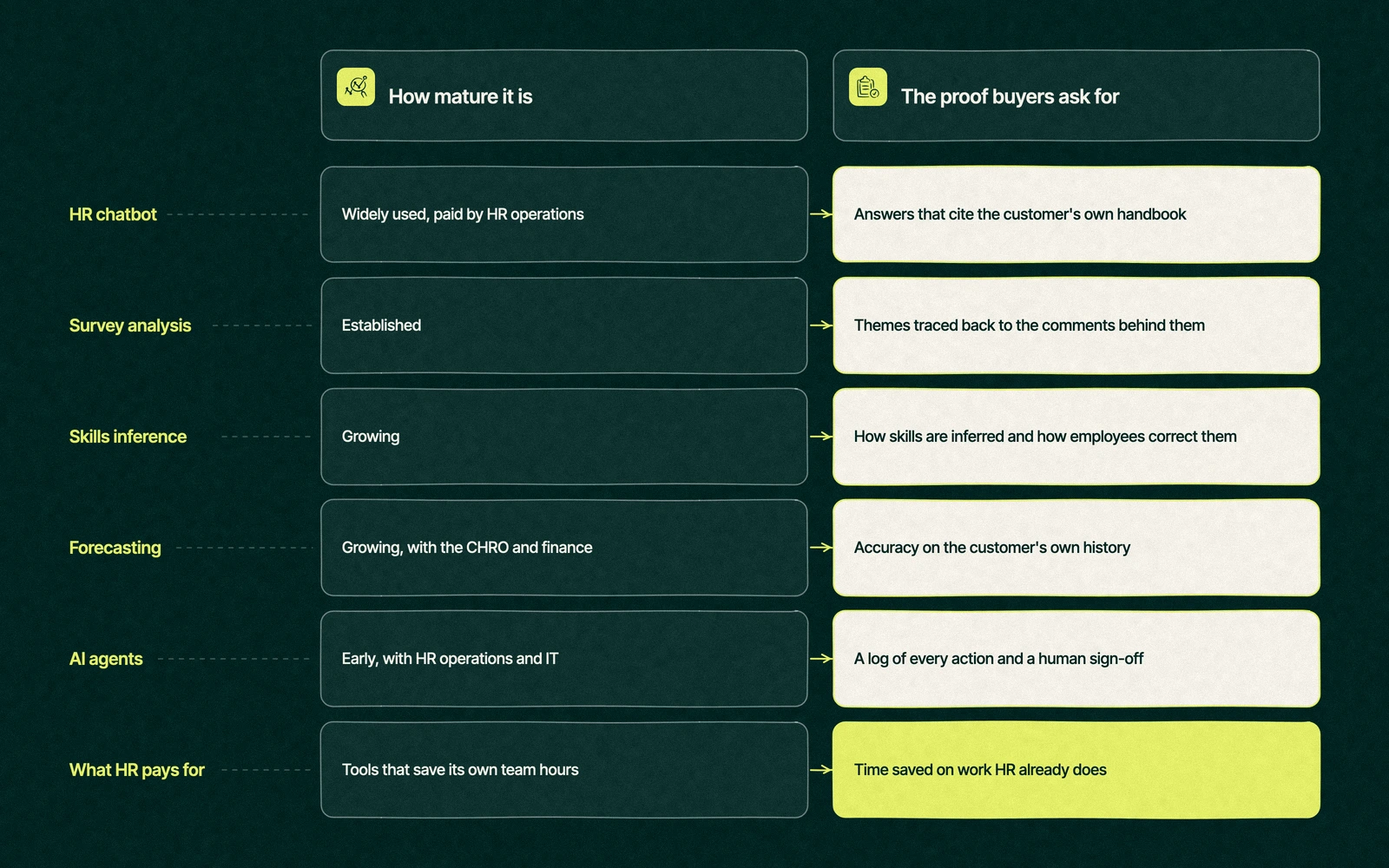
Some AI in HR is already routine, and some is still a pilot with a press release. The table sorts the common use cases by how mature they are in our reading of the market, who usually funds them and what the buyer asks to see first.

AI use caseMaturityWho paysProof buyers ask forRed flag
HR chatbot for policy and benefits questionsWidely usedHR operationsAnswers that cite the customer's own handbookAnswers drawn from generic templates
Writing help for job descriptions, reviews and lettersWidely usedHR and people managers, inside the suiteA manager approval step and an edit historyDrafts sent to employees without review
Survey and comment analysisEstablishedPeople analytics or HR business partnersThemes traced back to the comments behind themSentiment scores with no source
Skills inference and internal mobilityGrowingTalent and learning teamsHow skills are inferred and how employees correct themSkills profiles employees can't see
Attrition and workforce forecastingGrowingCHRO and financeAccuracy on the customer's own historyIndividual flight-risk scores shown to managers
Agents that complete multi-step HR tasksEarlyHR operations and IT togetherA log of every action and a human sign-offAgents that change records with no approval

The pattern is plain enough. HR pays soonest for tools that save its own team hours on work it already does, and slowest for tools that make judgments about people.

Hiring tools sit at the far end of that scale. Screening and ranking candidates carries the heaviest legal and reputational risk in HR, so those products face a longer evaluation with legal in the room, and they deserve a playbook of their own.

For a vendor, the table doubles as a sales forecast. A product in the top rows can sell on a short pilot and an HR operations budget, while a product in the bottom rows should plan for IT, legal and finance to join before anyone signs.

Comparison of AI HR tools by maturity and the proof required, with time saved as what HR will pay for

What is agentic AI in HR?

Agentic AI in HR means software that carries out a sequence of steps across systems on its own, such as opening a new hire's accounts, scheduling orientation and updating the HRIS record. It differs from a chatbot, which answers, and from an assistant, which drafts something for a person to finish.

The three words get used interchangeably in marketing, which is part of why buyers distrust them. A working set of definitions helps both sides.

  • Chatbot. Answers questions from a fixed set of sources, like a benefits guide or the employee handbook.
  • Assistant. Drafts, summarizes or suggests, and a person decides what happens next.
  • Agent. Takes actions in other systems toward a goal, ideally with approval points and a log of what it did.

Plenty of buyers say they want AI agents for HR, and fewer are ready to let one change payroll records unsupervised. Vendors selling agentic AI HR features close faster when the demo shows the approval step as prominently as the automation.

Trade You.

Your email for great content delivered to your inbox. Regularly. Unless we forget. Or get busy. But we'll try.

Thank you! Your submission has been received!
Oops! Something went wrong while submitting the form.

How do HR teams test AI before they trust it?

HR teams test AI the way they test a new hire with access to everyone's salary. They check what it can see, who it reports to and what happens when it gets something wrong.

  1. Data handling. Where employee data goes, which model providers process it, whether it trains anyone's model and how long it's kept.
  2. Bias testing. For tools used in hiring or promotion, New York City's Local Law 144 on automated employment decision tools has required a bias audit within one year of use, a public summary of the results and notice to candidates since enforcement began on July 5, 2023. Buyers elsewhere now ask for the same evidence.
  3. A human in the loop. Who approves the output before it reaches an employee, and whether that step can be switched off.
  4. Sources. Whether each answer shows the policy or record it came from, so HR can check it in seconds.
  5. A pilot on their own material. The customer's handbook, their survey comments and their job architecture, with a scored test set.
  6. Time saved. The hours the pilot saved, measured against how the team worked before.

That last item is the one budgets follow. In the Sapient survey, 75% of AI users measure AI's value by time saved and only 8% by headcount reduction, so the vendor promising a smaller HR team is selling the outcome buyers measure least.

Expect most of these questions to arrive in writing. Security questionnaires now carry a section on AI, often written by a reviewer who has never seen the product work, so every answer has to stand on its own.

The pilot that read the wrong handbook

Say a benefits guidance startup pilots its HR chatbot with a regional manufacturer. The bot is quick and friendly, and in the first days it answers questions about leave, overtime and shift swaps with total confidence.

Then a supervisor notices that its leave answers come from a generic policy template, while the plant runs on a union contract with different rules. The HR director pauses the pilot the same afternoon, because an AI that's mostly right about leave is a grievance with a friendly interface.

The fix is unglamorous. The vendor limits the bot to the customer's uploaded documents, shows the source paragraph under every answer and routes anything outside those documents to a person.

The bigger fix is in the marketing. The citation and the handoff to a human should have been the first thing in the demo, because they're the reason an HR director can say yes.

The AI claims buyers have stopped believing

AI-powered is now the HR software equivalent of cloud-based, true of everyone and remembered by no one. The claims below have been repeated so often that buyers skim past them, and each has a piece of evidence that works better.

Claim buyers tune outWhy it stopped workingThe proof that replaces it
AI-poweredEvery vendor in the category says itThe specific task, shown end to end, with the hours it saves
Eliminates biasNo vendor can prove a negative, and buyers know itA dated bias audit summary and the method behind it
Replaces manual HR workThe buyer is the HR team being describedThe approval steps HR keeps, and what they do with the time back
Works out of the boxSapient found 36% of AI users adopted it ahead of their processes and data, with results about the same as non-usersThe setup plan, the data it needs and how long the pilot takes
Fully autonomous agentsHR is accountable for every record an agent touchesThe action log and the sign-off screen

The fear behind the replacement claim is overstated in the data too. Sapient found AI cited by 12% of organizations that reduced staff, up from 1% a year earlier, while business performance and restructuring remained the leading reasons at 35% and 31%. Buyers who use AI for HR mostly want their team back for harder work.

How should you market AI HR software in 2027?

Sell the task, and let the model stay in the footnotes. HR buyers search for the job they want done, so the pages that win name the job, show it working on realistic data and say who approves the result.

A trust page does more for AI HR software than another feature page. Put the data handling, model providers, retention, bias testing and admin controls on one public page, and link it from every AI claim, so the security reviewer finds it before the questionnaire goes out.

Price the AI as plainly as you describe it. Buyers want to know whether the assistant is included in their plan, sold as an add-on per employee or metered by usage, and a vague "AI features available" line sends that question to procurement, where it waits.

Proof should arrive in the buyer's unit, which is hours. If a pilot customer's HR team stopped answering the same leave question by email, say how many hours a month that freed, and get the customer's permission to put their name next to it.

Visibility in AI answers matters here more than almost anywhere. When a buyer asks an assistant for the best AI tools for HR, the answer is assembled from those vendor-written lists and from review sites, so an even-handed comparison page of your own and a place on other people's lists of AI HR tools both count. Our guide to SEO for HR tech covers how those answers get built.

For context on the wider market, our posts on HR technology trends and HR tech companies show where AI sits in the market, and our HR tech stack guide shows which systems your AI has to plug into.

Selling AI to people who have heard it all

Marketing an AI feature to HR is a positioning job first and a content job second, and it's the kind of work we do in product marketing for software companies. Our senior marketers write the trust page, the use case pages and the demo script.

Search is where much of this pays off. For Conduit Tech, HVAC software later acquired by ServiceTitan, organic search grew 1,389% year over year through our SEO and AEO work, and the same method applies to the questions HR buyers ask about AI.

See how we work as an agency for HR tech marketing, or read our full HR tech marketing playbook.

Forward us the AI questionnaire from your last security review. We'll turn your answers into the page buyers read before they ever send one. Book a free strategy session and we'll mark which claims on your homepage to cut first.


“

The first call felt like talking to someone who already understood our business. We didn’t have to explain the basics. They showed up with questions that mattered.

James L.

Director of Growth, HR tech

Client

FAQ

Frequently asked questions

What are the best AI HR tools?

+

The strongest choices depend on the job. HR chatbots that cite your own handbook, writing assistants inside your HRIS and survey comment analysis are the most mature. Skills inference and forecasting are growing, and agents are early. Most published rankings are written by HR software vendors that list themselves, so judge any tool on a pilot with your own data.

What is agentic AI in HR?

+

Agentic AI describes software that completes multi-step HR tasks across systems by itself, such as setting up a new hire's accounts, booking orientation and updating the HRIS. A chatbot only answers and an assistant only drafts. Responsible agents log every action and pause for human approval before changing pay, benefits or employment records, which is what HR teams check first.

Will AI replace HR managers?

+

Current evidence points the other way. Sapient Insights Group's 2026 to 2027 survey found only 8% of AI users measure its value by headcount reduction, while 75% measure time saved. AI was cited by 12% of organizations that cut staff, behind business performance and restructuring. HR managers who use AI tend to shift toward advising leaders and handling complex cases.


How do HR teams evaluate AI tools?

+

Strong evaluations check data handling, bias testing for any tool touching hiring or promotion, a human approval step and whether answers cite their sources. Then they pilot on their own handbook or survey data and measure hours saved. HR tech marketers, Leapyn included, increasingly publish those answers on a trust page so buyers see them before sending a questionnaire.

Is an HR chatbot worth it?

+

For companies whose HR team answers the same policy and benefits questions all year, a chatbot usually pays for itself in time saved, provided it answers only from the company's own documents and hands anything else to a person. Smaller teams with few repeat questions may get more from the assistant already inside their HRIS than from a separate tool.

Leapyn frog mark for the Leapyn team, authors of the B2B marketing blog

Written by

The Leapyn team

Senior marketers who run strategy, creative and demand gen for B2B companies. We write about what’s working for our clients right now.

More from this author →

If you like us here, you'll love us on LinkedIn.

Stay updated

Keep reading

Related articles